
Search engine for discovering works of Art, research articles, and books related to Art and Culture


Javascript must be enabled to continue!
wood sculpture
View through Europeana Collections
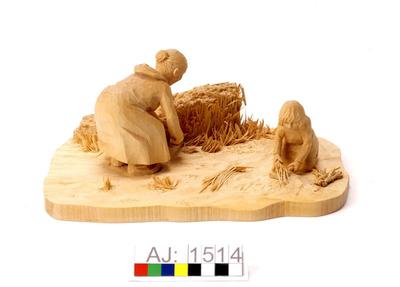
Wood-carved sculpture depicting woman and girl carrying shoehö. The woman cuts off the hay (the starring) and the girl combs it, sitting on her knee. 3 screws screwed from below. Skohö, gámasuojne has been used as a sock in the shoes and as a nerve suppose in the gloves. It keeps feet and hands warm in the cold in winter and dry during the summer. Skohö is made by starr, Carex. Various starry species have been used to make shoehö, the most common being bottle starr, Carex rostrata, and blue starr, Carex vesicaria. Starr to be used for shoehay is harvested in late summer, in August-September. The starry then contains a lot of plant fibers (cellulose), and is seg and does not crumble when processed. When harvesting shoehay, it is cut with a knife as close as possible to the ground as the lowest part of the starter becomes the best shoe hay. In order for the starter to be used as a shoehö, it must first be made soft. By hitting the starry several times against a sharp rock, it becomes soft. The starry can also be combed through a nail comb to cleave the straw so they become soft. The shoe hay is then braided to a wooden hob, bilggá. A wooden hay braid is rosy and takes a seat so one makes a shoe hearing, vierra, of two shoe hay braids. The braided hay was folded around a round-tied video path or around a ring of shoehay to a wreath until there is almost no hole in the middle. A shoe hearing was easy to freeze and store. Lulesamic names: gámasuojne - shoehö, suojnit -harvest shoehö, bilggá -shoehen, vierra - school cornering, tjåhkom - shoehökam, tsábbmet - beat the school hay, dállit - stop in the shoe hay. (Source: Kajsa Kuoljok: Gámasuojne/Skohö. Ájtte musei friends smilk 2012)
Ájtte, Swedish Mountain and Sámi Museum
Title: wood sculpture
Description:
Wood-carved sculpture depicting woman and girl carrying shoehö.
The woman cuts off the hay (the starring) and the girl combs it, sitting on her knee.
3 screws screwed from below.
Skohö, gámasuojne has been used as a sock in the shoes and as a nerve suppose in the gloves.
It keeps feet and hands warm in the cold in winter and dry during the summer.
Skohö is made by starr, Carex.
Various starry species have been used to make shoehö, the most common being bottle starr, Carex rostrata, and blue starr, Carex vesicaria.
Starr to be used for shoehay is harvested in late summer, in August-September.
The starry then contains a lot of plant fibers (cellulose), and is seg and does not crumble when processed.
When harvesting shoehay, it is cut with a knife as close as possible to the ground as the lowest part of the starter becomes the best shoe hay.
In order for the starter to be used as a shoehö, it must first be made soft.
By hitting the starry several times against a sharp rock, it becomes soft.
The starry can also be combed through a nail comb to cleave the straw so they become soft.
The shoe hay is then braided to a wooden hob, bilggá.
A wooden hay braid is rosy and takes a seat so one makes a shoe hearing, vierra, of two shoe hay braids.
The braided hay was folded around a round-tied video path or around a ring of shoehay to a wreath until there is almost no hole in the middle.
A shoe hearing was easy to freeze and store.
Lulesamic names: gámasuojne - shoehö, suojnit -harvest shoehö, bilggá -shoehen, vierra - school cornering, tjåhkom - shoehökam, tsábbmet - beat the school hay, dállit - stop in the shoe hay.
(Source: Kajsa Kuoljok: Gámasuojne/Skohö.
Ájtte musei friends smilk 2012).
Related Results
Standing Buddha Shakyamuni in Varada-mudra
Standing Buddha Shakyamuni in Varada-mudra
This sculpture depicts a Buddha gracefully standing on a shallow lotus pedestal, the Buddha likely the Buddha Sakyamuni (the Historical Buddha) though possibly the Buddha Dipankara...
Head of Buddha, probably the Buddha Sakyamuni
Head of Buddha, probably the Buddha Sakyamuni
Carved in gray limestone in Thailand in the seventh or early eighth century, this stone sculpture depicts the head of a Buddha, probably the Buddha Sakyamuni, the Historical Buddha...
Pair of leather shoes with linen shoe bag and pair of metal and wood shoe trees, designed by Hook, Knowles & Co, London, ca. 1900. Pair of women's leather shoes with a natural linen bag and a pair of metal and wood shoe trees.Bright red leather lace up sh
Pair of leather shoes with linen shoe bag and pair of metal and wood shoe trees, designed by Hook, Knowles & Co, London, ca. 1900. Pair of women's leather shoes with a natural linen bag and a pair of metal and wood shoe trees.Bright red leather lace up sh
Pair of leather shoes with linen shoe bag and pair of metal and wood shoe trees, designed by Hook, Knowles & Co, London, ca. 1900. Pair of women's leather shoes with a natural line...
figur, skulptur, sculpture
figur, skulptur, sculpture
God image. Temple figure (arca lingga or pratima) of cut and painted wood. The sculpture depicts a standing male figure with a high headdress. There are traces of gilding as well a...
Woman on a Stroll (The Little Parisienne)
Woman on a Stroll (The Little Parisienne)
Although primarily known as a painter, Gauguin was a proficient sculptor who strongly influenced modern sculpture. The versions of this statuette that he made himself document his ...
Mother and Child
Mother and Child
Renoir once quipped that had God not created the female breast, he might never have become an artist. Indeed, the full, womanly bosom figures prominently in Renoir's loving portray...