
Search engine for discovering works of Art, research articles, and books related to Art and Culture


Javascript must be enabled to continue!
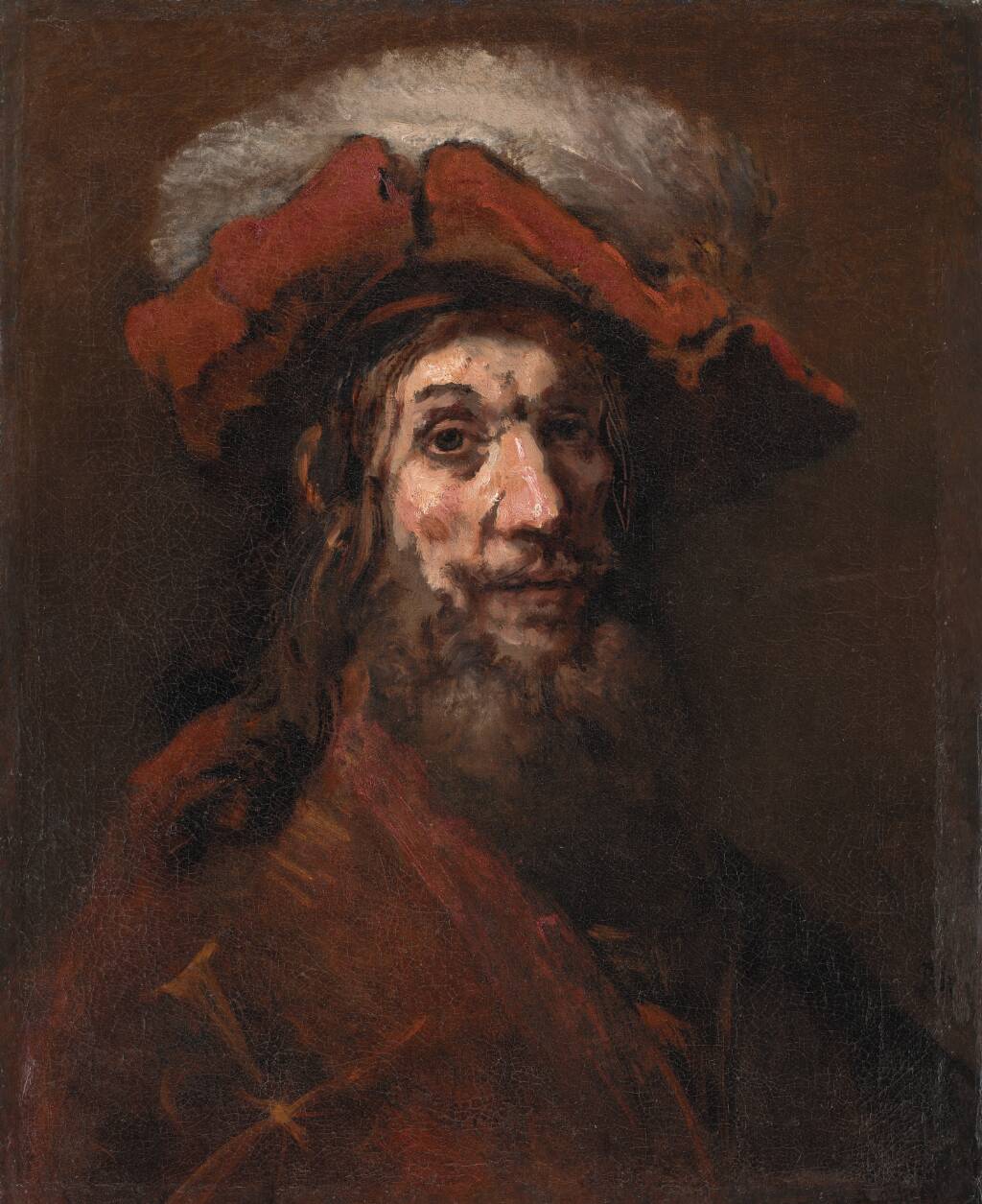
Sketch for The Knight with the Falcon, known as "The Crusader"
View through National Gallery of Denmark
In 1911 the Rembrandt connoisseur and then director of Statens Museum for Kunst, Karl Madsen, found The Crusader in a remote corner of Fredensborg Castle where it had been placed in temporary storage. Despite Karl Madsen's evident enthusiasm for the painting, its status was soon called into question, and in 1969 it was rejected as a Rembrandt. The most recent studies now tell us that the painting is a sketch for The Knight with the Falcon (Göteborgs Konstmuseum). X-rays support this assumption by demonstrating that the underlying layers of paint are built up in a manner typical of Rembrandt. The piece presumably depicts the Dutch Saint Bavo, and the painting has the convincing oscillation between the precise and the spontaneous that is so typical of Rembrandt. At the same time it exemplifies the pastose manner of painting characteristic of the artist's late work. There are, however, some signs to suggest that parts of the painting were done by one of Rembrandt's students, a common practice at the master's workshop.
Værkdatering: 1659-1661
fagligt skøn, se Rembrandt? Mesteren og hans værksted, udstillingskatalog, SMK 2006, s. 69 og note 56, s. 100
Title: Sketch for The Knight with the Falcon, known as "The Crusader"
Description:
In 1911 the Rembrandt connoisseur and then director of Statens Museum for Kunst, Karl Madsen, found The Crusader in a remote corner of Fredensborg Castle where it had been placed in temporary storage.
Despite Karl Madsen's evident enthusiasm for the painting, its status was soon called into question, and in 1969 it was rejected as a Rembrandt.
The most recent studies now tell us that the painting is a sketch for The Knight with the Falcon (Göteborgs Konstmuseum).
X-rays support this assumption by demonstrating that the underlying layers of paint are built up in a manner typical of Rembrandt.
The piece presumably depicts the Dutch Saint Bavo, and the painting has the convincing oscillation between the precise and the spontaneous that is so typical of Rembrandt.
At the same time it exemplifies the pastose manner of painting characteristic of the artist's late work.
There are, however, some signs to suggest that parts of the painting were done by one of Rembrandt's students, a common practice at the master's workshop.
Related Results
painting (watercolour): ["Portrait of Laura Knight"]
painting (watercolour): ["Portrait of Laura Knight"]
A full portrait of a seated woman, facing left, shown in profile, the whole composition reminiscent of Whistler's portrait of his mother. The woman wears a dark blue pleated dress ...
Sketchbook
Sketchbook
Sketchbook with black-leather-covered cardboard covers. Sewn page block; pages of off-white wove paper, each 27.2 x 20.8 cm. Drawings made in graphite and in vertical orientation...
Ten sketches for sculpture gardens
Ten sketches for sculpture gardens
One manila folder labeled "sculpture gardens" in Wilmarth's hand and ten loose sheets as follows (dates unknown):
1) Aerial (?) sketch in graphite
2) Sketch in graphite
3) Horiz...
Mughal emperor Shah Jahan receives a shaheen falcon from Raja Prithvi Singh of Chamba
Mughal emperor Shah Jahan receives a shaheen falcon from Raja Prithvi Singh of Chamba
In this painting, the Mughal emperor Shah Jahan (r.1627-1658) receives a shaheen falcon from ruler Raja Prithvi Singh of Chamba (1641-64), located in Himachal Pradesh. Shah Jahan’...
Icon of the Virgin and Child, Hodegetria variant
Icon of the Virgin and Child, Hodegetria variant
Tempera on wood, Byzantine or Crusader...
Design Sketch, Sketch No. II
Design Sketch, Sketch No. II
Sketch on board, with annotations "Sketch No. II", "trim of grey as in skirt", and "welt seam with pockets". A knee-length V-neck belted dress. The three-quarter length sleeves are...