
Search engine for discovering works of Art, research articles, and books related to Art and Culture


Javascript must be enabled to continue!
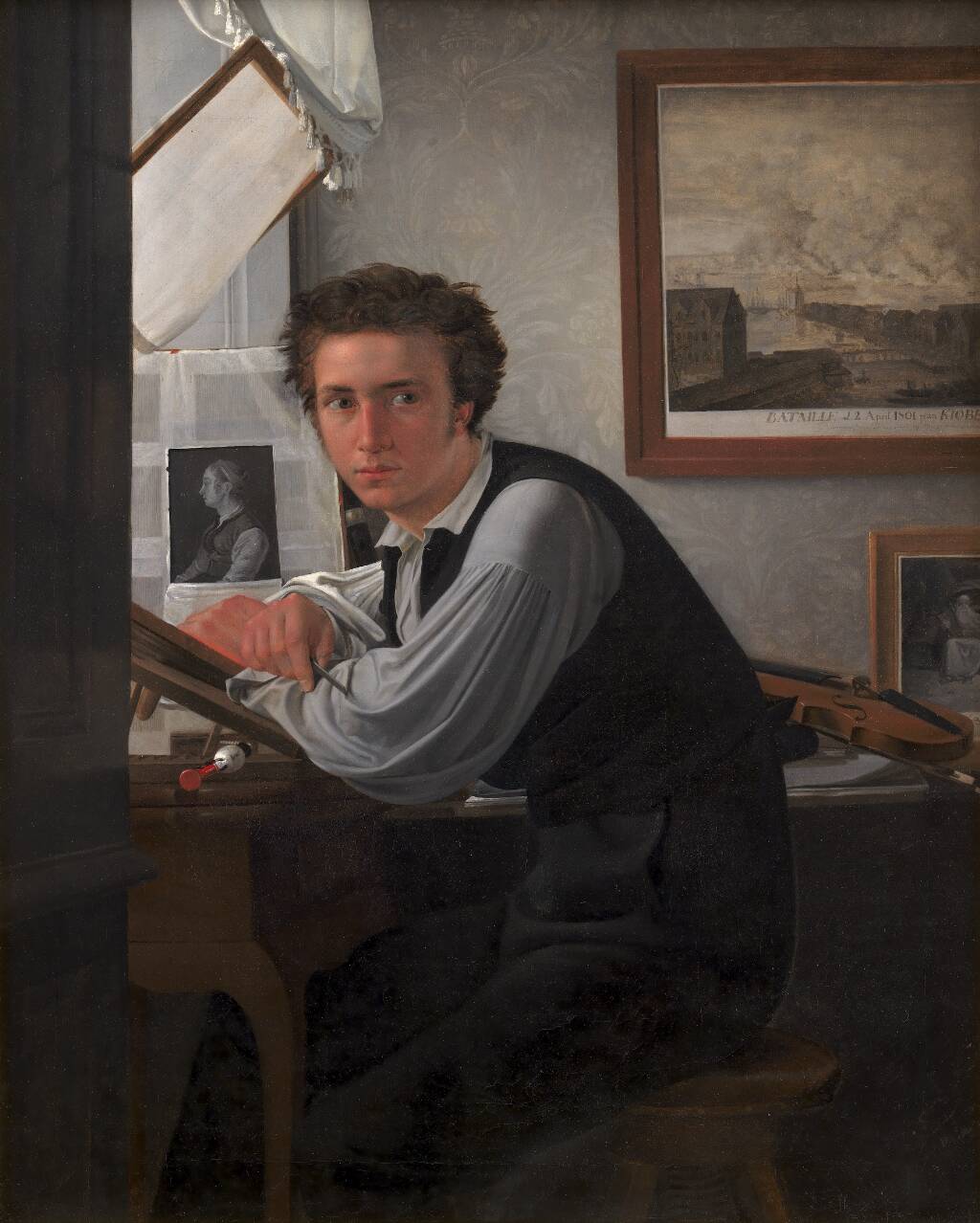
Portrait of the Copperplate Engraver Carl Edvard Sonne
View through National Gallery of Denmark
In paintings such as this, Ditlev Blunck together with Wilhelm Bendz developed the type of the genre painting of the time portraying the artist at work in his studio. Typical of this type of motif was the fact that in addition to portraying everyday situations in the studio, in the Romantic spirit of the time it also thematised the essence of art and the artist’s prerequisites. So it is of particular interest that it is a Dutch genre motif, Gerard ter Borch’s Seated girl in Peasant Costume (c. 1650), that is seen in what is to be assumed is a trial print hanging by the engraver’s work table. The other pictures behind Sonne are prints after Blunck’s teacher C.A. Lorentzen and the former professor from the Academy, N.A. Abildgaard. Blunck has thus introduced the Dutch model on an equal footing with his own teachers. With this, the picture gives an impression of the kinds of motif that were reproduced in the Denmark of the Golden Age. But if it is read as an artistic manifesto, it shows which masters formed the background to the oeuvres of Blunck and his colleagues. Blunck was one of the earliest genre painters of the Danish Golden Age. He derived inspiration both from Eckersberg and from the more idealised German art.
Værkdatering: Ca. 1826
Påbegyndt: baseret på kunstnerens årstal afsluttet: tilgået museet
Title: Portrait of the Copperplate Engraver Carl Edvard Sonne
Description:
In paintings such as this, Ditlev Blunck together with Wilhelm Bendz developed the type of the genre painting of the time portraying the artist at work in his studio.
Typical of this type of motif was the fact that in addition to portraying everyday situations in the studio, in the Romantic spirit of the time it also thematised the essence of art and the artist’s prerequisites.
So it is of particular interest that it is a Dutch genre motif, Gerard ter Borch’s Seated girl in Peasant Costume (c.
1650), that is seen in what is to be assumed is a trial print hanging by the engraver’s work table.
The other pictures behind Sonne are prints after Blunck’s teacher C.
A.
Lorentzen and the former professor from the Academy, N.
A.
Abildgaard.
Blunck has thus introduced the Dutch model on an equal footing with his own teachers.
With this, the picture gives an impression of the kinds of motif that were reproduced in the Denmark of the Golden Age.
But if it is read as an artistic manifesto, it shows which masters formed the background to the oeuvres of Blunck and his colleagues.
Blunck was one of the earliest genre painters of the Danish Golden Age.
He derived inspiration both from Eckersberg and from the more idealised German art.
Related Results
Album containing prints clipped from American and British periodicals
Album containing prints clipped from American and British periodicals
Hand-colored etching engraving lithograph mezzotint...
Picturesque America, or the Land We Live In, A Delineation by Pen and Pencil of the Mountains, Rivers, Lakes...with Illustrations on Steel and Wood by Eminent American Artists
Picturesque America, or the Land We Live In, A Delineation by Pen and Pencil of the Mountains, Rivers, Lakes...with Illustrations on Steel and Wood by Eminent American Artists
Illustrations: steel engraving and wood engraving...
The Antiquities of Athens, Measured and Delineated by James Stuart, F.R.S. and F.S.A. and Nicholas Revett, Painters and Architects
The Antiquities of Athens, Measured and Delineated by James Stuart, F.R.S. and F.S.A. and Nicholas Revett, Painters and Architects
Illustrations: etching and engraving...