
Search engine for discovering works of Art, research articles, and books related to Art and Culture


Javascript must be enabled to continue!
William Cheselden giving an anatomical demonstration.
View through Europeana Collections
William Cheselden giving an anatomical demonstration to six spectators in the anatomy-theatre of the Barber-Surgeons' Company, London, ca. 1730/1740. Oil painting attributed to Charles Phillips. William Cheselden was a leading English surgeon in the reign of George II, practising in the London of William Hogarth, Sir Isaac Newton and Alexander Pope. He was a member of the Barber-Surgeon's company, based in London near the Barbican. The company's building included an anatomy theatre designed by Inigo Jones, constructed in 1636 and demolished in 1784. The painting probably shows Cheselden in that anatomy theatre, demonstrating privately to a group of his colleagues or to interested gentlemen. Cheselden was one of those who concluded that Henry VIII's union of the company of barbers with the guild of surgeons in the Barber-Surgeon's company had had its day, and that the two guilds should separate. The group that seceded in 1745, known as the Company of Surgeons, built its new hall, called Surgeons' Hall, in Old Bailey, including a new anatomy theatre at Cheselden's stipulation. The Company of Surgeons was a predecessor of the Royal College of Surgeons of England, which is today the main support organization for surgeons in England and Wales.
Wellcome Collection
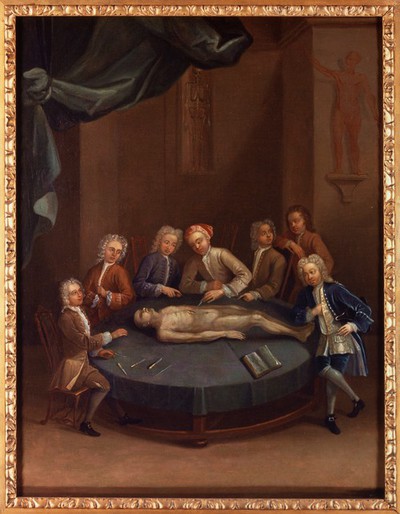
Title: William Cheselden giving an anatomical demonstration.
Description:
William Cheselden giving an anatomical demonstration to six spectators in the anatomy-theatre of the Barber-Surgeons' Company, London, ca.
1730/1740.
Oil painting attributed to Charles Phillips.
William Cheselden was a leading English surgeon in the reign of George II, practising in the London of William Hogarth, Sir Isaac Newton and Alexander Pope.
He was a member of the Barber-Surgeon's company, based in London near the Barbican.
The company's building included an anatomy theatre designed by Inigo Jones, constructed in 1636 and demolished in 1784.
The painting probably shows Cheselden in that anatomy theatre, demonstrating privately to a group of his colleagues or to interested gentlemen.
Cheselden was one of those who concluded that Henry VIII's union of the company of barbers with the guild of surgeons in the Barber-Surgeon's company had had its day, and that the two guilds should separate.
The group that seceded in 1745, known as the Company of Surgeons, built its new hall, called Surgeons' Hall, in Old Bailey, including a new anatomy theatre at Cheselden's stipulation.
The Company of Surgeons was a predecessor of the Royal College of Surgeons of England, which is today the main support organization for surgeons in England and Wales.
Related Results
Album containing prints clipped from American and British periodicals
Album containing prints clipped from American and British periodicals
Hand-colored etching engraving lithograph mezzotint...
Illustrated London Almanack
Illustrated London Almanack
Illustrations: wood engravings and color lithographs...
Votive Terracotta Penis and Scrotum
Votive Terracotta Penis and Scrotum
Mold made model of male genitalia of pinkish clay with coarse temper. The back side is hollow. Penis is uncircumcised. The right testicle hangs lower than the left. The surface is ...
Votive Terracotta Penis and Scrotum
Votive Terracotta Penis and Scrotum
Votive terracotta penis and scrotum. Brownish clay, porous, with gritty black impurities. Most likely from a sanctuary votive deposit in Etruria (central Italy). Such terracotta ma...
Votive Terracotta Penis and Scrotum
Votive Terracotta Penis and Scrotum
Votive terracotta penis and scrotum. Reddish brown clay, porous, with gritty black impurities. Most likely from a sanctuary votive deposit in Etruria (central Italy). Such terracot...
Votive Terracotta Ear
Votive Terracotta Ear
Votive terracotta ear. Porous buff clay. Most likely from a sanctuary votive deposit in Etruria (central Italy). Such terracotta ears may have been given either as a request or as ...