
Search engine for discovering works of Art, research articles, and books related to Art and Culture


Javascript must be enabled to continue!
Terracotta column-krater (vase for mixing wine and water)
View through The Met
Terracotta, Classical, Greek Attic
Greek and Roman Art, Metropolitan Museum of Art New York NY, Purchase 1896
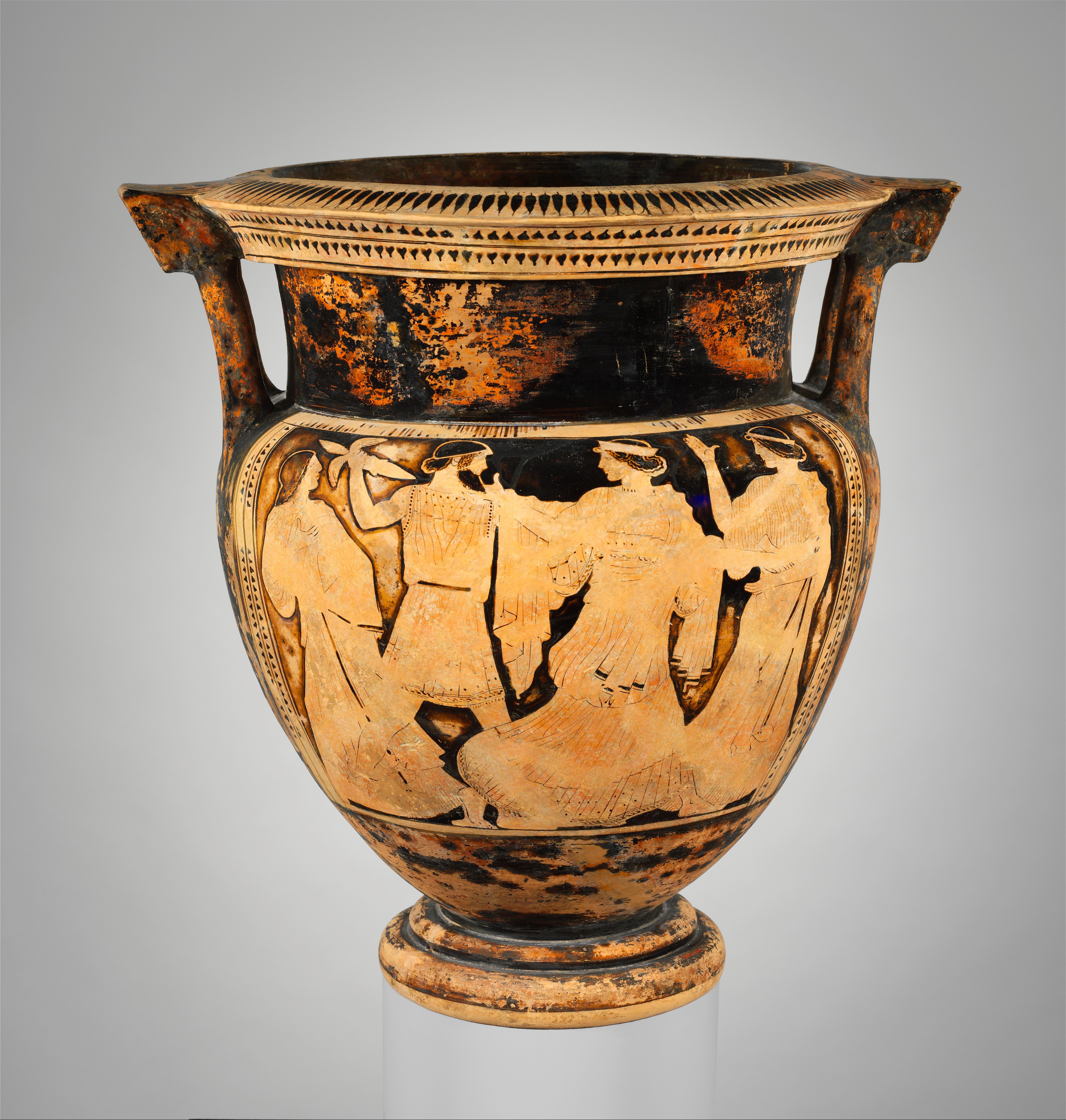
Title: Terracotta column-krater (vase for mixing wine and water)
Description:
Terracotta, Classical, Greek Attic.
Related Results
Calyx Krater (mixing bowl for wine and water): Return of Hephaistos to Olympos
Calyx Krater (mixing bowl for wine and water): Return of Hephaistos to Olympos
This krater (mixing bowl for wine and water) features a lively depiction of the return of the god of the forge Hephaistos to Olympos, the home of the gods. Hephaistos had previousl...
Column Krater (mixing bowl for wine and water): Theseus and Poseidon; Musician and Audience
Column Krater (mixing bowl for wine and water): Theseus and Poseidon; Musician and Audience
On one side: the Athenian hero Theseus visits his divine father Poseidon. Theseus’s mother was Aethra, and ancient sources sometimes consider him to be the son of her husband, Aege...
vase: ["Portland Vase"]
vase: ["Portland Vase"]
A late eighteenth century first edition black Jasperware Portland vase made in c. 1790. Number 29 marked on inner lip in pencil., A late eighteenth century Wedgwood Portland Vase, ...
Post-Marijuana (Dama zhi hou), Written in Shadow Script and Black-on-Black Script
Post-Marijuana (Dama zhi hou), Written in Shadow Script and Black-on-Black Script
This large, horizontally oriented, rectangular album leaf is divided visually into two parts, the right one-third, in which the characters appear a ghostly grayish white on a black...
Bell Krater (bowl for mixing wine and water): Bouzyges and the Plow
Bell Krater (bowl for mixing wine and water): Bouzyges and the Plow
On one side: at the right of the scene stands the nude and bearded Bouzyges (“Ox-yoker”), the legendary inventor of the plough. He faces towards the left, with his body turned away...
Diese großformatige Vase mit Deckel stammt aus Kutani in der Präfektur Ishikawa. Die dreifärbige (Gold, Rot, Schwarz), die gesamte Gefäßoberfläche ausfüllende Bemalung wird aka-e saikō genannt und war von der späten Edo- bis in die mittlere Meiji-Zeit (Mi
Diese großformatige Vase mit Deckel stammt aus Kutani in der Präfektur Ishikawa. Die dreifärbige (Gold, Rot, Schwarz), die gesamte Gefäßoberfläche ausfüllende Bemalung wird aka-e saikō genannt und war von der späten Edo- bis in die mittlere Meiji-Zeit (Mi
This large-format vase with lid comes from Kutani in Ishikawa Prefecture. The three-coloured (gold, red, black), the entire vessel surface filled painting is called aka-e saikō and...
Diese großformatige Vase mit Deckel stammt aus Kutani in der Präfektur Ishikawa. Die dreifärbige (Gold, Rot, Schwarz), die gesamte Gefäßoberfläche ausfüllende Bemalung wird aka-e saikō genannt und war von der späten Edo- bis in die mittlere Meiji-Zeit (Mi
Diese großformatige Vase mit Deckel stammt aus Kutani in der Präfektur Ishikawa. Die dreifärbige (Gold, Rot, Schwarz), die gesamte Gefäßoberfläche ausfüllende Bemalung wird aka-e saikō genannt und war von der späten Edo- bis in die mittlere Meiji-Zeit (Mi
This large-format vase with lid comes from Kutani in Ishikawa Prefecture. The three-coloured (gold, red, black), the entire vessel surface filled painting is called aka-e saikō and...
Bell Krater (mixing bowl for wine and water): Dionysos with Satyr and Maenad; Death of Orpheus
Bell Krater (mixing bowl for wine and water): Dionysos with Satyr and Maenad; Death of Orpheus
Attic red-figure bell krater. SIDE A: Dionysus with a satyr and a maenad. The satyr plays a flute, and wears a wreath on his head. The Maenad plays a drum. Movement is indicated by...