
Search engine for discovering works of Art, research articles, and books related to Art and Culture


Javascript must be enabled to continue!
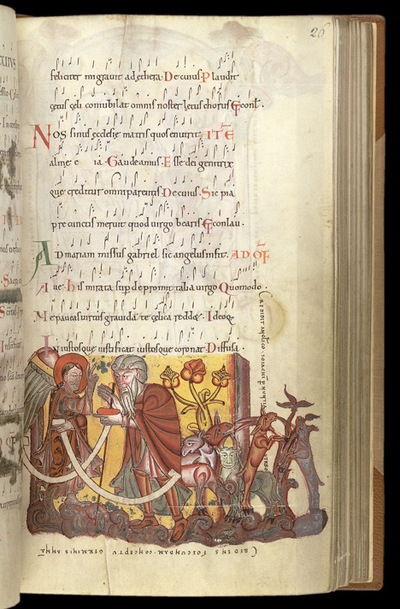
The Annunciation to Joachim, in The Caligula Troper
View through Europeana Collections
Made up of fragments from a late Anglo-Saxon
liturgical chant book, the Caligula Troper's illuminations
introduce songs which would be inserted into the mass on special
feast days and sung by a soloist, hence the book's small scale. The
pictures' geometric abstraction of form and use of vibrant colours
embellished with gold give an opulence that speaks of manufacture
for use by an important figure. It is named for its 17th-century
position in a bookcase supporting a bust of Caligula in the Cotton
rare books library. Its selection of tropes (songs) and where it
was in the Middle Ages suggest origins at Winchester or
Worcester.Below an Assumption trope, a picture of the Annunciation
to Joachim precedes tropes for the Nativity of the Virgin.
Extending into margins and text, the unframed, floating picture
shows Joachim fasting in the desert because his childlessness had
rendered his earlier sacrifice unworthy. An angel tells him that
Anna, his wife, has conceived a daughter, whereupon he orders a
massive sacrifice of lambs, calves, and goats, seen frolicking to
the side. The blank scrolls were meant as 'balloons' for the
dialogue. The story's ultimate sources are in Greek apocryphal
texts.
Title: The Annunciation to Joachim, in The Caligula Troper
Description:
Made up of fragments from a late Anglo-Saxon
liturgical chant book, the Caligula Troper's illuminations
introduce songs which would be inserted into the mass on special
feast days and sung by a soloist, hence the book's small scale.
The
pictures' geometric abstraction of form and use of vibrant colours
embellished with gold give an opulence that speaks of manufacture
for use by an important figure.
It is named for its 17th-century
position in a bookcase supporting a bust of Caligula in the Cotton
rare books library.
Its selection of tropes (songs) and where it
was in the Middle Ages suggest origins at Winchester or
Worcester.
Below an Assumption trope, a picture of the Annunciation
to Joachim precedes tropes for the Nativity of the Virgin.
Extending into margins and text, the unframed, floating picture
shows Joachim fasting in the desert because his childlessness had
rendered his earlier sacrifice unworthy.
An angel tells him that
Anna, his wife, has conceived a daughter, whereupon he orders a
massive sacrifice of lambs, calves, and goats, seen frolicking to
the side.
The blank scrolls were meant as 'balloons' for the
dialogue.
The story's ultimate sources are in Greek apocryphal
texts.
Related Results
Joachim, Anna and the Virgin Mary, in the Caligula
Troper
Joachim, Anna and the Virgin Mary, in the Caligula
Troper
Made up of fragments from a late Anglo-Saxon
liturgical chant book, the Caligula Troper's illuminations
introduce songs which would be inserted into the mass on special
feast days ...
The Naming of St John the Baptist, in the Caligula
Troper
The Naming of St John the Baptist, in the Caligula
Troper
Made up of fragments from a late Anglo-Saxon
liturgical chant book, the Caligula Troper's illuminations
introduce songs which would be inserted into the mass on special
feast days ...
The Annunciation
The Annunciation
El Greco depicted the subject of the Annunciation on various occasions throughout his career. Along with his depictions of The Adoration of the Shepherds, Saint Paul, and the mysti...
St Lawrence, in the Caligula Troper
St Lawrence, in the Caligula Troper
Made up of fragments from a late Anglo-Saxon
liturgical chant book, the Caligula Troper's illuminations
introduce songs which would be inserted into the mass on special
feast days ...
Temptation of St Martin, in the Caligula Troper
Temptation of St Martin, in the Caligula Troper
Made up of fragments from a late Anglo-Saxon
liturgical chant book, the Caligula Troper's illuminations
introduce songs which would be inserted into the mass on special
feast days ...
The Wise Virgins, in the Caligula Troper
The Wise Virgins, in the Caligula Troper
Made up of fragments from a late Anglo-Saxon
liturgical chant book, the Caligula Troper's illuminations
introduce songs which would be inserted into the mass on special
feast days ...
Common of the Apostles, in the Caligula Troper
Common of the Apostles, in the Caligula Troper
Made up of fragments from a late Anglo-Saxon
liturgical chant book, the Caligula Troper's illuminations
introduce songs which would be inserted into the mass on special
feast days ...
Sestertius of Caligula, Rome
Sestertius of Caligula, Rome
Obv.: Laureate head of Caligula l.; around, C CAESAR AVG GERMANICVS PON M TR POT.
Rev.: Gaius (Caligula), bare-headed and togate, stg. l. on platform before low stool, r. hand ext...