
Search engine for discovering works of Art, research articles, and books related to Art and Culture


Javascript must be enabled to continue!
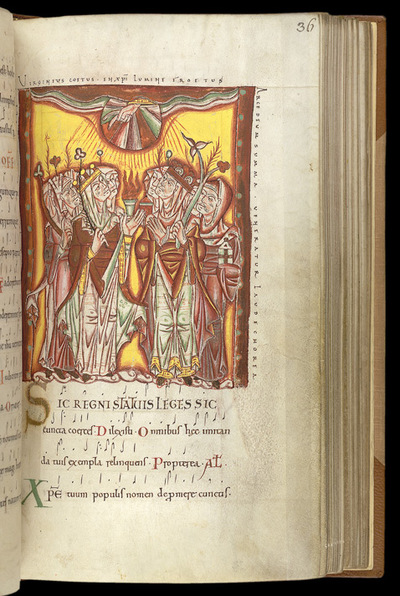
The Wise Virgins, in the Caligula Troper
View through Europeana Collections
Made up of fragments from a late Anglo-Saxon
liturgical chant book, the Caligula Troper's illuminations
introduce songs which would be inserted into the mass on special
feast days and sung by a soloist, hence the book's small scale. The
pictures' geometric abstraction of form and use of vibrant colours
embellished with gold give an opulence that speaks of manufacture
for use by an important figure. It is named for its 17th-century
position in a bookcase supporting a bust of Caligula in the Cotton
rare books library. Its selection of tropes (songs) and where it
was in the Middle Ages suggest origins at Winchester or Worcester.A
depiction of the wise virgins (Matthew 25:1-13) illustrates the
mass for virgin saints or the Common of Virgins. In two groups of
four, the virgins hold a torch and two lamps, evoking the parable,
and branches, which may represent palms of martyrdom to indicate
heavenly status. References to the parable of the wise and foolish
virgins and the hand of God above urge readers to prepare for the
Second Coming. Although related images of the 'choir of virgins'
are known in medieval liturgical books, this is unique in its
adaptation of the parable's imagery.
Title: The Wise Virgins, in the Caligula Troper
Description:
Made up of fragments from a late Anglo-Saxon
liturgical chant book, the Caligula Troper's illuminations
introduce songs which would be inserted into the mass on special
feast days and sung by a soloist, hence the book's small scale.
The
pictures' geometric abstraction of form and use of vibrant colours
embellished with gold give an opulence that speaks of manufacture
for use by an important figure.
It is named for its 17th-century
position in a bookcase supporting a bust of Caligula in the Cotton
rare books library.
Its selection of tropes (songs) and where it
was in the Middle Ages suggest origins at Winchester or Worcester.
A
depiction of the wise virgins (Matthew 25:1-13) illustrates the
mass for virgin saints or the Common of Virgins.
In two groups of
four, the virgins hold a torch and two lamps, evoking the parable,
and branches, which may represent palms of martyrdom to indicate
heavenly status.
References to the parable of the wise and foolish
virgins and the hand of God above urge readers to prepare for the
Second Coming.
Although related images of the 'choir of virgins'
are known in medieval liturgical books, this is unique in its
adaptation of the parable's imagery.
Related Results
The Naming of St John the Baptist, in the Caligula
Troper
The Naming of St John the Baptist, in the Caligula
Troper
Made up of fragments from a late Anglo-Saxon
liturgical chant book, the Caligula Troper's illuminations
introduce songs which would be inserted into the mass on special
feast days ...
The Foolish Virgins Rejected
The Foolish Virgins Rejected
Etching; early state, The Wise Virgins and The Foolish Virgins
(Les Vierges sages et les Vierges folles)...
Foolish Virgins Sleeping
Foolish Virgins Sleeping
Etching; first state of two, The Wise Virgins and The Foolish Virgins...
The Foolish Virgins Conversing
The Foolish Virgins Conversing
Etching; first state of two, The Wise Virgins and The Foolish Virgins
(Les Vierges sages et les vierges folles)...
St Lawrence, in the Caligula Troper
St Lawrence, in the Caligula Troper
Made up of fragments from a late Anglo-Saxon
liturgical chant book, the Caligula Troper's illuminations
introduce songs which would be inserted into the mass on special
feast days ...
Temptation of St Martin, in the Caligula Troper
Temptation of St Martin, in the Caligula Troper
Made up of fragments from a late Anglo-Saxon
liturgical chant book, the Caligula Troper's illuminations
introduce songs which would be inserted into the mass on special
feast days ...
Common of the Apostles, in the Caligula Troper
Common of the Apostles, in the Caligula Troper
Made up of fragments from a late Anglo-Saxon
liturgical chant book, the Caligula Troper's illuminations
introduce songs which would be inserted into the mass on special
feast days ...
Joachim, Anna and the Virgin Mary, in the Caligula
Troper
Joachim, Anna and the Virgin Mary, in the Caligula
Troper
Made up of fragments from a late Anglo-Saxon
liturgical chant book, the Caligula Troper's illuminations
introduce songs which would be inserted into the mass on special
feast days ...