
Search engine for discovering works of Art, research articles, and books related to Art and Culture


Javascript must be enabled to continue!
ROMAN JEWELLERY
View through Europeana Collections
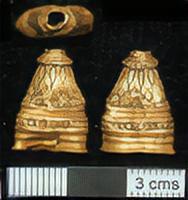
Treasure Case 2009 T40 "A small sheet gold object originally of hollow sub-conical shape but now irregularly flattened and slightly damaged. At the broader end a plain rim is followed by a series of concave mouldings interspersed with thin bands of fine dot-punching and two rows of circular pellets. A zone of incised interlocking lentil and diamond motifs is followed by further bands of pellets, dot-punching and simple mouldings terminating in a slightly torn plain rim with an internal diameter of c. 2 mm. The function of the object, probably a component of Roman jewellery, is uncertain. It may be a decorative collar from the terminal of a gold necklace chain. More probably it is a broken variant of the 'Hercules club' type of ear-ring, an identification strengthened by the presence of the incised lentil motif, a shape used on the 'Hercules club' ear-rings and pendants to represent the stylised knots on the surface of the club (Johns 1996, 129-30, Fig. 6.2. Allason-Jones 1989, Type 15). Date: probably 1st - 4th century AD. Dimensions: Length 17.6 mm. Weight: 2.8 g. In age and precious metal content the object qualifies as Treasure under the terms of the 1996 Treasure Act. Ralph Jackson Dept. of Prehistory & Europe British Museum 16th April 2009"
The Portable Antiquities Scheme
Title: ROMAN JEWELLERY
Description:
Treasure Case 2009 T40 "A small sheet gold object originally of hollow sub-conical shape but now irregularly flattened and slightly damaged.
At the broader end a plain rim is followed by a series of concave mouldings interspersed with thin bands of fine dot-punching and two rows of circular pellets.
A zone of incised interlocking lentil and diamond motifs is followed by further bands of pellets, dot-punching and simple mouldings terminating in a slightly torn plain rim with an internal diameter of c.
2 mm.
The function of the object, probably a component of Roman jewellery, is uncertain.
It may be a decorative collar from the terminal of a gold necklace chain.
More probably it is a broken variant of the 'Hercules club' type of ear-ring, an identification strengthened by the presence of the incised lentil motif, a shape used on the 'Hercules club' ear-rings and pendants to represent the stylised knots on the surface of the club (Johns 1996, 129-30, Fig.
6.
2.
Allason-Jones 1989, Type 15).
Date: probably 1st - 4th century AD.
Dimensions: Length 17.
6 mm.
Weight: 2.
8 g.
In age and precious metal content the object qualifies as Treasure under the terms of the 1996 Treasure Act.
Ralph Jackson Dept.
of Prehistory & Europe British Museum 16th April 2009".
Related Results
Multi-piece jewellery, harrowing (saL), multi-piece jewellery, neck jewellery, jewellery
Multi-piece jewellery, harrowing (saL), multi-piece jewellery, neck jewellery, jewellery
A piece of jewellery consisting of two tin-embroidered round plates that are attached to a silver chain. The large plate consists of blue and red clothing with white skin and tin e...
Lamp: human figure crouching over phallus
Lamp: human figure crouching over phallus
Mold made lamp. Material is soft, well-levigated light-gray clay with micaceous impurities. Has a reddish brown glaze. Nozzle is coated with carbon. Designed for suspension with tw...