
Search engine for discovering works of Art, research articles, and books related to Art and Culture


Javascript must be enabled to continue!
mask
View through Europeana Collections
Function: From kaya, “up towards the mountain”, i.e. the volcano Gunung Agung, the abode of the gods and the heavenly sphere, flows forces of blessing down to the humans. In the opposite direction lies kelod “down towards the sea”, which is seen as a home of evil spirits and destructive powers which emanate from the underworld. In Balinese cosmology equilibrium is thought to prevail between these two poles, divine and demoniac, upper world and lower world, order and chaos. If this state is disturbed the cosmic powers become unbalanced and evil spirits and demons may roam freely. To restore the equilibrium the menacing and dangerous must be neutralised. Several Balinese dance dramas serve exactly this purpose to control and force back evil spirits. This happens for example in the dance drama Calon Arang. The main character in the drama is Rangda, the wrathful, destroying side of the widow Calwanarang from Girah. Furious that no man dares to marry her beautiful daughter because of the mother’s knowledge of black magic she turns to the death goddess Durga to receive her permission for vengeance. With Durga’s help she is transformed into the terrible witch Rangda that spreads pestilence and destruction across the country. Rangda is rendered harmless by the wise and holy Mpu Bharadah, who kills her demoniac self and thus delivers her. A south Balinese village usually owns two Rangda masks. One is kept in the village temple, Pura Desa, the other in the underworld temple, Pura Dalem. These masks have been carved directly from a growing kapok tree. At an consecration ceremony the masks are “charged with power”. The power is connected with the underworld and the death goddess. That is why a consecrated mask is dangerous. At the same time the Rangda masks protect the village from destructive, evil and sickness generating powers, which they chase away with their mere presence. The Rangda figure thus has a beneficial side.
Acquisition Acquired by Åke Kistner (1908-1976). Between 1937 and 1939 he lived in Bali, where he during the two first years brought together a sizeable collection which he donated to the Museum of Ethnography, Stockholm.
Why this is a masterpiece
This particular mask has been chosen as an example of similar wooden objects from Bali exemplifying that kind of "art" before it became popular with tourists and masks were turned out in large quantities for the tourist market.
History of the Object
History before the acquisition made by Åke Kistner not known. Since 1938 it has been with the Museum of Ethnography. (Virtual Collection of Masterpieces, http://masterpieces.asemus.museum/Default.aspx)
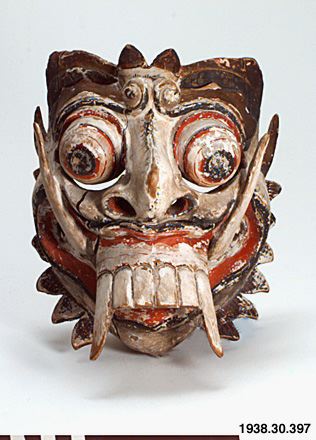
Title: mask
Description:
Function: From kaya, “up towards the mountain”, i.
e.
the volcano Gunung Agung, the abode of the gods and the heavenly sphere, flows forces of blessing down to the humans.
In the opposite direction lies kelod “down towards the sea”, which is seen as a home of evil spirits and destructive powers which emanate from the underworld.
In Balinese cosmology equilibrium is thought to prevail between these two poles, divine and demoniac, upper world and lower world, order and chaos.
If this state is disturbed the cosmic powers become unbalanced and evil spirits and demons may roam freely.
To restore the equilibrium the menacing and dangerous must be neutralised.
Several Balinese dance dramas serve exactly this purpose to control and force back evil spirits.
This happens for example in the dance drama Calon Arang.
The main character in the drama is Rangda, the wrathful, destroying side of the widow Calwanarang from Girah.
Furious that no man dares to marry her beautiful daughter because of the mother’s knowledge of black magic she turns to the death goddess Durga to receive her permission for vengeance.
With Durga’s help she is transformed into the terrible witch Rangda that spreads pestilence and destruction across the country.
Rangda is rendered harmless by the wise and holy Mpu Bharadah, who kills her demoniac self and thus delivers her.
A south Balinese village usually owns two Rangda masks.
One is kept in the village temple, Pura Desa, the other in the underworld temple, Pura Dalem.
These masks have been carved directly from a growing kapok tree.
At an consecration ceremony the masks are “charged with power”.
The power is connected with the underworld and the death goddess.
That is why a consecrated mask is dangerous.
At the same time the Rangda masks protect the village from destructive, evil and sickness generating powers, which they chase away with their mere presence.
The Rangda figure thus has a beneficial side.
Acquisition Acquired by Åke Kistner (1908-1976).
Between 1937 and 1939 he lived in Bali, where he during the two first years brought together a sizeable collection which he donated to the Museum of Ethnography, Stockholm.
Why this is a masterpiece
This particular mask has been chosen as an example of similar wooden objects from Bali exemplifying that kind of "art" before it became popular with tourists and masks were turned out in large quantities for the tourist market.
History of the Object
History before the acquisition made by Åke Kistner not known.
Since 1938 it has been with the Museum of Ethnography.
(Virtual Collection of Masterpieces, http://masterpieces.
asemus.
museum/Default.
aspx).
Related Results
ansiktsmask, mask, topeng
ansiktsmask, mask, topeng
Mask of painted wood. Remains of a piece of leather are nailed to the inside of the mask. By biting the leather piece, the dancer has been able to keep the mask in place. The mask...
Reptile skin gas-mask bag with gas mask inside, H Wald & Co., Great Britain, 1940-1942. Light tan reptile skin gas-mask bag with a top closure and long strap with buckle. Containing a gas mask. Reptile skin.
Reptile skin gas-mask bag with gas mask inside, H Wald & Co., Great Britain, 1940-1942. Light tan reptile skin gas-mask bag with a top closure and long strap with buckle. Containing a gas mask. Reptile skin.
Reptile skin gas-mask bag with gas mask inside, H Wald & Co., Great Britain, 1940-1942. Light tan reptile skin gas-mask bag with a top closure and long strap with buckle. Containin...
mask, topeng, tapel
mask, topeng, tapel
Dance mask made of cut and painted wood. White face color with details in red, black and gold. The mask has a smiling mouth, with blotted upper tooth row, diadem and outstanding ea...
mask, ansiktsmask, topeng
mask, ansiktsmask, topeng
Mask of painted wood. Hake beard of fur attached with nails. The mask has two small holes, one on each side, to attach a ribbon to tie around the head. There are remnants of rope i...
mask, topeng, tapel
mask, topeng, tapel
Dance mask made of cut and painted wood. The mask is painted red with details in black, white and gold. The mask has round, open eyes, slightly open mouth with upper tooth row expo...