
Search engine for discovering works of Art, research articles, and books related to Art and Culture


Javascript must be enabled to continue!
Pilgrimage to the Cedars in Lebanon
View through Europeana Collections
Tivadar Csontváry Kosztka has become an emblematic figure in Hungarian painting as a result of the path his life took, his devotion to his art, and his unique, almost mission-inspired voice as a painter. In 1894, he was already in his forties when he gave up his previous career as a pharmacist to begin regular artistic studies in Munich. He subsequently travelled far and wide in search of the “grand motif” for his art. The paintings of cedar trees he made in Lebanon, such as Pilgrimage, are key pieces of his œuvre. Their symbolic force derives partly from their strong confessional nature, as the two cedar pictures can be viewed as concealed self-portraits, while they are also open to interpretation as a more general symbol. According to a popularly held belief at the time, thousand-year-old cedars played a prominent role in ancient Hungarian mythology; in choosing this subject, Csontváry was also giving shape to an original national programme. The artist’s worldview is also reflected in his technique: he evoked the animation of the earthly regions using broad impasto brushwork, but as he progressed towards the heavens, he adopted increasingly smooth and homogeneous surfaces.
Hungarian National Gallery
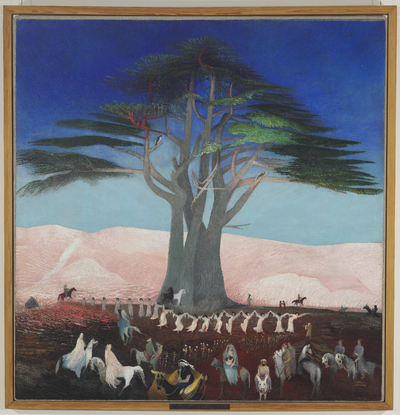
Title: Pilgrimage to the Cedars in Lebanon
Description:
Tivadar Csontváry Kosztka has become an emblematic figure in Hungarian painting as a result of the path his life took, his devotion to his art, and his unique, almost mission-inspired voice as a painter.
In 1894, he was already in his forties when he gave up his previous career as a pharmacist to begin regular artistic studies in Munich.
He subsequently travelled far and wide in search of the “grand motif” for his art.
The paintings of cedar trees he made in Lebanon, such as Pilgrimage, are key pieces of his œuvre.
Their symbolic force derives partly from their strong confessional nature, as the two cedar pictures can be viewed as concealed self-portraits, while they are also open to interpretation as a more general symbol.
According to a popularly held belief at the time, thousand-year-old cedars played a prominent role in ancient Hungarian mythology; in choosing this subject, Csontváry was also giving shape to an original national programme.
The artist’s worldview is also reflected in his technique: he evoked the animation of the earthly regions using broad impasto brushwork, but as he progressed towards the heavens, he adopted increasingly smooth and homogeneous surfaces.
Related Results
Convicted: Uriel Acosta and Spinoza.
Convicted: Uriel Acosta and Spinoza.
A divided postcard containing a black-and-white print from Samuel Hirschenberg's painting: Uriel D'Acosta and Baruch Spinoza (1881). On the visible right, her description was print...
M. Taranbatz: Shekala and Tarya.
M. Taranbatz: Shekala and Tarya.
A pair of identical copies of the same postcard, containing a print from a painting by the Polish-Jewish painter Maurycy Trńbacz (1861-1941), of a student and his rabbi look at gem...
C. Storm: Judith before Holifernos.
C. Storm: Judith before Holifernos.
Four identical copies of the same postcard, including a reproduction of the work of the French artist Gaston Casimir Saint-Pierre (1833-1916), depicting the heroine of the book "Ju...
5) Wood: Daniel in the lion's den.
5) Wood: Daniel in the lion's den.
A pair of different copies from the same postcard, including a reproduction of a painting by the French artist Horace Vernet (1789-1863) depicting the biblical figure of the Prophe...
L. Bunt: Job.
L. Bunt: Job.
A divided postcard containing a black-and-white reproduction of the painting by the French artist Léon Bonnat (1822-1833) "Job" (1880) on the postcard printed the artist's name and...