
Search engine for discovering works of Art, research articles, and books related to Art and Culture


Javascript must be enabled to continue!
"Venus disarming Amor" in a medallion surrounded by plants, fruits, insects and shellfish
View through National Gallery of Denmark
Joris Hoefnagel is one of the most important Northern European artists from the second half of the 16th century. Back in his own day, his fame rested on manuscript illuminations and cabinet miniatures (such as this); his work was amongst the most exquisite created in his day.
The picture shows a strange mixture of motifs that do not make sense to modernday audiences, but which would have been decipherable to scholars from the artist's own time. Even so, we can make some progress towards understanding the images. The medallion's subject matter and inscription "Plus aloes quam mellis habent" (They contain more bitterness than sweetness) is a reference to how earthly love (the arrows of Amor/Cupid) always end up bringing pain even if it begins sweetly; a familiar moral lesson at the time. The inscription at the bottom, "Quatuor in rerum natura elementa" (the four elements of Nature) explains the flowers and fruits (which symbolise earth), butterflies (air), the other insects (fire), and the lobster (water). But we no longer know the significance of placing "The Four Elements" and "Venus Disarming Amor" within the same context. The knowledge that was active during the 16th century - and which was very much about how all of Creation was intervowen in a web of interconnected meanings - has largely been lost now. We can no longer "see" these overall connections, the vast intervowen fabric that made sense to people, at least to scholars, at that time.
Værkdatering: ca. 1595
Dateringen er skønnet på baggrund af Hoefnagels øvrige kabinetminiaturer
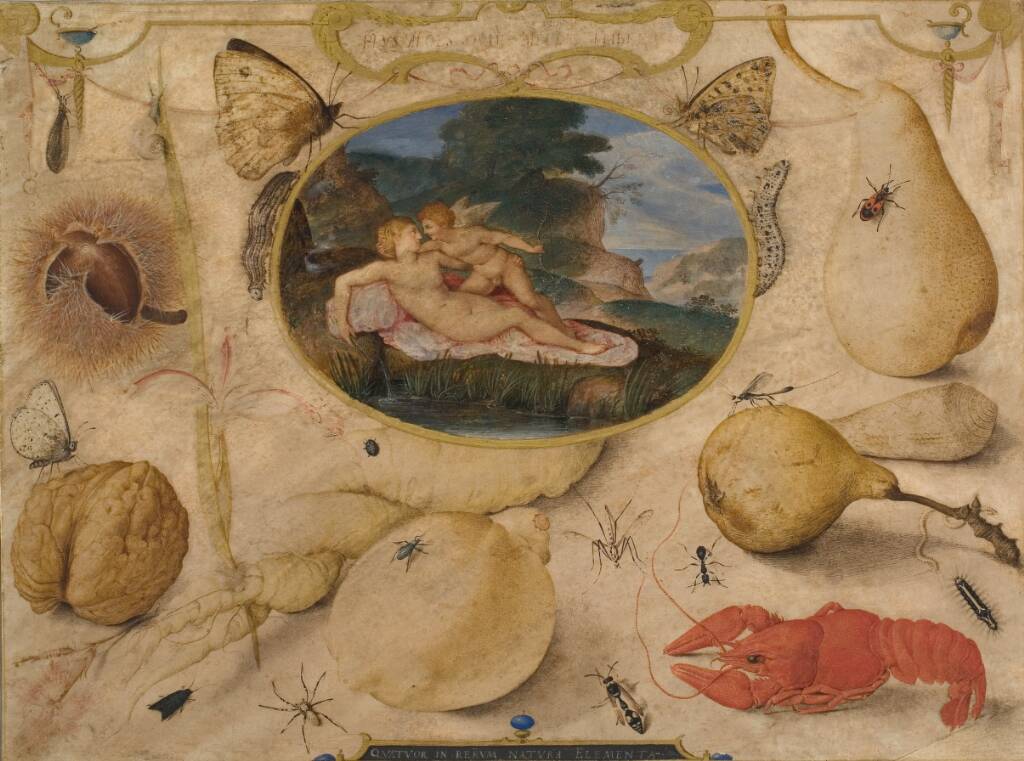
Title: "Venus disarming Amor" in a medallion surrounded by plants, fruits, insects and shellfish
Description:
Joris Hoefnagel is one of the most important Northern European artists from the second half of the 16th century.
Back in his own day, his fame rested on manuscript illuminations and cabinet miniatures (such as this); his work was amongst the most exquisite created in his day.
The picture shows a strange mixture of motifs that do not make sense to modernday audiences, but which would have been decipherable to scholars from the artist's own time.
Even so, we can make some progress towards understanding the images.
The medallion's subject matter and inscription "Plus aloes quam mellis habent" (They contain more bitterness than sweetness) is a reference to how earthly love (the arrows of Amor/Cupid) always end up bringing pain even if it begins sweetly; a familiar moral lesson at the time.
The inscription at the bottom, "Quatuor in rerum natura elementa" (the four elements of Nature) explains the flowers and fruits (which symbolise earth), butterflies (air), the other insects (fire), and the lobster (water).
But we no longer know the significance of placing "The Four Elements" and "Venus Disarming Amor" within the same context.
The knowledge that was active during the 16th century - and which was very much about how all of Creation was intervowen in a web of interconnected meanings - has largely been lost now.
We can no longer "see" these overall connections, the vast intervowen fabric that made sense to people, at least to scholars, at that time.
Related Results
Emperor Ferdinand III. elevates Wentzl Hegemüller von Dubenweiller to the status of free gentlemen, is awarded by Herr Hegemüller’s predicate Freyherr auf Albrechtsberg an der Pielach and improves his coat of arms
Emperor Ferdinand III. elevates Wentzl Hegemüller von Dubenweiller to the status of free gentlemen, is awarded by Herr Hegemüller’s predicate Freyherr auf Albrechtsberg an der Pielach and improves his coat of arms
Character: description on folk. 7a and 7b, miniature on folk. 4a, 155 x 187 mm.
Cosmo inclined gold shield with black cosmic crossbar on which is a double-tailed lion 1) with red t...
Corded pendant for an ecclesiastical vestment
Corded pendant for an ecclesiastical vestment
Pendant consisting of embroidered panels of couched metallic yarns and outlined in red silk suspended from a braided cord with black and white chevrons. From top to bottom:
1) ...
Heginric medallion
Heginric medallion
Middle part embossed, embossed. - This piece of jewelry, the name of which varies widely in the literature, offers the only contemporary portrait of King Henry I, with which the ne...
Emperor Ferdinand I awards Cypryan, Jan and Nicholas to the brothers Roudnice’s coat of arms and predicate from Mydlovar
Emperor Ferdinand I awards Cypryan, Jan and Nicholas to the brothers Roudnice’s coat of arms and predicate from Mydlovar
Character: description, miniature in the middle of the leaf, 95 x 107 mm.
Red shield with a green lawn on which there is a beaver of natural colors and a curved horn of unicorn 1 a...
Red Band with Rider, Nereid, and Plants
Red Band with Rider, Nereid, and Plants
This large red band is decorated with multicolored human figures, animals, and fanciful plants inside square compartments. In the lower portion of the band, three such squares are ...
Band with Medallion and Dancers
Band with Medallion and Dancers
Tapestry woven band representing a bust portrait and three dancers. The bust portrait is oriented perpendicularly to the orientation of the standing dancers. It is positioned in a ...
Portuguese S: take Isabella’s words
Portuguese S: take Isabella’s words
Polychrome, oval medallion with in high relief S: take Isabella in blue dress and mackerel lined, red robe, crown on head, overreaching an alms mosa to one in front of her kneeling...