
Search engine for discovering works of Art, research articles, and books related to Art and Culture


Javascript must be enabled to continue!
Henry Moore: Reclining Figures
View through Artsy
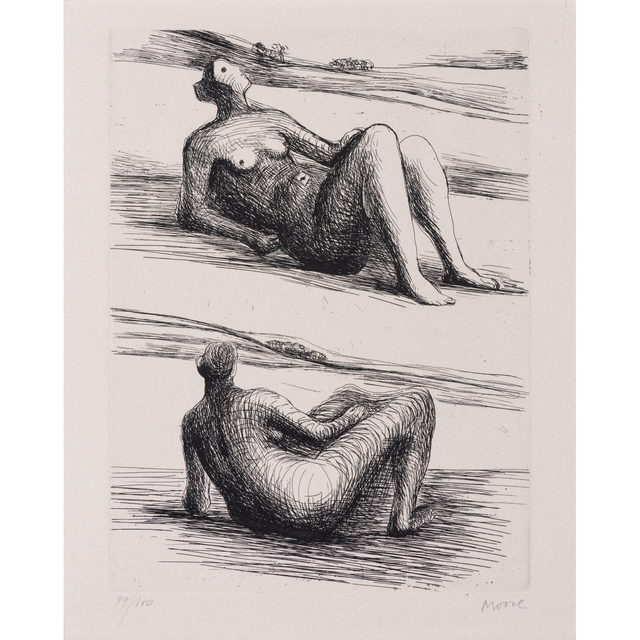
English artist [Henry Moore](/artist/henry-moore) is most known for his abstracted sculptures of reclining women, some of which are held in the collections of major museums including the Tate in London and the Metropolitan Museum of Art in New York. Inspired by natural formations such as bones, rocks, and mountain ranges, Moore began depicting reclining figures in 1924, exploring the form in his sketches and sculptures. Though Moore began with wood and stone, he chose to cast his works in metal beginning in the late 1930s so that he could create multiple versions of a single design. In 1951, Moore debuted his monumental *Reclining Figure: Festival*, a bronze work from an edition of five, in London’s newly built South Bank—a public sculpture that symbolized the resilience of Britain after World War II. The work later set Moore’s auction record, reaching over $30 million at Christie’s in 2016.
Title: Henry Moore: Reclining Figures
Description:
English artist [Henry Moore](/artist/henry-moore) is most known for his abstracted sculptures of reclining women, some of which are held in the collections of major museums including the Tate in London and the Metropolitan Museum of Art in New York.
Inspired by natural formations such as bones, rocks, and mountain ranges, Moore began depicting reclining figures in 1924, exploring the form in his sketches and sculptures.
Though Moore began with wood and stone, he chose to cast his works in metal beginning in the late 1930s so that he could create multiple versions of a single design.
In 1951, Moore debuted his monumental *Reclining Figure: Festival*, a bronze work from an edition of five, in London’s newly built South Bank—a public sculpture that symbolized the resilience of Britain after World War II.
The work later set Moore’s auction record, reaching over $30 million at Christie’s in 2016.
Related Results
Sketchbook
Sketchbook
Sketchbook with black-leather-covered cardboard covers. Sewn page block. Pages of white wove paper, each 34.7 x 27.1 cm. Pages numbered at l.l. of verso in graphite. Drawings i...
Sketchbook
Sketchbook
Sketchbook with blue-and-white marbled cardboard covers. Black fabric tape at spine. Sewn page block; sheets perforated for removal. Pages of off-white wove paper, each 36.7 x 2...
Sketchbook
Sketchbook
Sketchbook with blue- and black-fabric-covered cardboard covers. Sewn page block; pages of off-white wove paper, each 27.6 x 21.6 cm. Each sheet numbered on verso at l.l. Drawin...
Sketchbook
Sketchbook
Sketchbook with beige-fabric-covered cardboard covers. Sewn page block. Pages of off-white wove paper, 37 x 31.2 cm. Pages numbered in graphite at l.l. of verso. Drawings mostl...
Sketchbook
Sketchbook
Sketchbook with black-leather-covered cardboard covers. Sewn page block; pages of off-white wove paper, each 27.2 x 20.8 cm. Drawings made in graphite and in vertical orientation...
Portrait of Henry VIII of England
Portrait of Henry VIII of England
During the 16th century portraiture was the leading genre in England and almost the only one to which artists could devote themselves following the events of the early 1530s, the c...
Woman's jacket 'Barbed Wire' hand-made in screen-printed rayon, designed by Henry Spencer Moore, made by Ascher Ltd., England, ca. 1946.
Woman's jacket 'Barbed Wire' hand-made in screen-printed rayon, designed by Henry Spencer Moore, made by Ascher Ltd., England, ca. 1946.
Woman's jacket 'Barbed Wire' hand-made in screen-printed rayon, designed by Henry Spencer Moore, made by Ascher Ltd., England, ca. 1946. ...