
Search engine for discovering works of Art, research articles, and books related to Art and Culture


Javascript must be enabled to continue!
Japanese Cloisonne Vase (20th c.)
View through Artsy
Patchwork decoration around rim, with central reserve of two birds on a branch, Japan, 6 in diameter
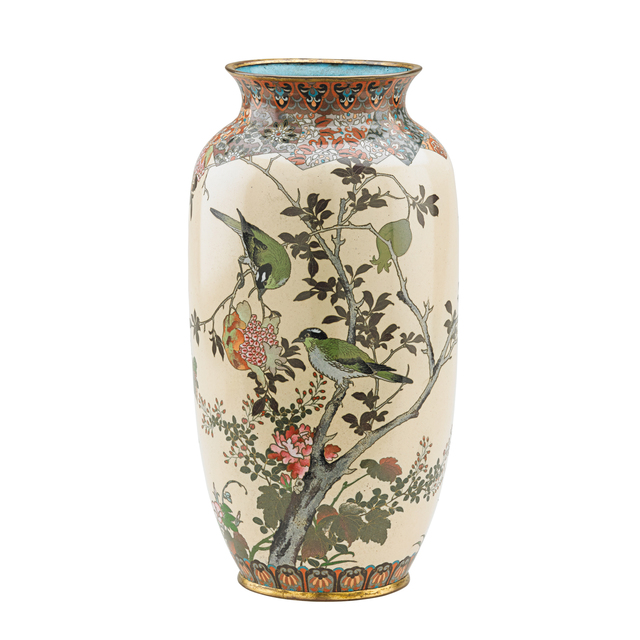
Title: Japanese Cloisonne Vase (20th c.)
Description:
Patchwork decoration around rim, with central reserve of two birds on a branch, Japan, 6 in diameter.
Related Results
Diese großformatige Vase mit Deckel stammt aus Kutani in der Präfektur Ishikawa. Die dreifärbige (Gold, Rot, Schwarz), die gesamte Gefäßoberfläche ausfüllende Bemalung wird aka-e saikō genannt und war von der späten Edo- bis in die mittlere Meiji-Zeit (Mi
Diese großformatige Vase mit Deckel stammt aus Kutani in der Präfektur Ishikawa. Die dreifärbige (Gold, Rot, Schwarz), die gesamte Gefäßoberfläche ausfüllende Bemalung wird aka-e saikō genannt und war von der späten Edo- bis in die mittlere Meiji-Zeit (Mi
This large-format vase with lid comes from Kutani in Ishikawa Prefecture. The three-coloured (gold, red, black), the entire vessel surface filled painting is called aka-e saikō and...
Diese großformatige Vase mit Deckel stammt aus Kutani in der Präfektur Ishikawa. Die dreifärbige (Gold, Rot, Schwarz), die gesamte Gefäßoberfläche ausfüllende Bemalung wird aka-e saikō genannt und war von der späten Edo- bis in die mittlere Meiji-Zeit (Mi
Diese großformatige Vase mit Deckel stammt aus Kutani in der Präfektur Ishikawa. Die dreifärbige (Gold, Rot, Schwarz), die gesamte Gefäßoberfläche ausfüllende Bemalung wird aka-e saikō genannt und war von der späten Edo- bis in die mittlere Meiji-Zeit (Mi
This large-format vase with lid comes from Kutani in Ishikawa Prefecture. The three-coloured (gold, red, black), the entire vessel surface filled painting is called aka-e saikō and...
Vase in the Shape of an Archaic Jade 'Cong' Ritual Implement
Vase in the Shape of an Archaic Jade 'Cong' Ritual Implement
Square in section, this tall vase has a circular footring and a short, circular neck with lightly flaring walls. The vase is strongly archaistic in character, its shape deriving f...
Vas. Dehuaporcelain, Ming-Qingdynasty.
Vas. Dehuaporcelain, Ming-Qingdynasty.
VAS, A vase in an archaic bronze form called gu. The vase was probably part of an altar set at a Buddhist temple. During the end of the Ming Dynasty and the following Qing Dynasty,...
Imperial Presentation Vase with Maple Branches and Imperial Chrysanthemum Crest (one of a pair)
Imperial Presentation Vase with Maple Branches and Imperial Chrysanthemum Crest (one of a pair)
Standard and repoussé cloisonné enamel; silver wires and rims; signed: combined marks of Andō Cloisonné Company and Kawade Shibatarō, Meiji period (1868–1912), Japan...
Imperial Presentation Vase with Maple Branches and Imperial Chrysanthemum Crest (one of a pair)
Imperial Presentation Vase with Maple Branches and Imperial Chrysanthemum Crest (one of a pair)
Standard and repoussé cloisonné enamel; silver wires and rims; signed: combined marks of Andō Cloisonné Company and Kawade Shibatarō, Meiji period (1868–1912), Japan...
Vas. Longquan, Yuandynasty.
Vas. Longquan, Yuandynasty.
VASE. (mei-ping) Conversely pear-shaped, with a slight neck edge. Decor in relief, in several places with carved details. Around the abdomen a wide stretcher with a winding flower ...
A Vase is a Vase is a Vase
A Vase is a Vase is a Vase
"A Vase is a Vase is a Vase" is a group exhibition co-curated with Alejandro Jassan, featuring new works by Sarah Bedford, Charlie Goering, Caroline Larsen, Karen Lederer, Emilia O...