
Search engine for discovering works of Art, research articles, and books related to Art and Culture


Javascript must be enabled to continue!
Horse Bridle or Belt Ornaments
View through The Met
Gilt copper or copper alloy and cloisonné enamel, Spanish
Rights: Public Domain
Medieval Art, Metropolitan Museum of Art New York NY, Gift of J. Pierpont Morgan 1917
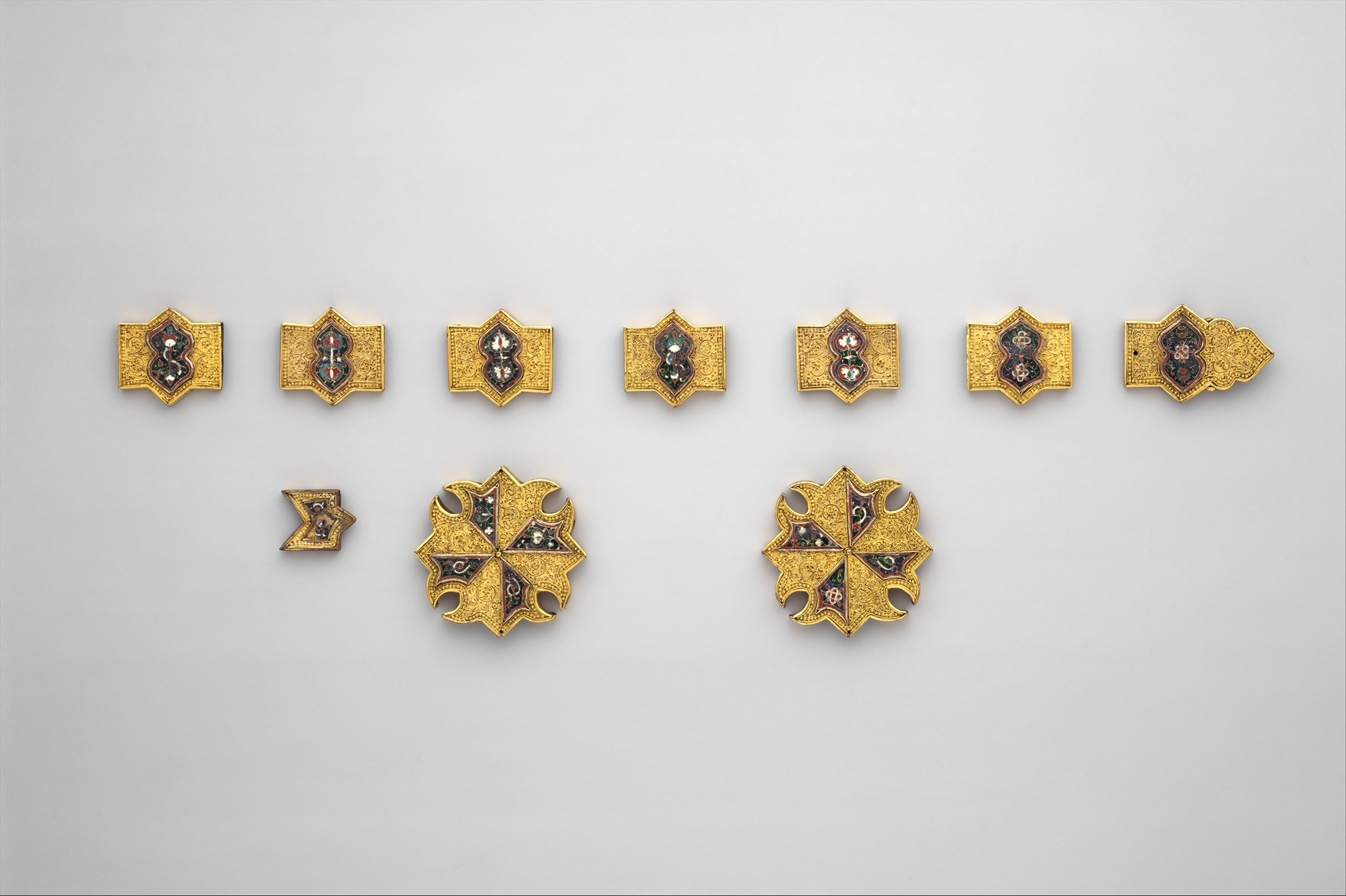
Title: Horse Bridle or Belt Ornaments
Description:
Gilt copper or copper alloy and cloisonné enamel, Spanish.
Related Results
Image frieze over Queen Victoria’s of England coronation procession 1838-06-28, published by Fore 's Sporting & Fine Print Repository, London.
Image frieze over Queen Victoria’s of England coronation procession 1838-06-28, published by Fore 's Sporting & Fine Print Repository, London.
Image frieze on the short ends with glued joints attached sheets paper, l: 185 mm, h: 10.3 mm. Attached to a pearl cardboard sleeve with glued brown pink (?) fabric with pressed fr...
Fragment of architectural plaque: horses (from frieze depicting chariot race)
Fragment of architectural plaque: horses (from frieze depicting chariot race)
Fragment of a molded terracotta plaque, broken on all sides. Flat on the back. A great deal of brown dirt or accretion in the crevices.
Two overlapping horses, facing right.
...
Figur. Man till häst, Östra Handynastin.
Figur. Man till häst, Östra Handynastin.
FIGURE. Man to Horse. Roughly modelled of reddish-brown goods with greenish, flame glaze. Probably the figure is broken from a larger object. On the inside of the horse’s forelimb ...
Red belt with geometric motifs
Red belt with geometric motifs
The belt (faja in Spanish) is woven in a hip loom with wool and metallic thread. The belt consists of one piece of textile. The weaving technique used is upholstery or tapisserie (...
Belt in blue and pink with geometric motifs
Belt in blue and pink with geometric motifs
The belt (faja in Spanish) is woven in a hip loom with wool and metallic thread. The belt consists of one piece of textile. The weaving technique used is upholstery or tapisserie (...
Man's suede jacket and snakeskin belt, probably made in Great Britain, 1972. Man's suede jacket with details and trimming of snakeskin, and belt. Hip-length jacket with a snakeskin yoke and cuff. Single-breasted and fastens with fine horn buttons, each wi
Man's suede jacket and snakeskin belt, probably made in Great Britain, 1972. Man's suede jacket with details and trimming of snakeskin, and belt. Hip-length jacket with a snakeskin yoke and cuff. Single-breasted and fastens with fine horn buttons, each wi
Man's suede jacket and snakeskin belt, probably made in Great Britain, 1972. Man's suede jacket with details and trimming of snakeskin, and belt. Hip-length jacket with a snakeskin...
BRONZE AGE JEWELLERY
BRONZE AGE JEWELLERY
TREASURE CASE 2015 T72. Two Copper Age (Chalcolithic) gold 'basket ornaments', possibly hair ornaments or ear rings, cut from thin gold sheet into an elongated oval shapes.The firs...
Bridle with Cheek Pieces Depicting Horses
Bridle with Cheek Pieces Depicting Horses
The cheek pieces of this horse bit are in the shape of walking horses. The bit is a square-sectioned rod, hammered and curled in opposite directions on the ends (20.8 cm long, 2.7 ...