
Search engine for discovering works of Art, research articles, and books related to Art and Culture


Javascript must be enabled to continue!
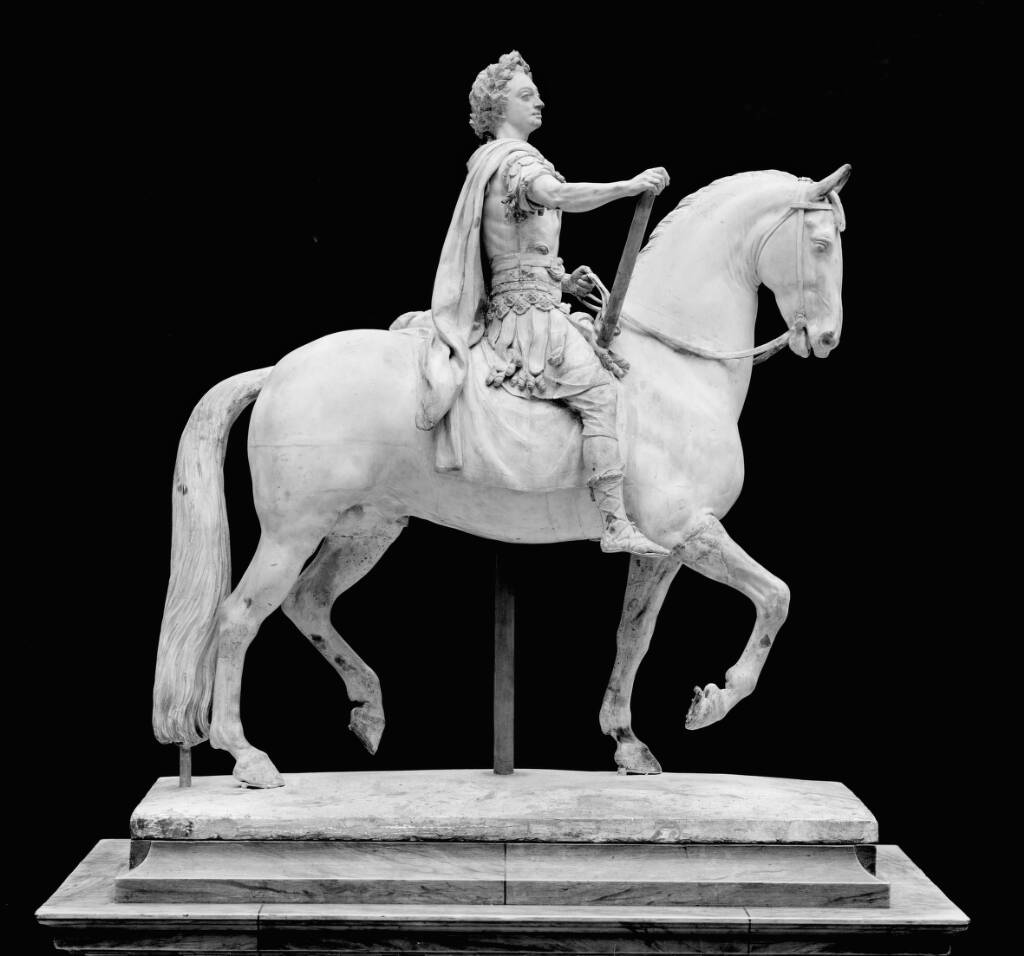
Frederik V on Horseback. Sketch for Equestrian Statue in Amalienborg Palace Square
View through National Gallery of Denmark
For centuries the horse was an essential foundation for the worldly power of kings and princes. Its importance in war and peace - as a weapon and as a means of transport and communication – made it a strong symbol of might and glory. It would take more than 15 years from start to finish before Frederik V had his own splendid equestrian statue in the square of Amalienborg Palace. It shows the king as a keeper of peace and a father to his people rather than as a general. He controls the powerful creature with gentleness. The mount itself is an idealised version of the Danish Frederiksborg horse, which was bred intensively in the 19th century but later became extinct. The artist Saly was already established in France when he went to Denmark in 1753. Smaller studies were used to plan the large, complex task of constructing the statue, which ended up costing half a million Danish thaler. Enough to build ten mansions at Amalienborg Square!
Title: Frederik V on Horseback. Sketch for Equestrian Statue in Amalienborg Palace Square
Description:
For centuries the horse was an essential foundation for the worldly power of kings and princes.
Its importance in war and peace - as a weapon and as a means of transport and communication – made it a strong symbol of might and glory.
It would take more than 15 years from start to finish before Frederik V had his own splendid equestrian statue in the square of Amalienborg Palace.
It shows the king as a keeper of peace and a father to his people rather than as a general.
He controls the powerful creature with gentleness.
The mount itself is an idealised version of the Danish Frederiksborg horse, which was bred intensively in the 19th century but later became extinct.
The artist Saly was already established in France when he went to Denmark in 1753.
Smaller studies were used to plan the large, complex task of constructing the statue, which ended up costing half a million Danish thaler.
Enough to build ten mansions at Amalienborg Square!.
Related Results
[Planning of the surroundings of the Royal Palace and the San Francisco neighborhood]. General plant that comprehende the works that are projected to communicate from the Royal Palace to the neighborhood of S. Francisco [Material Pl]
[Planning of the surroundings of the Royal Palace and the San Francisco neighborhood]. General plant that comprehende the works that are projected to communicate from the Royal Palace to the neighborhood of S. Francisco [Material Pl]
Manuscript inscription, pen and black Chinese ink, in the upper left angle: "General plant that comprehends the works that are projected to/communicate from the Royal Palace to the...
Sketchbook
Sketchbook
Sketchbook with black-leather-covered cardboard covers. Sewn page block; pages of off-white wove paper, each 27.2 x 20.8 cm. Drawings made in graphite and in vertical orientation...
Plate 9: equestrian statue of Vitellius, seen three-quarters to the left, with his death scene in the background at right, his body being thrown into the Tiber at upper right, from 'Roman Emperors on Horseback'
Plate 9: equestrian statue of Vitellius, seen three-quarters to the left, with his death scene in the background at right, his body being thrown into the Tiber at upper right, from 'Roman Emperors on Horseback'
Engraving squared in red, 'Roman Emperors on Horseback'...
Plate 8: equestrian statue of Otho, seen from behind, his death scene in the background with him stabbing himself at right and the burning of his body at left, from 'Roman Emperors on Horseback'
Plate 8: equestrian statue of Otho, seen from behind, his death scene in the background with him stabbing himself at right and the burning of his body at left, from 'Roman Emperors on Horseback'
Engraving squared in graphite, 'Roman Emperors on Horseback'...
Plate 4: equestrian statue of Caligula, seen three-quarters to the left, wearing a winged helmet and holding double-headed arrows, a military scene in the background, from 'Roman Emperors on Horseback'
Plate 4: equestrian statue of Caligula, seen three-quarters to the left, wearing a winged helmet and holding double-headed arrows, a military scene in the background, from 'Roman Emperors on Horseback'
Engraving squared in graphite, 'Roman Emperors on Horseback'...
Ten sketches for sculpture gardens
Ten sketches for sculpture gardens
One manila folder labeled "sculpture gardens" in Wilmarth's hand and ten loose sheets as follows (dates unknown):
1) Aerial (?) sketch in graphite
2) Sketch in graphite
3) Horiz...
elefantbete, carved altar tusk, elephant tusk
elefantbete, carved altar tusk, elephant tusk
Exhibition text STADEN 1998, Benin City:
“WHERE THE KING OF GRACE PREVAILS OVER LIFE AND DEATH”
The Kingdom of Benin is located in the tropical rainforest in southern Nigeria. The...
elefantbete, carved altar tusk, elephant tusk
elefantbete, carved altar tusk, elephant tusk
Exhibition text STADEN 1998, Benin City:
“WHERE THE KING OF GRACE PREVAILS OVER LIFE AND DEATH”
The Kingdom of Benin is located in the tropical rainforest in southern Nigeria. The...