
Search engine for discovering works of Art, research articles, and books related to Art and Culture


Javascript must be enabled to continue!
The Russian Sculptor and Graphic Artist Ghana Orloff
View through National Gallery of Denmark
This portrait was made in Paris, where the Danish sculptor Adam Fischer lived from 1913 to 1933 with his wife, the painter Ellen Fischer. Originally a painter himself, Adam Fischer
only turned to sculpture after arriving in Paris. Drawing inspiration from movements such as Cubism, he developed a stringent, simplified, geometric idiom and became an important innovator of Danish sculpture.
Between 1900 and 1940, Paris was an international centre of art that attracted artists from large parts of the world. Chana Orloff,
a draughtsperson and sculptor born in what
was then the Russian Empire (now Ukraine) was part of this milieu. Orloff made portraits as well as human and animal figures in materials such as stone, marble, bronze and, above all, wood. Fisher’s portrait can thus be seen
as both a depiction of a well-respected fellow artist and as an expression of Fischer’s artistic position in 1916, at which point he aimed to simplify his subject matter and find the essence of each form.
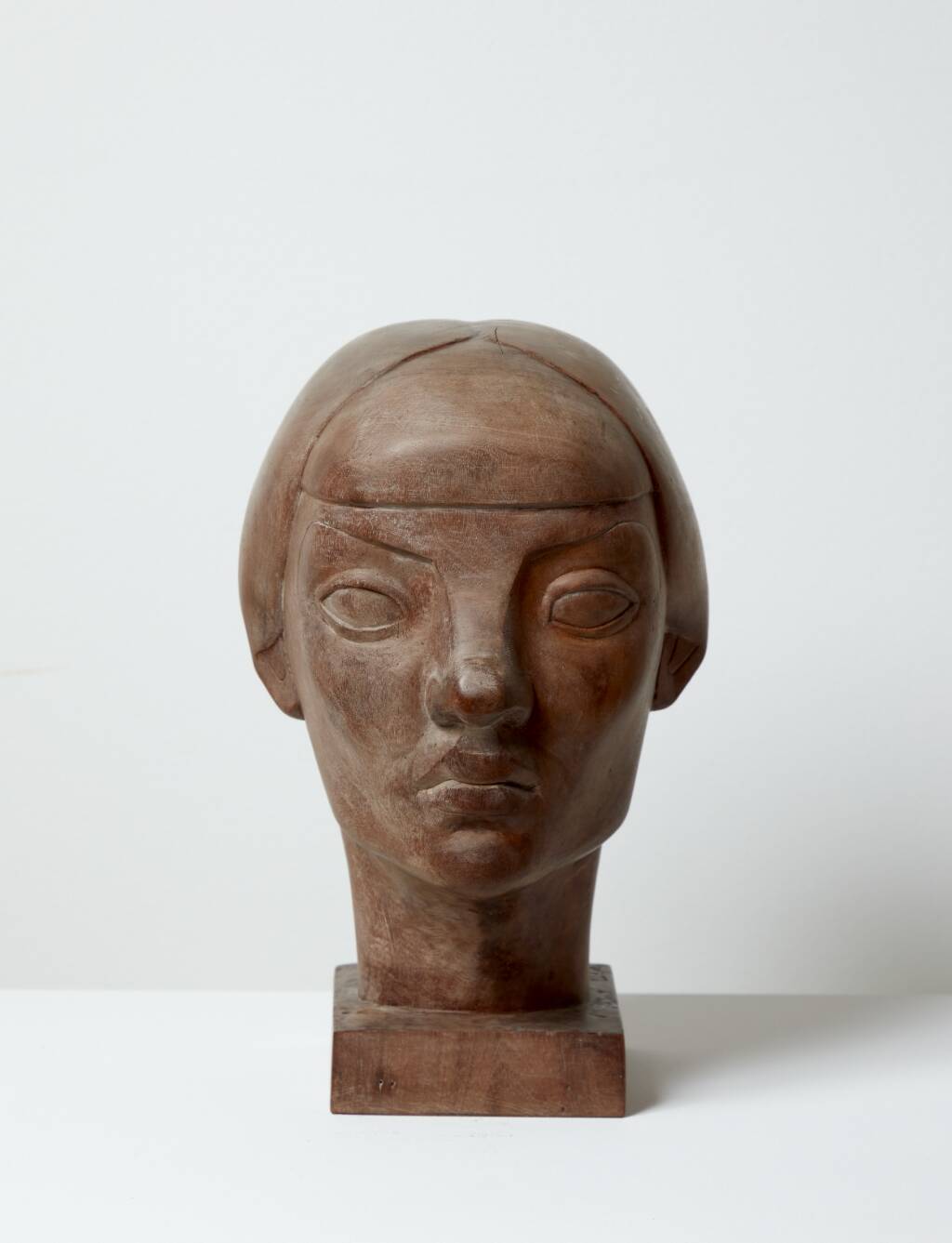
Title: The Russian Sculptor and Graphic Artist Ghana Orloff
Description:
This portrait was made in Paris, where the Danish sculptor Adam Fischer lived from 1913 to 1933 with his wife, the painter Ellen Fischer.
Originally a painter himself, Adam Fischer
only turned to sculpture after arriving in Paris.
Drawing inspiration from movements such as Cubism, he developed a stringent, simplified, geometric idiom and became an important innovator of Danish sculpture.
Between 1900 and 1940, Paris was an international centre of art that attracted artists from large parts of the world.
Chana Orloff,
a draughtsperson and sculptor born in what
was then the Russian Empire (now Ukraine) was part of this milieu.
Orloff made portraits as well as human and animal figures in materials such as stone, marble, bronze and, above all, wood.
Fisher’s portrait can thus be seen
as both a depiction of a well-respected fellow artist and as an expression of Fischer’s artistic position in 1916, at which point he aimed to simplify his subject matter and find the essence of each form.
Related Results
Illustrated London Almanack
Illustrated London Almanack
Illustrations: wood engravings and color lithographs...
Album containing prints clipped from American and British periodicals
Album containing prints clipped from American and British periodicals
Hand-colored etching engraving lithograph mezzotint...
The Aldine: Typograhic Art Journal, Vol. 6, Nos. 1-12
The Aldine: Typograhic Art Journal, Vol. 6, Nos. 1-12
Illustrations: engraving...
Illustrated London Almanack
Illustrated London Almanack
Illustrations: wood engravings and color lithographs...
The Aldine: Typograhic Art Journal, Vol. 5, Nos. 1-12
The Aldine: Typograhic Art Journal, Vol. 5, Nos. 1-12
Illustrations: wood engraving...
The Aldine: Typograhic Art Journal, Vol. 4, Nos. 1-12
The Aldine: Typograhic Art Journal, Vol. 4, Nos. 1-12
Illustrations: wood engraving...
American Abstract Artists 60th Anniversary Print Portfolio
American Abstract Artists 60th Anniversary Print Portfolio
A portfolio of 40 lithographs by 40 American artists...