
Search engine for discovering works of Art, research articles, and books related to Art and Culture


Javascript must be enabled to continue!
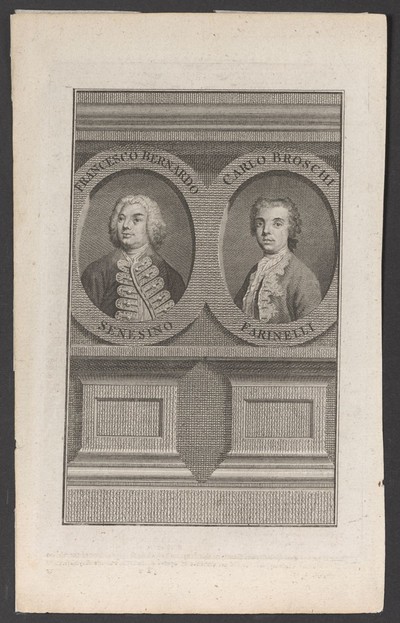
Double portrait Francesco Bernardi, called Senesino (1680-1750) and Carlo Broschi, called Farinelli (1705-1782)
View through Europeana Collections
On the copper engraving are the two famous catrasts of the baroque period Francesco Bernardi (called: Senesino) and Carlo Broschi (called: Farinelli). They lived and worked during Handel’s lifetime. Senesino took over the title games in many Handel operas in London, such as “Giulio Cesare in Egitto” and “Riccardo I, Re d 'Inghilterra.” He celebrated great audience success with these roles. However, with the establishment of the Opera of the Nobility, a competitor to Handel’s own opera company, Senesino changed its place of action. Farinelli, on the other hand, was never engaged by Händel and supported the Opera of the Nobility from the beginning. Nevertheless, he also celebrated great success in London.
The present illustration of the castrates Senesino and Farinelli was created around 1785 and comes from the English engraver Joseph Wilson Lowry (1803-1879). He was presented with two copper engravings by Charles Grignion d.Ä. (1717-1810), which in turn (in the case of Farinellis) copied a template Jacopo Amigonis (1675-1752). Grignion’s copper engravings appeared in Hawkins' “A general history of the science and practice of music” (London 1776).
The illustrations of the two singers are in an oval, simple frame in which the bourgeois names and their pseudonyms are engraved as inscriptions. In turn, the frames are integrated into various architectural elements. The portrayed artists wear plain clothes that were similar to the style of the time.
Caption: Francesco Bernardo Senesino. Carlo Broschi Farinelli. (Stiftung Händel-Haus Halle Foundation)
Title: Double portrait Francesco Bernardi, called Senesino (1680-1750) and Carlo Broschi, called Farinelli (1705-1782)
Description:
On the copper engraving are the two famous catrasts of the baroque period Francesco Bernardi (called: Senesino) and Carlo Broschi (called: Farinelli).
They lived and worked during Handel’s lifetime.
Senesino took over the title games in many Handel operas in London, such as “Giulio Cesare in Egitto” and “Riccardo I, Re d 'Inghilterra.
” He celebrated great audience success with these roles.
However, with the establishment of the Opera of the Nobility, a competitor to Handel’s own opera company, Senesino changed its place of action.
Farinelli, on the other hand, was never engaged by Händel and supported the Opera of the Nobility from the beginning.
Nevertheless, he also celebrated great success in London.
The present illustration of the castrates Senesino and Farinelli was created around 1785 and comes from the English engraver Joseph Wilson Lowry (1803-1879).
He was presented with two copper engravings by Charles Grignion d.
Ä.
(1717-1810), which in turn (in the case of Farinellis) copied a template Jacopo Amigonis (1675-1752).
Grignion’s copper engravings appeared in Hawkins' “A general history of the science and practice of music” (London 1776).
The illustrations of the two singers are in an oval, simple frame in which the bourgeois names and their pseudonyms are engraved as inscriptions.
In turn, the frames are integrated into various architectural elements.
The portrayed artists wear plain clothes that were similar to the style of the time.
Caption: Francesco Bernardo Senesino.
Carlo Broschi Farinelli.
(Stiftung Händel-Haus Halle Foundation).
Related Results
Sketchbook
Sketchbook
Sketchbook with blue- and black-fabric-covered cardboard covers. Sewn page block; pages of off-white wove paper, each 27.6 x 21.6 cm. Each sheet numbered on verso at l.l. Drawin...
Album of Fingernail Artwork
Album of Fingernail Artwork
This codex-format album consists of 19 relief images created by the pressure of the artist’s fingernail on paper (san`at-i nākhun). Specimens include calligraphic, floral, and figu...
(XXIV) Peintures de la Sala Borgia au Vatican de l'invention de Raphael recueilles par les Piranesi et Dessinées par Thomas Piroli, Paris (Pietro and Francesco Piranesi and Leblanc) and Rome (Piroli) (1803); (XXV) Peintures de la Villa Lante, à Rome, de l
(XXIV) Peintures de la Sala Borgia au Vatican de l'invention de Raphael recueilles par les Piranesi et Dessinées par Thomas Piroli, Paris (Pietro and Francesco Piranesi and Leblanc) and Rome (Piroli) (1803); (XXV) Peintures de la Villa Lante, à Rome, de l
Engraving, (XXIV) Peintures de la Sala Borgia au Vatican de l'invention de Raphael recueilles par les Piranesi et Dessinées par Thomas Piroli Paris (Pietro and Francesco Piranesi ...
Kerchief, cotton embroidered with silk in double running stitch variations and with metal thread in satin stitch and double running in a line, trimmed with a lace-like edging, Crete; Turkey, 1800-1875. Kerchief, cotton embroidered with silk in double runn
Kerchief, cotton embroidered with silk in double running stitch variations and with metal thread in satin stitch and double running in a line, trimmed with a lace-like edging, Crete; Turkey, 1800-1875. Kerchief, cotton embroidered with silk in double runn
Kerchief, cotton embroidered with silk in double running stitch variations and with metal thread in satin stitch and double running in a line, trimmed with a lace-like edging, Cret...
Francesco Bernardi known as "Il Senesino" (1686–1758)
Francesco Bernardi known as "Il Senesino" (1686–1758)
Terracotta with later marble base...
Ten Thousand Years, Ten Thousand Years of Sleep, One Hundred Million Scattered Pieces
Ten Thousand Years, Ten Thousand Years of Sleep, One Hundred Million Scattered Pieces
This triptych comprises a set of three hanging scrolls, each painted in ink on paper. The central scroll is a formal portrait of Mao Zedong (1893–1976); the flanking scrolls repres...