
Search engine for discovering works of Art, research articles, and books related to Art and Culture


Javascript must be enabled to continue!
Kim Ki-Chang, Nam Kwan, and Lee Bann, Mystic Star of the Orient; Illusion of Human Mask; Let's Make the Whole Demilitarized Zone into a Grand Park for All Korean Peopleand an Olympeace Park (a group of three prints from The Official Arts Portfolio of the
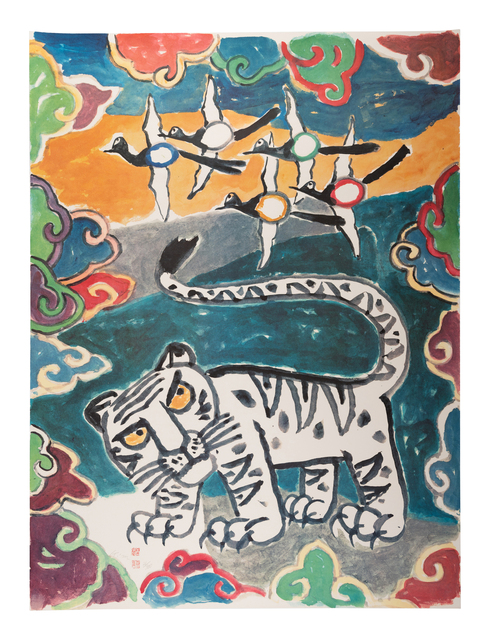
Title: Kim Ki-Chang, Nam Kwan, and Lee Bann, Mystic Star of the Orient; Illusion of Human Mask; Let's Make the Whole Demilitarized Zone into a Grand Park for All Korean Peopleand an Olympeace Park (a group of three prints from The Official Arts Portfolio of the
Description:
Lithographs.
Related Results
Six Landscapes
Six Landscapes
This six-panel folding screen presents six individual landscape scenes. The landscapes reflect the so-called Orthodox style that became popular in China in the seventeenth and eigh...
Valley (Gu)
Valley (Gu)
The following printer's colophon appears on the back of the print: CHEN CHI KWAN / "Clear day", 1990 / Original lithograph, size 72 x 37 cm / Printed in France / by Ateliers d'Art ...
ansiktsmask, mask, topeng
ansiktsmask, mask, topeng
Mask of painted wood. Remains of a piece of leather are nailed to the inside of the mask. By biting the leather piece, the dancer has been able to keep the mask in place. The mask...
Reptile skin gas-mask bag with gas mask inside, H Wald & Co., Great Britain, 1940-1942. Light tan reptile skin gas-mask bag with a top closure and long strap with buckle. Containing a gas mask. Reptile skin.
Reptile skin gas-mask bag with gas mask inside, H Wald & Co., Great Britain, 1940-1942. Light tan reptile skin gas-mask bag with a top closure and long strap with buckle. Containing a gas mask. Reptile skin.
Reptile skin gas-mask bag with gas mask inside, H Wald & Co., Great Britain, 1940-1942. Light tan reptile skin gas-mask bag with a top closure and long strap with buckle. Containin...
Bamboo through the Four Seasons
Bamboo through the Four Seasons
Korean folding screens often have six panels, like those painted in Japan; more characteristically, however, Korean screens boast eight, ten, or even twelve panels. In some cases, ...