
Search engine for discovering works of Art, research articles, and books related to Art and Culture


Javascript must be enabled to continue!
Funerary monument of Mamertinus and his wife Partenope found on Via Labicana in 1765 together with a vase and lamps
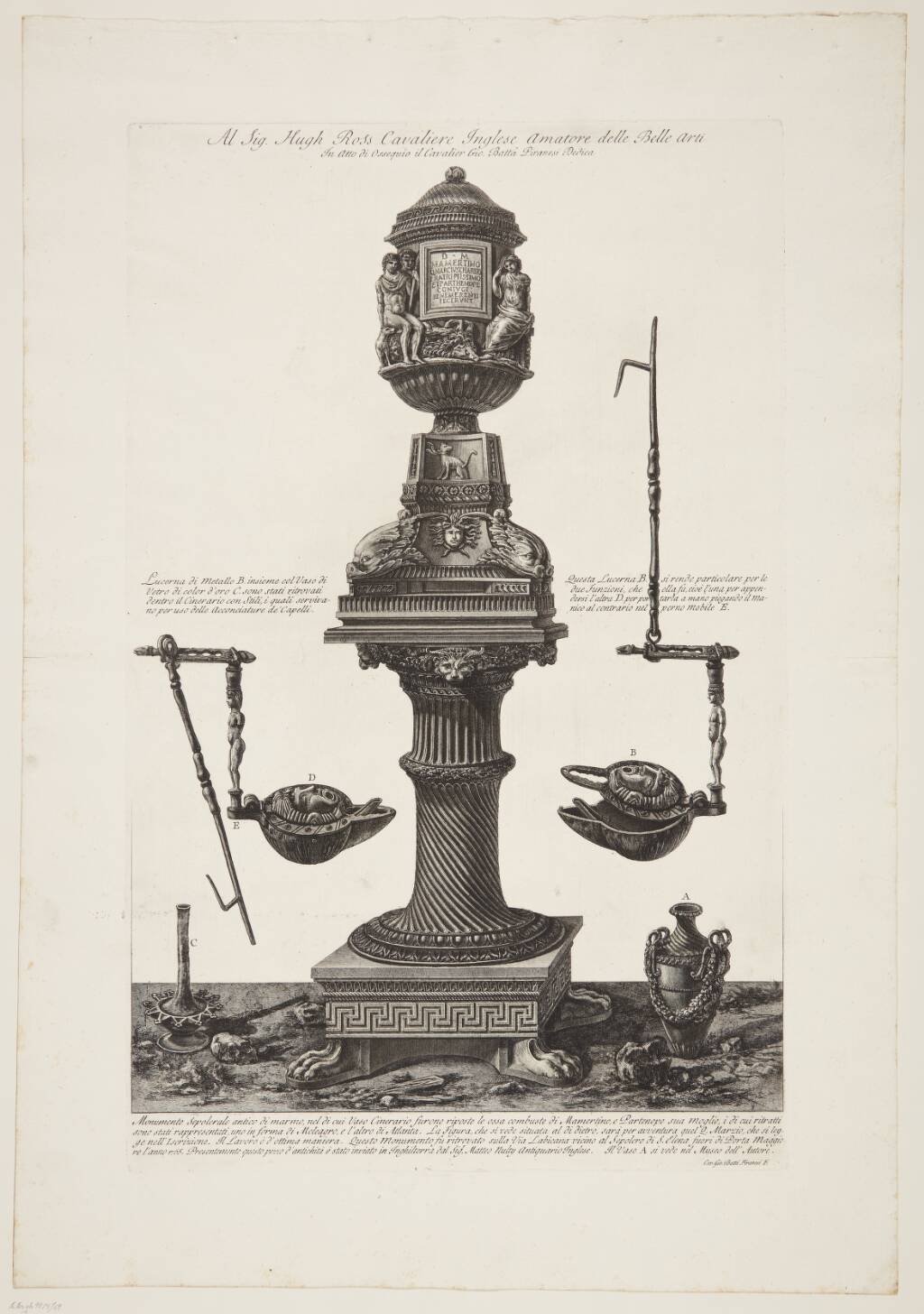
Title: Funerary monument of Mamertinus and his wife Partenope found on Via Labicana in 1765 together with a vase and lamps
Description not available.
Related Results
Funerary monument of Mamertinus and his wife Partenope found on Via Labicana in 1765 together with a vase and lamps, from "Vasi, candelabri, cippi, sarcofagi, tripodi, lucerne, ed ornamenti antichi disegnati ed incisi dal Cav. Gio. Batt. Piranesi, Vol. II
Funerary monument of Mamertinus and his wife Partenope found on Via Labicana in 1765 together with a vase and lamps, from "Vasi, candelabri, cippi, sarcofagi, tripodi, lucerne, ed ornamenti antichi disegnati ed incisi dal Cav. Gio. Batt. Piranesi, Vol. II
Etching, Vasi candelabri cippi sarcofagi tripodi lucerne ed ornamenti antichi disegnati ed incisi dal Cav. Gio. Batt. Piranesi Vol. II...
Lamp: human figure crouching over phallus
Lamp: human figure crouching over phallus
Mold made lamp. Material is soft, well-levigated light-gray clay with micaceous impurities. Has a reddish brown glaze. Nozzle is coated with carbon. Designed for suspension with tw...
Lamp: Black African crouching over phallus
Lamp: Black African crouching over phallus
Mold made lamp. Material is soft, well-levigated light-gray clay with micaceous impurities. Has a reddish brown glaze. Nozzle is coated with carbon. Designed for suspension with tw...
Diese großformatige Vase mit Deckel stammt aus Kutani in der Präfektur Ishikawa. Die dreifärbige (Gold, Rot, Schwarz), die gesamte Gefäßoberfläche ausfüllende Bemalung wird aka-e saikō genannt und war von der späten Edo- bis in die mittlere Meiji-Zeit (Mi
Diese großformatige Vase mit Deckel stammt aus Kutani in der Präfektur Ishikawa. Die dreifärbige (Gold, Rot, Schwarz), die gesamte Gefäßoberfläche ausfüllende Bemalung wird aka-e saikō genannt und war von der späten Edo- bis in die mittlere Meiji-Zeit (Mi
This large-format vase with lid comes from Kutani in Ishikawa Prefecture. The three-coloured (gold, red, black), the entire vessel surface filled painting is called aka-e saikō and...
Diese großformatige Vase mit Deckel stammt aus Kutani in der Präfektur Ishikawa. Die dreifärbige (Gold, Rot, Schwarz), die gesamte Gefäßoberfläche ausfüllende Bemalung wird aka-e saikō genannt und war von der späten Edo- bis in die mittlere Meiji-Zeit (Mi
Diese großformatige Vase mit Deckel stammt aus Kutani in der Präfektur Ishikawa. Die dreifärbige (Gold, Rot, Schwarz), die gesamte Gefäßoberfläche ausfüllende Bemalung wird aka-e saikō genannt und war von der späten Edo- bis in die mittlere Meiji-Zeit (Mi
This large-format vase with lid comes from Kutani in Ishikawa Prefecture. The three-coloured (gold, red, black), the entire vessel surface filled painting is called aka-e saikō and...
Sculpture from the funerary chamber of Toya (Peal de Becerro, Jaén, Spain)
Sculpture from the funerary chamber of Toya (Peal de Becerro, Jaén, Spain)
Sculpture in round bundle carved in limestone. It represents a herbivore that lacks his head. Currently this sculptural fragment is preserved in the Museo Arqueológico Nacional of ...
Vase in the Shape of an Archaic Jade 'Cong' Ritual Implement
Vase in the Shape of an Archaic Jade 'Cong' Ritual Implement
Square in section, this tall vase has a circular footring and a short, circular neck with lightly flaring walls. The vase is strongly archaistic in character, its shape deriving f...
Latin Funerary Inscription of Q. Caecilius Hilarus and Caecilia Eleutheris
Latin Funerary Inscription of Q. Caecilius Hilarus and Caecilia Eleutheris
Marble Latin Funerary Inscription of Caecilius Hilarius, physician to Caecilia Metella. Excellent condition. Thin crack from right-of-center bottom to middle of fourth row of inscr...