
Search engine for discovering works of Art, research articles, and books related to Art and Culture


Javascript must be enabled to continue!
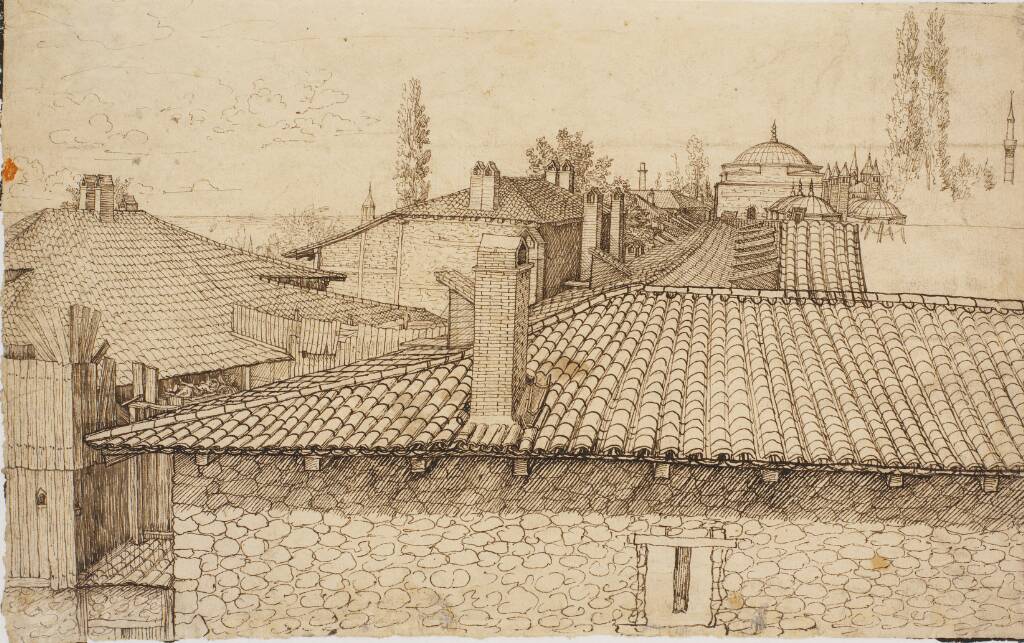
View over Roofs towards the Column of Arcadios in Constantinople
View through National Gallery of Denmark
In the mid-sixteenth century, Melchior Lorck spent
approximately four years in Constantinople (present-day
Istanbul), the capital of the Ottoman Empire. For Lorck, this
seemed a very foreign culture with a foreign religion, Islam.
Lorck arrived there, as part of a delegation sent by the Holy
Roman Empire, and his task was to document the Ottoman
culture and subsequently present his pictures back in Europe.
Here he has drawn the view from his residence. With
lines of great accuracy and precision, he strives to convince
us that this is how it actually looked. For example, you can
recognize the distinctive Atik Ali Pasha Mosque in the
background a little to the right, and the Sea of Marmara
appears in the distance.
On the left, somewhat surprisingly, a loving couple
is seen on a covered terrace. Why did Lorck include this
scene, which could be considered inappropriate in several
ways? Perhaps he used it as a sort of marker of credibility:
‘That is what I saw, so I had to put it in’? Its inclusion makes
us trust the veracity of Lorck’s image (50 Favorites in the SMK Collection).
Title: View over Roofs towards the Column of Arcadios in Constantinople
Description:
In the mid-sixteenth century, Melchior Lorck spent
approximately four years in Constantinople (present-day
Istanbul), the capital of the Ottoman Empire.
For Lorck, this
seemed a very foreign culture with a foreign religion, Islam.
Lorck arrived there, as part of a delegation sent by the Holy
Roman Empire, and his task was to document the Ottoman
culture and subsequently present his pictures back in Europe.
Here he has drawn the view from his residence.
With
lines of great accuracy and precision, he strives to convince
us that this is how it actually looked.
For example, you can
recognize the distinctive Atik Ali Pasha Mosque in the
background a little to the right, and the Sea of Marmara
appears in the distance.
On the left, somewhat surprisingly, a loving couple
is seen on a covered terrace.
Why did Lorck include this
scene, which could be considered inappropriate in several
ways? Perhaps he used it as a sort of marker of credibility:
‘That is what I saw, so I had to put it in’? Its inclusion makes
us trust the veracity of Lorck’s image (50 Favorites in the SMK Collection).
Related Results
Post-Marijuana (Dama zhi hou), Written in Shadow Script and Black-on-Black Script
Post-Marijuana (Dama zhi hou), Written in Shadow Script and Black-on-Black Script
This large, horizontally oriented, rectangular album leaf is divided visually into two parts, the right one-third, in which the characters appear a ghostly grayish white on a black...
"Because of the void everything is possible. Without the void nothing is possible.", Written in Bold Black Script
"Because of the void everything is possible. Without the void nothing is possible.", Written in Bold Black Script
This large, horizontally oriented, rectangular album leaf is inscribed with seven columns of text, the columns with varying numbers of characters. The calligraphy on this album lea...
Gabled Roofs (Gabled Roofs, Vitré)
Gabled Roofs (Gabled Roofs, Vitré)
Transfer lithograph with stumping; only state (Chicago); printed in black ink on medium weight ivory laid paper...
Table Plateau
Table Plateau
BORDSPLATY Consisting of a bottom plate (plateau) with a mirror glass, two flower bowls with artificial bouquets, two fruit bowls with glass bowls, six confectionery bowls with gla...
San Pietro in Vincoli, Rom
San Pietro in Vincoli, Rom
New acquisition, June 2014: View of San Pietro in Vincoli in Rome by Constantin Hansen Nationalmuseum has expanded its fine art collection with the acquisition of a view of Rome wi...
Plate III: Front view of Trajan's column, from "Trofeo o sia Magnifica Colonna Coclide..." (The Trophy or Magnificent Spiral Column...)
Plate III: Front view of Trajan's column, from "Trofeo o sia Magnifica Colonna Coclide..." (The Trophy or Magnificent Spiral Column...)
Etching, Trofeo o sia Magnifica Colonna Coclide di marmo composta di grossi macigni ove si veggono scolpite le due guerre daciche fatte da Trajano inalzata nel mezzo del Gran Foro...
Panathenaic Prize Amphora (storage jar)
Panathenaic Prize Amphora (storage jar)
Side A: Athena Promachos advancing to right clothed in an archaic Ionic chiton ornamented with a dotted border in white and provided with rudimentary sleeves ending in two swallow-...