
Search engine for discovering works of Art, research articles, and books related to Art and Culture


Javascript must be enabled to continue!
crafts, basket, root, with lid, dájvvelihtte låhkijn
View through Europeana Collections
Root bonding: In order to bind root, it is necessary to have steep support trains and thinner connective trains, which may be split in addition. The support trains can be twice as rough as the connective trains. The support trains build up the shape of the object. Around the support trains, the connectors are wound. Sami root technique is characterised by mostly tying over two support trains instead of one and keeping the object with the pattern side outwards during work. The bond is very dense. One has colored roots and used. A long way you have used plant colours, then came the aniline colours (later half of the 1800s). When tying with colored roots, one lets the train that is not used run together with the support train. It is then hidden and found in the right place when the latter is needed. The roots of the spruce can withstand a lot of wetting. Of spruce roots, it becomes strong rope and coils to nets and notes. Of the birch’s roots, fine items were made that lacked themselves well to food handling, since birch leaves no taste. Before the roots are used, the bark is scraped away. The root must always be softened in water before you can work with it and should be humid when working with it. When it dries, it becomes hard and can’t bend without breaking. During the days of self-catering, households made their own items for home use. Today, the height of root is mainly an exclusive craft, a handicraft. Source: Dájvve - about root and crafts and utensils/ruohttsasa giehtaduojen ja nävon. Ájtte 1995. Parallel text in Swedish and Lulesamic. Learn more about Sami root height in “Asa Kitok and her Daughters” by Tom G Svensson.
Ájtte, Swedish Mountain and Sámi Museum
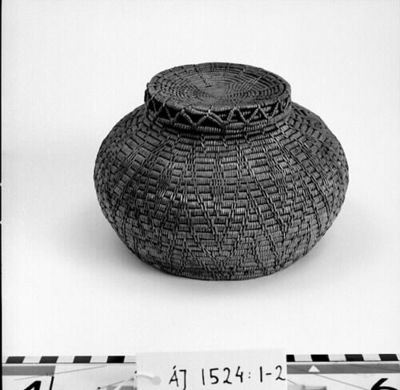
Title: crafts, basket, root, with lid, dájvvelihtte låhkijn
Description:
Root bonding: In order to bind root, it is necessary to have steep support trains and thinner connective trains, which may be split in addition.
The support trains can be twice as rough as the connective trains.
The support trains build up the shape of the object.
Around the support trains, the connectors are wound.
Sami root technique is characterised by mostly tying over two support trains instead of one and keeping the object with the pattern side outwards during work.
The bond is very dense.
One has colored roots and used.
A long way you have used plant colours, then came the aniline colours (later half of the 1800s).
When tying with colored roots, one lets the train that is not used run together with the support train.
It is then hidden and found in the right place when the latter is needed.
The roots of the spruce can withstand a lot of wetting.
Of spruce roots, it becomes strong rope and coils to nets and notes.
Of the birch’s roots, fine items were made that lacked themselves well to food handling, since birch leaves no taste.
Before the roots are used, the bark is scraped away.
The root must always be softened in water before you can work with it and should be humid when working with it.
When it dries, it becomes hard and can’t bend without breaking.
During the days of self-catering, households made their own items for home use.
Today, the height of root is mainly an exclusive craft, a handicraft.
Source: Dájvve - about root and crafts and utensils/ruohttsasa giehtaduojen ja nävon.
Ájtte 1995.
Parallel text in Swedish and Lulesamic.
Learn more about Sami root height in “Asa Kitok and her Daughters” by Tom G Svensson.
Related Results
Table Plateau
Table Plateau
BORDSPLATY Consisting of a bottom plate (plateau) with a mirror glass, two flower bowls with artificial bouquets, two fruit bowls with glass bowls, six confectionery bowls with gla...
dockhusgeråd
dockhusgeråd
1 coffee pot with lid, white porcelain with gold decor and flower in red and green, H 5.5 cm.
1 coffee pot without lid in white porcelain, gold decor and print with the coat of ar...
Urn with lid. Kangxi, Qing Dynasty
Urn with lid. Kangxi, Qing Dynasty
The URNA with a lid. Low-neck oviposition Cupy lid with round bud. Main motif consisting of a landscape with two bird Fenix.
Purchased by Johanna Kempe on 22 March 1890 at art de...
BRONZE AGE JEWELLERY
BRONZE AGE JEWELLERY
TREASURE CASE 2015 T72. Two Copper Age (Chalcolithic) gold 'basket ornaments', possibly hair ornaments or ear rings, cut from thin gold sheet into an elongated oval shapes.The firs...
Funeral urn with lid. Grave finds. Qingbai porcelain The Southern Song Dynasty.
Funeral urn with lid. Grave finds. Qingbai porcelain The Southern Song Dynasty.
URN. Funeral urn with lid (container for rice). Grave finds. The lower part has an elongated oval shape, the upper part is conical with imposed figures. The lid is conical with a b...
Urn with lid. Shunzi.Qing dynasty.
Urn with lid. Shunzi.Qing dynasty.
The URNA with a lid. Conversely pear-shaped with slightly turned foot, straight standing neck with rounded edge of mouth and flat bottom. A bell-shaped lid (possibly from another u...
BRONZE AGE JEWELLERY
BRONZE AGE JEWELLERY
A Copper Age (Chalcolithic) gold 'basket ornament', possibly a hair ornament or ear ring, cut from thin gold sheet into an elongated oval shape extending into a narrow tang. The pi...
Basket, jewellery
Basket, jewellery
This jewellery basket probably dates from the nineteenth century. It is a rectangular basket, with a lid, lined with blue silk padded on the base and the lid. It is made of very fi...