
Search engine for discovering works of Art, research articles, and books related to Art and Culture


Javascript must be enabled to continue!
mask
View through Europeana Collections
1916.9.295
Name and identification of character
The cobra king called Bhuma na-raja (Sin.).
Context
A demon character in stage two in a Kolam performance.
Material
Wood, vel-kaduru (Sin.) (Nux vomica).
Iconography
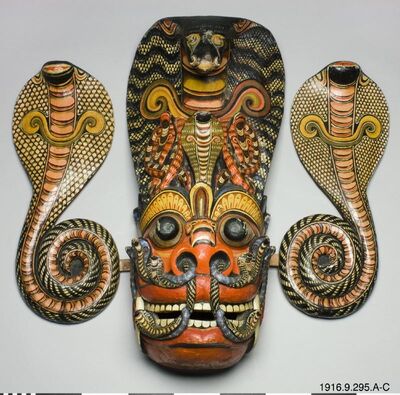
The mask is huge and heavy with an abundance of cobras in a variety of decorative shapes. A few masks of huge proportions have been used in Kolam dancing as evidenced from the cross-plank, kattuva (Sin.), attached to the mask from the inside. It enables the dancer to balance the tall structure.
A demonic face and a headdress composed of a large cobra, with an expanded neck, which shelters three smaller cobras. These are connected to a petal shaped wooden plank indicating a forehead ornament of sacred significance, tilaka (Sin.). The large cobra-hood represents the mythical cobra king called maha kela na raju (Sin.), who is supposed to have sheltered the Buddha from rain. The cobras have been decorated with the usual colour combinations and geometric pattern. These contain small red dots and white and black lines.
The mouth is broad and the space between the two rows of teeth is for the dancer to see through.
2000 09 04
Dr. M. H. Goonatilleka
Title: mask
Description:
1916.
9.
295
Name and identification of character
The cobra king called Bhuma na-raja (Sin.
).
Context
A demon character in stage two in a Kolam performance.
Material
Wood, vel-kaduru (Sin.
) (Nux vomica).
Iconography
The mask is huge and heavy with an abundance of cobras in a variety of decorative shapes.
A few masks of huge proportions have been used in Kolam dancing as evidenced from the cross-plank, kattuva (Sin.
), attached to the mask from the inside.
It enables the dancer to balance the tall structure.
A demonic face and a headdress composed of a large cobra, with an expanded neck, which shelters three smaller cobras.
These are connected to a petal shaped wooden plank indicating a forehead ornament of sacred significance, tilaka (Sin.
).
The large cobra-hood represents the mythical cobra king called maha kela na raju (Sin.
), who is supposed to have sheltered the Buddha from rain.
The cobras have been decorated with the usual colour combinations and geometric pattern.
These contain small red dots and white and black lines.
The mouth is broad and the space between the two rows of teeth is for the dancer to see through.
2000 09 04
Dr.
M.
H.
Goonatilleka.
Related Results
ansiktsmask, mask, topeng
ansiktsmask, mask, topeng
Mask of painted wood. Remains of a piece of leather are nailed to the inside of the mask. By biting the leather piece, the dancer has been able to keep the mask in place. The mask...
Reptile skin gas-mask bag with gas mask inside, H Wald & Co., Great Britain, 1940-1942. Light tan reptile skin gas-mask bag with a top closure and long strap with buckle. Containing a gas mask. Reptile skin.
Reptile skin gas-mask bag with gas mask inside, H Wald & Co., Great Britain, 1940-1942. Light tan reptile skin gas-mask bag with a top closure and long strap with buckle. Containing a gas mask. Reptile skin.
Reptile skin gas-mask bag with gas mask inside, H Wald & Co., Great Britain, 1940-1942. Light tan reptile skin gas-mask bag with a top closure and long strap with buckle. Containin...
mask, topeng, tapel
mask, topeng, tapel
Dance mask made of cut and painted wood. White face color with details in red, black and gold. The mask has a smiling mouth, with blotted upper tooth row, diadem and outstanding ea...
mask, ansiktsmask, topeng
mask, ansiktsmask, topeng
Mask of painted wood. Hake beard of fur attached with nails. The mask has two small holes, one on each side, to attach a ribbon to tie around the head. There are remnants of rope i...
mask, topeng, tapel
mask, topeng, tapel
Dance mask made of cut and painted wood. The mask is painted red with details in black, white and gold. The mask has round, open eyes, slightly open mouth with upper tooth row expo...