
Search engine for discovering works of Art, research articles, and books related to Art and Culture


Javascript must be enabled to continue!
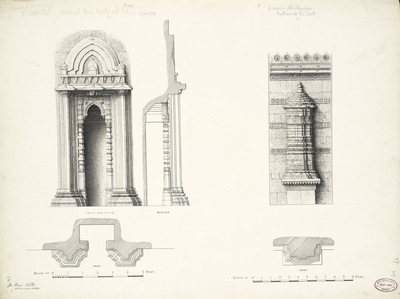
Ahmadabad: Mehrab from Mahoumed Ghans mosque (left), Darvish Alis Mosque, buttress on the back (right)
View through Europeana Collections
Illustration of a buttress at the Darvish Ali
mosque near Ahmadabad, in Gujarat. The Darvish Ali mosque, also
referred to as the Khonja Bibi mosque, has an inscription dating
the building to 1504. This small mosque consists of an interior
extending to 37 feet in length and utilizes four key pillars to
support a roof consisting of six domes in two rows. The richly
decorated minarets, niches, mihrab, and windows are key features of
this mosque and show similarities in style with the Rani Sipri
mosque also in Ahmadabad. On the back of the mosque, ?are
buttresses?richly moulded in keeping with the details of the
minarets and mihrabs.?
Title: Ahmadabad: Mehrab from Mahoumed Ghans mosque (left), Darvish
Alis Mosque, buttress on the back (right)
Description:
Illustration of a buttress at the Darvish Ali
mosque near Ahmadabad, in Gujarat.
The Darvish Ali mosque, also
referred to as the Khonja Bibi mosque, has an inscription dating
the building to 1504.
This small mosque consists of an interior
extending to 37 feet in length and utilizes four key pillars to
support a roof consisting of six domes in two rows.
The richly
decorated minarets, niches, mihrab, and windows are key features of
this mosque and show similarities in style with the Rani Sipri
mosque also in Ahmadabad.
On the back of the mosque, ?are
buttresses?richly moulded in keeping with the details of the
minarets and mihrabs.
?.
Related Results
Emperor Leopold I elevates Mark Putz von Adlersthurn, court chamber council and secret secretary, to the old knight’s state, improves his coat of arms and improves his predicate on von Putz zu Adlerßthurn and grants him a new predicate Edler von Schrotten
Emperor Leopold I elevates Mark Putz von Adlersthurn, court chamber council and secret secretary, to the old knight’s state, improves his coat of arms and improves his predicate on von Putz zu Adlerßthurn and grants him a new predicate Edler von Schrotten
Character: description on folk. 5b and 6a, miniature on folk. 5a, 166 x 151 mm.
Quarter shield with crowned heart plate. It is red with a silver crossbar, above the crossbar is the...
Album of calligraphy specimens
Album of calligraphy specimens
The album contains 19 folios, carrying 36 pieces of calligraphy. A small note suggests that the album entered the library of Khanlar Mirza Ihtisham al-Dawla, in Muharram 1271/Sep-O...
Nestoris (two-handled jar) with Mythological Scenes
Nestoris (two-handled jar) with Mythological Scenes
Red-figured Lucanian Type II nestoris. Broad ring foot with mid-length stem. Body flares from stem, rounds up, and turns in sharply to form a relatively narrow, flat shoulder. Neck...
Fickur med skyddsboett och chatelaine samt etui
Fickur med skyddsboett och chatelaine samt etui
Boett of gold, dial of enamel and works with spindle gait. Ground shell strongly convex, smooth, with a vulcanised outer edge; at the left side a piece from the edge a hole for the...
Image frieze over Queen Victoria’s of England coronation procession 1838-06-28, published by Fore 's Sporting & Fine Print Repository, London.
Image frieze over Queen Victoria’s of England coronation procession 1838-06-28, published by Fore 's Sporting & Fine Print Repository, London.
Image frieze on the short ends with glued joints attached sheets paper, l: 185 mm, h: 10.3 mm. Attached to a pearl cardboard sleeve with glued brown pink (?) fabric with pressed fr...
Column Krater (mixing bowl for wine and water): Theseus and Poseidon; Musician and Audience
Column Krater (mixing bowl for wine and water): Theseus and Poseidon; Musician and Audience
On one side: the Athenian hero Theseus visits his divine father Poseidon. Theseus’s mother was Aethra, and ancient sources sometimes consider him to be the son of her husband, Aege...