
Search engine for discovering works of Art, research articles, and books related to Art and Culture


Javascript must be enabled to continue!
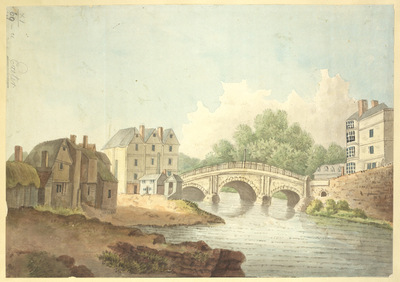
New Bridge, Exeter
View through Europeana Collections
View of Exeter showing the 'New Bridge' over the
River Exe and houses either side. During the Middle Ages, Exeter
had a single bridge to serve the town. It was constantly damaged
and repaired and improved many times. By the late 18th century the
medieval bridge could no longer cope with the vast increase in
wheeled traffic. In 1770 a new bridge was built by Joseph Dixon in
a new location, but unfortunately by 1775 it had been destroyed.
Between 1776 and 1778 another bridge was constructed by John
Goodwin, this time on solid rock foundations. This is the bridge
seen here, which has three wide arches and a balustrade, typical to
many late 18th century bridges.
Title: New Bridge, Exeter
Description:
View of Exeter showing the 'New Bridge' over the
River Exe and houses either side.
During the Middle Ages, Exeter
had a single bridge to serve the town.
It was constantly damaged
and repaired and improved many times.
By the late 18th century the
medieval bridge could no longer cope with the vast increase in
wheeled traffic.
In 1770 a new bridge was built by Joseph Dixon in
a new location, but unfortunately by 1775 it had been destroyed.
Between 1776 and 1778 another bridge was constructed by John
Goodwin, this time on solid rock foundations.
This is the bridge
seen here, which has three wide arches and a balustrade, typical to
many late 18th century bridges.
Related Results
Untitled (seven view at Oxford University, clockwise from top left, Interior of Hall, Exeter College; Library, Exeter College; Pugin's Gateway, Magdalen College; Merton Tower; Merton College; Turl Street Front; Broad Street Front; verso: clockwise from to
Untitled (seven view at Oxford University, clockwise from top left, Interior of Hall, Exeter College; Library, Exeter College; Pugin's Gateway, Magdalen College; Merton Tower; Merton College; Turl Street Front; Broad Street Front; verso: clockwise from to
Photograph information:
Recto (clockwise from top left):
Interior of Hall, Exeter College
Library, Exeter College
Pugin's Gateway, Magdalen College
Merton Tower
M...
Untitled (Group portrait of Exeter College "Torpid" (rowing team) 1865. Bow. C. H. Adams; 2. A. J. Pile; 3. C. E. Roberts; 4. W. B. Besley; 5. G. H. Morrell; 6. A. Lethbridge; 7. J. P. Young; Stroke, G. H. Swinny; Coxman, E. Kingdon; verso: Photo montage
Untitled (Group portrait of Exeter College "Torpid" (rowing team) 1865. Bow. C. H. Adams; 2. A. J. Pile; 3. C. E. Roberts; 4. W. B. Besley; 5. G. H. Morrell; 6. A. Lethbridge; 7. J. P. Young; Stroke, G. H. Swinny; Coxman, E. Kingdon; verso: Photo montage
Photograph information:
Recto:
Group portrait of Exeter College "Torpid" (rowing team) 1865.
Bow. C. H. Adams
2. A. J. Pile
3. C. E. Roberts
4. W. B. Besley
5....
Untitled (clockwise from top left, Broad Walk, Christ Church College; Addison's Walk, Magdalen College; Lime Walk, Trinity College; Magdalen College Tower; Oxford from Tower of St. Mary's; Interior of Hall, Christ Church College; Radcliffe; River from Fol
Untitled (clockwise from top left, Broad Walk, Christ Church College; Addison's Walk, Magdalen College; Lime Walk, Trinity College; Magdalen College Tower; Oxford from Tower of St. Mary's; Interior of Hall, Christ Church College; Radcliffe; River from Fol
Photograph information:
Recto (clockwise from top left):
Broad Walk, Christ Church College
Addison's Walk, Magdalen College
Lime Walk, Trinity College
Magdalen Colle...
Rom, 84. Veduta di Ponte Molle
Rom, 84. Veduta di Ponte Molle
The depicted bridge is the Milvische Bei (itl. outdated: Ponte Molle), which is the starting point of the straightforward north-south connection between TiBei fer and Forum Romanum...
Expulsion. Moon and Firelight
Expulsion. Moon and Firelight
“The whole landscape, which, seen by a favourable light, and in a genial temperature, had been found so lovely, appeared now like some pictured allegory of life, in which objects w...
South west coast of England from Exeter to Land's End,
1539-40
South west coast of England from Exeter to Land's End,
1539-40
This is a map of the south-west coast of England,
from Exeter to Land’s End. It dates from 1539-40 and its creation
can be imputed to the threat of invasion which became probable i...