
Search engine for discovering works of Art, research articles, and books related to Art and Culture


Javascript must be enabled to continue!
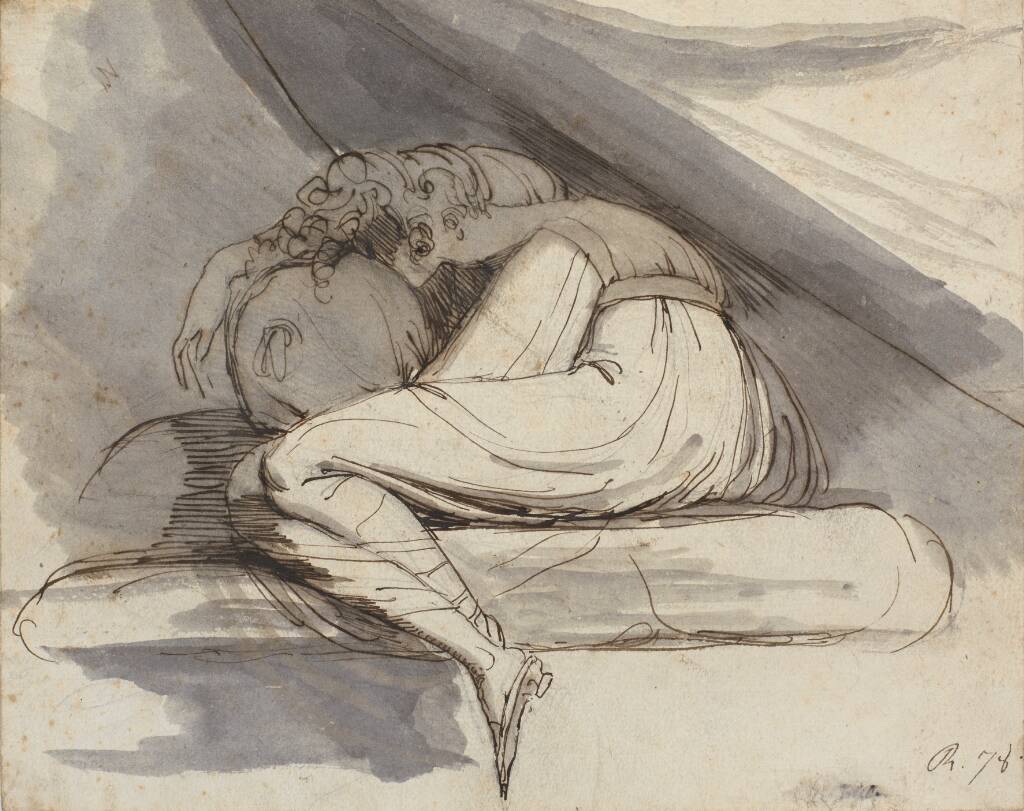
Woman Sitting, Curled up
View through National Gallery of Denmark
Füssli’s drawing has no specific meaning or content, shows no specific scene. No particular story is being related here, nor does the scene refer to a character known from literature. The female figure in the drawing primarily refers to itself, the forms determining the picture’s content.
The drawing's figure
The figure’s curling position, closed in upon itself; the curve of the neck; the sharp, angular abstraction of the face; the hair flowing chaotically across the pillow; the limply dangling hand; the sharply pointed foot - all this is combined to form an impression of restlessness and tension, creating an image of a woman who appears to be in a traumatic state.
Michelangelo as role model
The picture points back to Michelangelo (1475-1564), Füssli’s great role model. When the stories are peeled away, only the nameless figure is left, says the art historian Julius Lange (1838-1896) about the essence of Michelangelo’s figures. The figures become real, come into their own through their physical, bodily expressions.
Like so many of Füssli’s works, the drawing’s abstract, formal statement about human existence can also be viewed as forestalling modernism and its permanent awareness of crisis.
Title: Woman Sitting, Curled up
Description:
Füssli’s drawing has no specific meaning or content, shows no specific scene.
No particular story is being related here, nor does the scene refer to a character known from literature.
The female figure in the drawing primarily refers to itself, the forms determining the picture’s content.
The drawing's figure
The figure’s curling position, closed in upon itself; the curve of the neck; the sharp, angular abstraction of the face; the hair flowing chaotically across the pillow; the limply dangling hand; the sharply pointed foot - all this is combined to form an impression of restlessness and tension, creating an image of a woman who appears to be in a traumatic state.
Michelangelo as role model
The picture points back to Michelangelo (1475-1564), Füssli’s great role model.
When the stories are peeled away, only the nameless figure is left, says the art historian Julius Lange (1838-1896) about the essence of Michelangelo’s figures.
The figures become real, come into their own through their physical, bodily expressions.
Like so many of Füssli’s works, the drawing’s abstract, formal statement about human existence can also be viewed as forestalling modernism and its permanent awareness of crisis.
Related Results
Werbefilme der Insel-Film GmbH: Musterrolle 69/1
Werbefilme der Insel-Film GmbH: Musterrolle 69/1
Spot Nr. 1 (00:34): POLAR Rum 68/1: A person dressed in fur jacket in snow flurry. „Winter time, polar time, grog time - time for Polar.“ The person is serving grog with Polar Rum....
Sketchbook
Sketchbook
Sketchbook with black-leather-covered cardboard covers. Sewn page block. Pages of white wove paper, each 34.7 x 27.1 cm. Pages numbered at l.l. of verso in graphite. Drawings i...
Sketchbook
Sketchbook
Sketchbook with black-leather-covered cardboard covers. Sewn page block; pages of off-white wove paper, each 27.2 x 20.8 cm. Drawings made in graphite and in vertical orientation...
Pelike depicting Helen and Paris
Pelike depicting Helen and Paris
The scene on the front of the pelike (jar) comprises five figures: a couple consisting of a woman and a young man, flanked by a boy and second woman, respectively. A small Eros flu...
Christ and the Woman of Samaria at the Well
Christ and the Woman of Samaria at the Well
The meeting between Christ and the woman of Samaria at the well is only recounted in the Gospel of Saint John. Christ, travelling to Galilee, reached the Samarian city of Sychar. W...
drawing (ink and watercolour and gouache): ["Four Designs for Book Illustrations for 'The Happy Hypocrite'"]
drawing (ink and watercolour and gouache): ["Four Designs for Book Illustrations for 'The Happy Hypocrite'"]
Four drawings on one piece of card. Top left, numbered 1, a man and woman in early nineteenth century [?] costume, walking along with a dog on a lead. The woman wears a white dress...
Photographic postcard, black and white, of a girl sitting on the sand next to a black dog, taken on the south coast of England, by Remington's Photo Service (A.H. Remington), England, 1920-39. Black and white photographic postcard (landscape) of a girl si
Photographic postcard, black and white, of a girl sitting on the sand next to a black dog, taken on the south coast of England, by Remington's Photo Service (A.H. Remington), England, 1920-39. Black and white photographic postcard (landscape) of a girl si
Photographic postcard, black and white, of a girl sitting on the sand next to a black dog, taken on the south coast of England, by Remington's Photo Service (A.H. Remington), Engla...