
Search engine for discovering works of Art, research articles, and books related to Art and Culture


Javascript must be enabled to continue!
Mermaid
View through National Gallery of Denmark
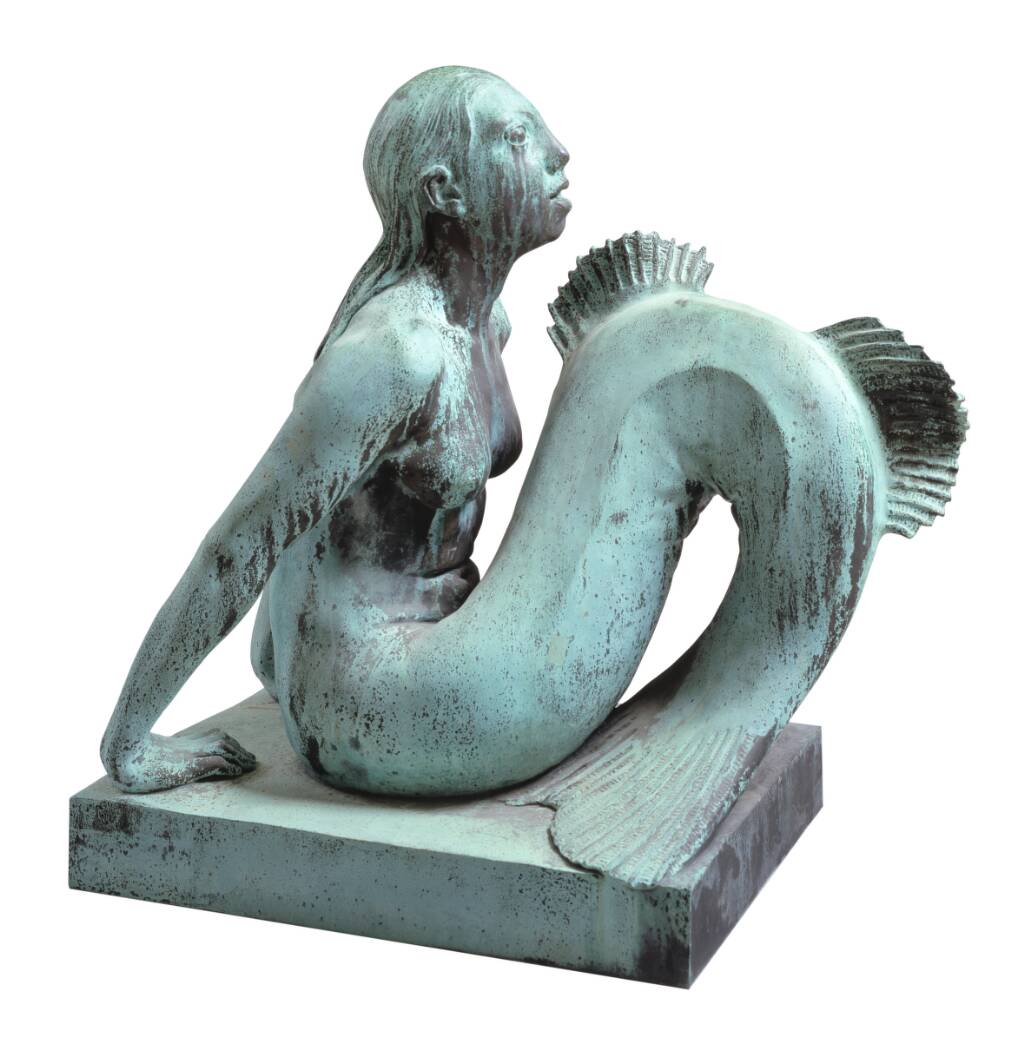
With mouth and eyes wide open, the mermaid meets the world with a scream. She speaks directly to us about basic, vital instincts. About zest for life and inner strength which runs through the works of Anne Marie Carl-Nielsen. But also about despair and loss, which was personally motivated by her husband, the composer Carl Nielsen’s, many affairs. A few years earlier she had filed for divorce, but by 1920 she had resurfaced from the marital crisis with renewed strength and agency.
Edvard Eriksen’s sculpture The Little Mermaid (1913) at Langelinje in Copenhagen is a world famous tourist attraction. Anne Marie Carl-Nielsen’s Mermaid is a few years younger and is on display outside the Royal Library and at Statens Museum for Kunst where it is part of the permanent collection. The two artistic interpretations of the motif are remarkably different in form and expression. Eriksen’s mermaid is almost transformed into a human, only a small remnant of the fish tail is still attached to her legs. Late romanticist, pretty and completely harmless in comparison with the unsentimental hybrid creature presented to us by Anne Marie Carl-Nielsen. Her face is very human but with large, fishlike eyes. The torso is feminine, the lower body however is one big, supple tail with stylized fish scales. H. C. Andersen’s fairy tale The Little Mermaid from 1837 is the common reference, which had garnered new interest through a ballet performance at the Royal Theatre in Copenhagen in 1909.
The mermaid’s expressive outlet of vitality and will to live is a defining trait of Anne Marie Carl Nielsen’s work, both seen in her many animal sculptures and athletic human figures. In Mermaid, she manages to unite this all-pervasive life urge in a statue which has become a major work in the history of Danish Vitalism and Danish sculpture in general
Title: Mermaid
Description:
With mouth and eyes wide open, the mermaid meets the world with a scream.
She speaks directly to us about basic, vital instincts.
About zest for life and inner strength which runs through the works of Anne Marie Carl-Nielsen.
But also about despair and loss, which was personally motivated by her husband, the composer Carl Nielsen’s, many affairs.
A few years earlier she had filed for divorce, but by 1920 she had resurfaced from the marital crisis with renewed strength and agency.
Edvard Eriksen’s sculpture The Little Mermaid (1913) at Langelinje in Copenhagen is a world famous tourist attraction.
Anne Marie Carl-Nielsen’s Mermaid is a few years younger and is on display outside the Royal Library and at Statens Museum for Kunst where it is part of the permanent collection.
The two artistic interpretations of the motif are remarkably different in form and expression.
Eriksen’s mermaid is almost transformed into a human, only a small remnant of the fish tail is still attached to her legs.
Late romanticist, pretty and completely harmless in comparison with the unsentimental hybrid creature presented to us by Anne Marie Carl-Nielsen.
Her face is very human but with large, fishlike eyes.
The torso is feminine, the lower body however is one big, supple tail with stylized fish scales.
H.
C.
Andersen’s fairy tale The Little Mermaid from 1837 is the common reference, which had garnered new interest through a ballet performance at the Royal Theatre in Copenhagen in 1909.
The mermaid’s expressive outlet of vitality and will to live is a defining trait of Anne Marie Carl Nielsen’s work, both seen in her many animal sculptures and athletic human figures.
In Mermaid, she manages to unite this all-pervasive life urge in a statue which has become a major work in the history of Danish Vitalism and Danish sculpture in general.
Related Results
Anne Marie Carl-Nielsen, Mermaid, 1920
Anne Marie Carl-Nielsen, Mermaid, 1920
With mouth and eyes wide open, the mermaid meets the world with a scream. She speaks directly to us about basic, vital instincts. About zest for life and inner strength which runs ...
Mermaid pendant and chain, gold, ronde-bosse enamel, baroque pearls, table-cut diamonds and a ruby, made by Louis Wièse (1852-1923), Paris, about 1880 . Pendant of a mermaid. Her torso is a baroque pearl, the rest enamelled gold. Her spiralling double tai
Mermaid pendant and chain, gold, ronde-bosse enamel, baroque pearls, table-cut diamonds and a ruby, made by Louis Wièse (1852-1923), Paris, about 1880 . Pendant of a mermaid. Her torso is a baroque pearl, the rest enamelled gold. Her spiralling double tai
Mermaid pendant and chain, gold, ronde-bosse enamel, baroque pearls, table-cut diamonds and a ruby, made by Louis Wièse (1852-1923), Paris, about 1880 . Pendant of a mermaid. Her t...
Enamelled plaques set in gold, connected by gold chains, designed and made in Edinburgh by Phoebe Traquair, 1905. Enamelled plaques set in gold, connected by gold chains, depicting a mermaid on the central plaques, and ships. The central plaque is signed,
Enamelled plaques set in gold, connected by gold chains, designed and made in Edinburgh by Phoebe Traquair, 1905. Enamelled plaques set in gold, connected by gold chains, depicting a mermaid on the central plaques, and ships. The central plaque is signed,
Enamelled plaques set in gold, connected by gold chains, designed and made in Edinburgh by Phoebe Traquair, 1905. Enamelled plaques set in gold, connected by gold chains, depicting...
Bobbin lace collar, scalloped, 1630s, mounted on modern linen. Length of bobbin lace intended for a man's collar : 13 deep scallops in two alternating designs, a pot of flowers with double-tailed mermaid above it, and floral form with double-headed eagle
Bobbin lace collar, scalloped, 1630s, mounted on modern linen. Length of bobbin lace intended for a man's collar : 13 deep scallops in two alternating designs, a pot of flowers with double-tailed mermaid above it, and floral form with double-headed eagle
Bobbin lace collar, scalloped, 1630s, mounted on modern linen. Length of bobbin lace intended for a man's collar : 13 deep scallops in two alternating designs, a pot of flowers wit...
Border Fragment
Border Fragment
Long, narrow red band woven with "mermaid" figures and flowering vines in which are birds and monkeys....
Three mermaids, one of them showing posterior and front view. Coloured engraving, 1817.
Three mermaids, one of them showing posterior and front view. Coloured engraving, 1817.
Lettering: Mermaid. Mermaids exhibited successively in the years 1758, 1775, & 1795. J. Pass. sc....