
Search engine for discovering works of Art, research articles, and books related to Art and Culture



Javascript must be enabled to continue!
'Hajj' pilgrimage certificate scroll, 14th century
View through Europeana Collections
This beautiful scroll from the 15th century
commemorates the pilgrimage to Mecca of Maymunah. Illustrated with
images of Mecca and other places of interest en route, it is a
fascinating document that combines both religious and geographical
information. The scroll attests that Maymunah, daughter of Muhammad
ibn 'Abd Allah al-Zardali, made the pilgrimage to Mecca and visited
the tomb of the Prophet Muhammad in the year 836 AH (AD 1432 to
1433). The scroll as a whole depicts the principal stations of the
pilgrimage to Mecca, and the Prophet's tomb at Medina. Once in his
or her lifetime every Moslem who is able to do so must journey to
Mecca and perform the prescribed rites of hajj. This is always done
in the 12th month of the Islamic calendar, Dhu al-Hijjah, to which
the pilgrimage had given its name. While the Prophet's tomb at
Medina is not a prescribed part of the pilgrimage, pilgrims make
use of their presence in Arabia to visit places associated with the
Prophet. This scroll belongs to a tradition of illustration which
was concerned to represent accurately, and in detail, the Moslem
holy places, and the artist has accordingly depicted and labelled
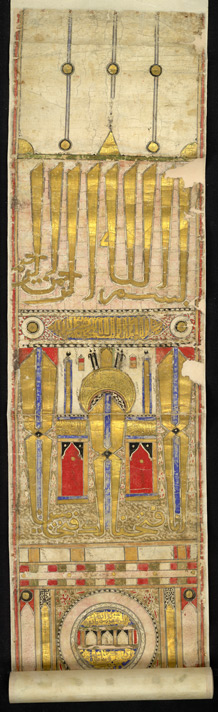
each of the tombs and other venerated landmarks. The portion of the
scroll seen here shows, reading downwards: the sanctuary of the
Ka'bah at Mecca, the hill al-Marwah (depicted as a series of
concentric circles), the shrine of the Prophet Muhammad at Medina,
and the sole of the Prophet's sandal, in which is written one of
his sayings. The calligraphic bands of Arabic script are quotations
from the Holy Qur'an concerning, among other things, the
hajj.
Title: 'Hajj' pilgrimage certificate scroll, 14th century
Description:
This beautiful scroll from the 15th century
commemorates the pilgrimage to Mecca of Maymunah.
Illustrated with
images of Mecca and other places of interest en route, it is a
fascinating document that combines both religious and geographical
information.
The scroll attests that Maymunah, daughter of Muhammad
ibn 'Abd Allah al-Zardali, made the pilgrimage to Mecca and visited
the tomb of the Prophet Muhammad in the year 836 AH (AD 1432 to
1433).
The scroll as a whole depicts the principal stations of the
pilgrimage to Mecca, and the Prophet's tomb at Medina.
Once in his
or her lifetime every Moslem who is able to do so must journey to
Mecca and perform the prescribed rites of hajj.
This is always done
in the 12th month of the Islamic calendar, Dhu al-Hijjah, to which
the pilgrimage had given its name.
While the Prophet's tomb at
Medina is not a prescribed part of the pilgrimage, pilgrims make
use of their presence in Arabia to visit places associated with the
Prophet.
This scroll belongs to a tradition of illustration which
was concerned to represent accurately, and in detail, the Moslem
holy places, and the artist has accordingly depicted and labelled
each of the tombs and other venerated landmarks.
The portion of the
scroll seen here shows, reading downwards: the sanctuary of the
Ka'bah at Mecca, the hill al-Marwah (depicted as a series of
concentric circles), the shrine of the Prophet Muhammad at Medina,
and the sole of the Prophet's sandal, in which is written one of
his sayings.
The calligraphic bands of Arabic script are quotations
from the Holy Qur'an concerning, among other things, the
hajj.
Related Results
Landscape with Mountain Village
Landscape with Mountain Village
Painted on paper in ink and the relatively light shades of color that the literati painters of the Suzhou-based Wu School typically employed, this long handscroll presents a panora...
Bagnacavallo, Pieve di San Pietro in Sylvis, Apostoli
Bagnacavallo, Pieve di San Pietro in Sylvis, Apostoli
The apostles Matthew, Simon, James the Great, Barholomew, James the Less and Saint Paul...
Nahan (Chinese, Luohan) Standing in a Landscape Viewing an Ink-Painted Scroll Depicting a Seated Bodhisattva While Assisted by an Elderly Male Attendant
Nahan (Chinese, Luohan) Standing in a Landscape Viewing an Ink-Painted Scroll Depicting a Seated Bodhisattva While Assisted by an Elderly Male Attendant
This painting is mounted and framed as a discrete album leaf. Done in ink and colors on paper, the painting, which might originally have been mounted as a hanging scroll, presumabl...
Ten Thousand Years, Ten Thousand Years of Sleep, One Hundred Million Scattered Pieces
Ten Thousand Years, Ten Thousand Years of Sleep, One Hundred Million Scattered Pieces
This triptych comprises a set of three hanging scrolls, each painted in ink on paper. The central scroll is a formal portrait of Mao Zedong (1893–1976); the flanking scrolls repres...
Ten Thousand Years, Ten Thousand Years of Sleep, One Hundred Million Scattered Pieces
Ten Thousand Years, Ten Thousand Years of Sleep, One Hundred Million Scattered Pieces
This triptych comprises a set of three hanging scrolls, each painted in ink on paper. The central scroll is a formal portrait of Mao Zedong (1893–1976); the flanking scrolls repres...
Ten Thousand Years, Ten Thousand Years of Sleep, One Hundred Million Scattered Pieces
Ten Thousand Years, Ten Thousand Years of Sleep, One Hundred Million Scattered Pieces
This triptych comprises a set of three hanging scrolls, each painted in ink on paper. The central scroll is a formal portrait of Mao Zedong (1893–1976); the flanking scrolls repres...
kyrka, skulptur, orgel, kyrkointeriör
kyrka, skulptur, orgel, kyrkointeriör
Overthorny Church. Medieval sculptures that had previously belonged to the disappeared Särkilax chapel.
1. Princess Sankta Katarina of Alexandria, daughter of the King of Cyprus. D...