
Search engine for discovering works of Art, research articles, and books related to Art and Culture


Javascript must be enabled to continue!
Galileo, astonished by changes in the face of the earth, from "News of the Day"
View through The Met
Lithograph on newsprint; second state of two (Delteil), News of the Day (Actualités)
News of the Day (Actualités), Drawings and Prints, Metropolitan Museum of Art New York NY, Harris Brisbane Dick Fund 1936
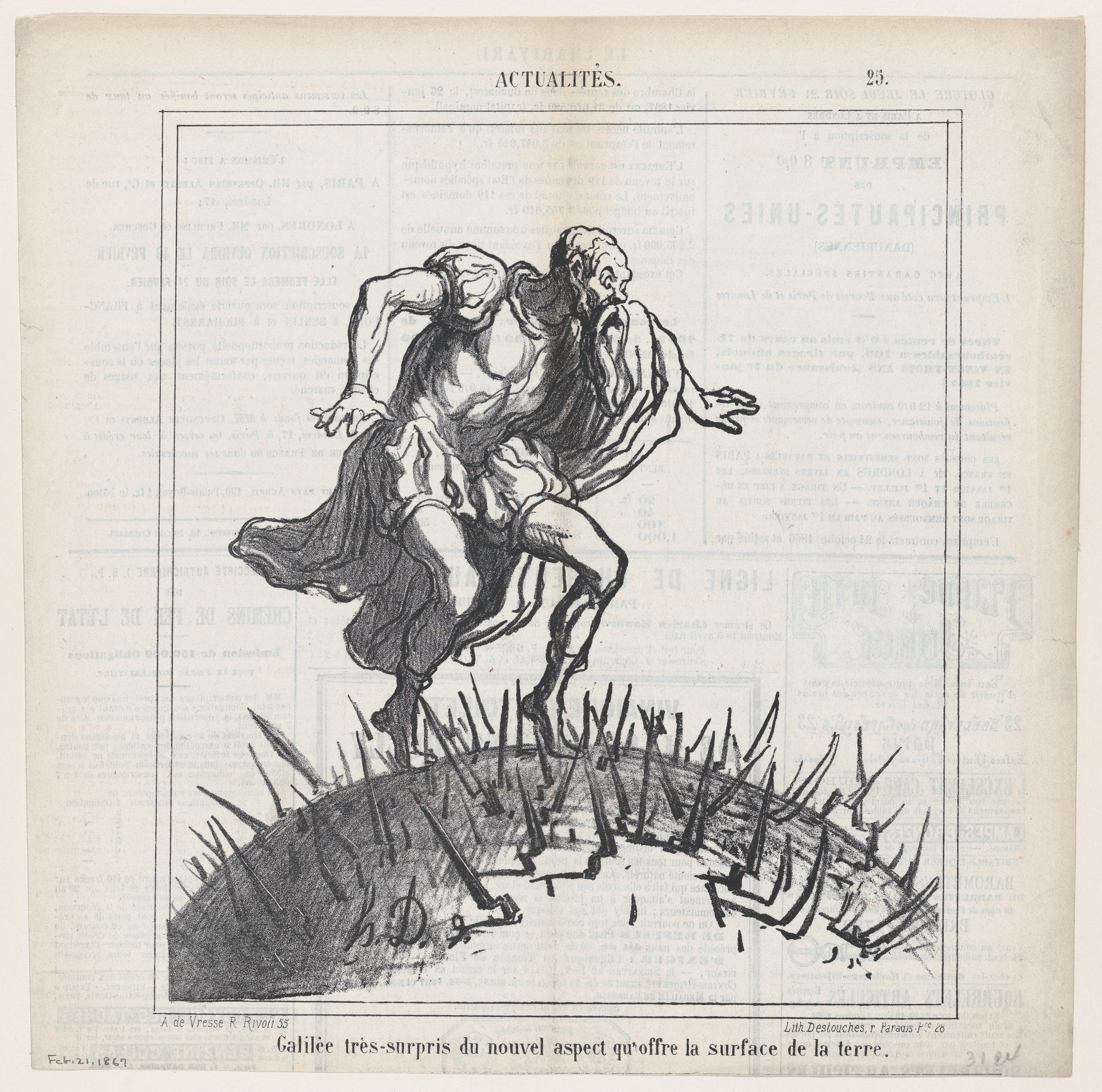
Title: Galileo, astonished by changes in the face of the earth, from "News of the Day"
Description:
Lithograph on newsprint; second state of two (Delteil), News of the Day (Actualités).
Related Results
Sidereus nuncius magna longeque admirabiblia spectacula pandens, suspiciendaque proponens vnicuique praesertim vero philosophis
Sidereus nuncius magna longeque admirabiblia spectacula pandens, suspiciendaque proponens vnicuique praesertim vero philosophis
Galileo Galilei (1564–1642) was an Italian astronomer, mathematician, physicist, philosopher, and inventor. He revolutionized the sciences in the Western world by using mathematics...
Galileo Galilei (1564-1642), after Justus Suttermans (1597-1681)
Galileo Galilei (1564-1642), after Justus Suttermans (1597-1681)
Harvard owns another portrait of Galileo, also copied from the Sustermanns original. See object number H182. The original painting by Justus Suttermans is in the Uffizi Gallery, Fl...
Galileo Galilei (1564-1642), after Justus Suttermans
Galileo Galilei (1564-1642), after Justus Suttermans
The original portrait of Galileo by Sustermanns is in the Uffizi Museum, Florence....
Warrior with double armor. Sculptural group of Cerrillo Blanco (Porcuna, Jaén, Spain)
Warrior with double armor. Sculptural group of Cerrillo Blanco (Porcuna, Jaén, Spain)
A round-lumped sculpture made of white calcarenite representing a warrior. She’s the only one in the group that keeps her face. The head is of square proportions, with torn eyes of...
Caetra held with hand. Sculptural group of Cerrillo Blanco (Porcuna, Jaén, Spain)
Caetra held with hand. Sculptural group of Cerrillo Blanco (Porcuna, Jaén, Spain)
Sculpture fragment in round bulk. Known as “Caetra asida por mano” It represents a fairly well preserved caetra and a hand that grabs it by its handle. On the inside face, the caet...