
Search engine for discovering works of Art, research articles, and books related to Art and Culture


Javascript must be enabled to continue!
Supper at Emmaus
View through National Gallery of Denmark
The Bible relates the story of two disciples who travelled from Jerusalem to the town of Emmaus following the death of Christ. During their travels they meet a stranger who joins them. When arriving at the town they go to an inn where Christ – for it is he – takes the bread, blesses it and breaks it. Only then do the disciples realise that the stranger is Christ risen from the dead. The divinity of Christ is revealed This scene shows the moment where the divinity of Christ is revealed to the disciples (Luke 24: 30-31). Their fright and reverence contrast sharply with the calm and serene demeanour of Christ. The painting's symbolic light With his characteristic use of symbolic light, Rembrandt lets Christ light up the dark space lit by a candle brought in by an unsuspecting kitchen hand. The illusionistic curtain painted in the left-hand side of the picture has been drawn back, accentuating how the scene represents the unveiling of a miracle. The authenticity of the painting The authenticity of this picture has been the object of some debate in recent decades. Many factors indicate that it was painted by assistants in Rembrandt’s workshop on the basis of studies by the master and under his supervision.
Værkdatering: 1648
signaturen er ikke autentisk, se Rembrandt? Mesteren og hans værksted, udstillingskatalog, SMK 2006, s. 90 og note 135 s. 103
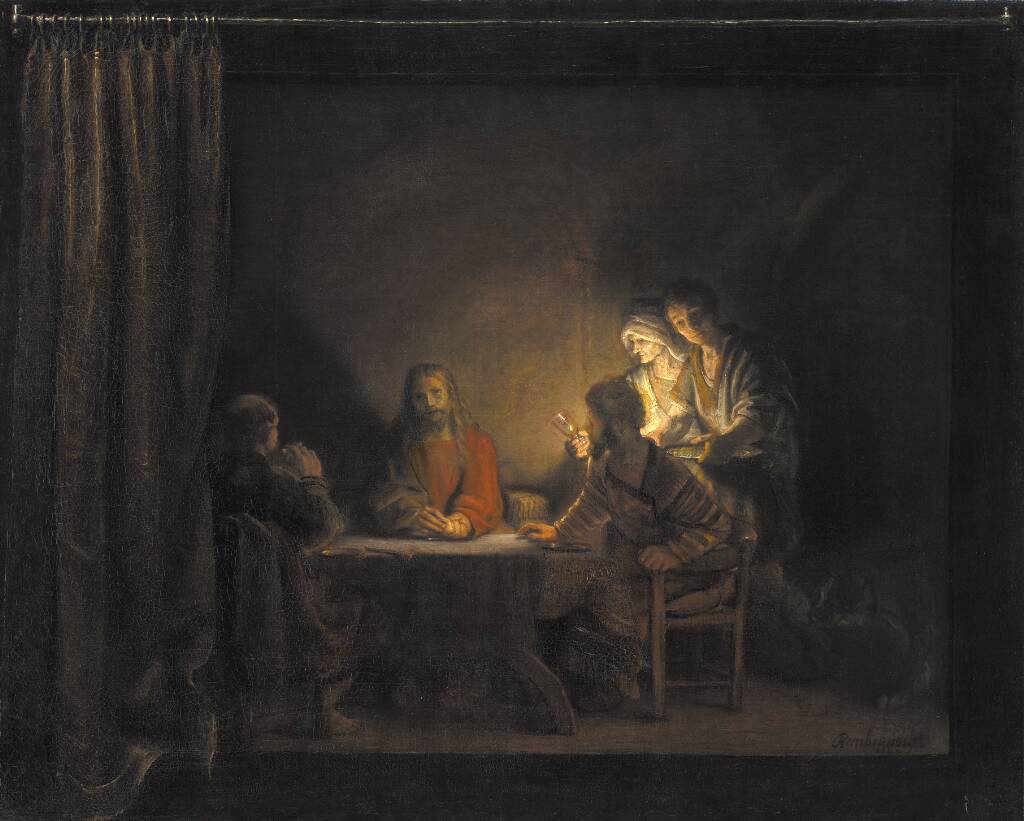
Title: Supper at Emmaus
Description:
The Bible relates the story of two disciples who travelled from Jerusalem to the town of Emmaus following the death of Christ.
During their travels they meet a stranger who joins them.
When arriving at the town they go to an inn where Christ – for it is he – takes the bread, blesses it and breaks it.
Only then do the disciples realise that the stranger is Christ risen from the dead.
The divinity of Christ is revealed This scene shows the moment where the divinity of Christ is revealed to the disciples (Luke 24: 30-31).
Their fright and reverence contrast sharply with the calm and serene demeanour of Christ.
The painting's symbolic light With his characteristic use of symbolic light, Rembrandt lets Christ light up the dark space lit by a candle brought in by an unsuspecting kitchen hand.
The illusionistic curtain painted in the left-hand side of the picture has been drawn back, accentuating how the scene represents the unveiling of a miracle.
The authenticity of the painting The authenticity of this picture has been the object of some debate in recent decades.
Many factors indicate that it was painted by assistants in Rembrandt’s workshop on the basis of studies by the master and under his supervision.
Related Results
Dinner in Emmaus - Supper at Emmaus
Dinner in Emmaus - Supper at Emmaus
Caravaggio painted the Supper at Emmaus between 1605 and 1606, that is to say between the end of his stay in Rome and his flight from the city following his conviction for murder. ...
The Last Supper
The Last Supper
Wool silk silver-gilt silver thread (18-19 warps per inch 7-8 per cm.)...
Supper at Emmaus (Christ at Emmaus)
Supper at Emmaus (Christ at Emmaus)
NOTE:
LIT: Rusina, Ivan - Zervan, Marian: Stories of the New Testament - iconography. Bratislava: SNG, 2000, p. 234-235;
Rusina, Ivan. Masterpieces of Nizozem art in Slovakia. B...
The Supper at Emmaus
The Supper at Emmaus
The life and artistic personality of this artist from Amersfoort were reconstructed in the 20th century on the basis of a series of documents and scholarly studies that were publis...
The Children's Supper
The Children's Supper
Paul Sérusier, primogenitor of the Nabi group of Symbolist painters, was born in Paris on November, 1864. Raised in an affluent, bourgeois household, Sérusier attended the best sch...
X-radiograph(s) of "Christ at Emmaus"
X-radiograph(s) of "Christ at Emmaus"
X-Radiograph Description: 2 details
Burroughs Number: 1875
X-Radiograph(s) of:
Artist: Tiepolo, Giovanni Battista, Italian, 1696-1770
Title: Christ at Emmaus
Owner: Louvr...
X-radiograph(s) of "Christ at Emmaus"
X-radiograph(s) of "Christ at Emmaus"
Burroughs Number: 1968
X-Radiograph(s) of:
Artist: Velazquez, Diego, Spanish, 1599-1660
Title: Christ at Emmaus
Date: ca.1620
Owner: Metropolitan Museum, New York
Object N...