
Search engine for discovering works of Art, research articles, and books related to Art and Culture


Javascript must be enabled to continue!
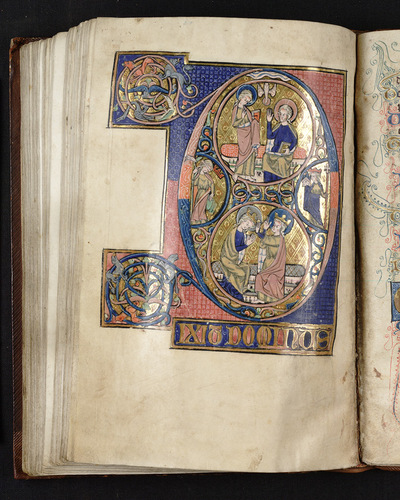
Trinity and Coronation of the Virgin (Psalm 109), in the Huth Psalter
View through Europeana Collections
Named for its donor, the Huth Psalter reveals its
origin by listing in its calendar of feasts and litany Saints Hugh,
Wilfrid, and John of Beverly: all associated with Lincoln or York.
Medieval psalters could be used publicly in the liturgy or
privately as a prayerbook, with decoration, calendar and added
prayers tailored for the use of an individual or community. Unusual
features of its illuminations give vivid impressions of
contemporary concerns and devotional practices.Psalm 109's opening
initial is unusual in pairing the enthroned Trinity (top) with a
conventional Coronation of the Virgin. To either side stand
personifications of Judaism (Synagoga) and the Church (Ecclesia).
Blindfolded Synagoga's crown falls from her bowed head while
Ecclesia peers at the coronation, emphasising the hard-line
attitude of that age in which Christianity's vision of the divine
relegated Judaism.
Title: Trinity and Coronation of the Virgin (Psalm 109), in the
Huth Psalter
Description:
Named for its donor, the Huth Psalter reveals its
origin by listing in its calendar of feasts and litany Saints Hugh,
Wilfrid, and John of Beverly: all associated with Lincoln or York.
Medieval psalters could be used publicly in the liturgy or
privately as a prayerbook, with decoration, calendar and added
prayers tailored for the use of an individual or community.
Unusual
features of its illuminations give vivid impressions of
contemporary concerns and devotional practices.
Psalm 109's opening
initial is unusual in pairing the enthroned Trinity (top) with a
conventional Coronation of the Virgin.
To either side stand
personifications of Judaism (Synagoga) and the Church (Ecclesia).
Blindfolded Synagoga's crown falls from her bowed head while
Ecclesia peers at the coronation, emphasising the hard-line
attitude of that age in which Christianity's vision of the divine
relegated Judaism.
Related Results
October, in the Huth Psalter
October, in the Huth Psalter
Named for its donor, the Huth Psalter reveals its
origin by listing in its calendar of feasts and litany Saints Hugh,
Wilfrid, and John of Beverly?all associated with Lincoln or Yo...
Second Coming and Last Judgement, in the Huth
Psalter
Second Coming and Last Judgement, in the Huth
Psalter
Named for its donor, the Huth Psalter reveals its
origin by listing in its calendar of feasts and litany Saints Hugh,
Wilfrid, and John of Beverly?all associated with Lincoln or Yo...
Crucifixion, The Arundel Psalter f.52v
Crucifixion, The Arundel Psalter f.52v
Probably made at Winchester, although it is not
certain by or for which religious house there, the Arundel Psalter
seems to have been a personal prayerbook. Throughout the middle
a...
painting (oil): ["Rest on the Flight Into Egypt"]
painting (oil): ["Rest on the Flight Into Egypt"]
Angels hovering overhead or bringing food on dishes are a common feature of the subject of the rest (or repose) on the flight to Egypt, where Joseph took Jesus and his mother to es...
The Virgin and the Child between Angels
The Virgin and the Child between Angels
This anonymous painter worked in the city of Bruges, as we can tell from the depictions of the city that appear in some of the backgrounds of his paintings. His name is derived fro...
The Coronation of the Virgin with five Angels
The Coronation of the Virgin with five Angels
This panel depicting The Coronation of the Virgin remained unpublished until its inclusion in the 1930 Munich exhibition of paintings from the Collection, appearing in the catalogu...
Diptych with symbols of the Virgin and Redeeming Christ: Virgin and Child in the Hortus Conclusus (Left wing)
Diptych with symbols of the Virgin and Redeeming Christ: Virgin and Child in the Hortus Conclusus (Left wing)
This pair of panels formed part of a large ensemble of which the other subjects are now unknown. Within the Museum’s collection they are among the most iconographically interesting...