
Search engine for discovering works of Art, research articles, and books related to Art and Culture



Javascript must be enabled to continue!
Foil
View through Europeana Collections
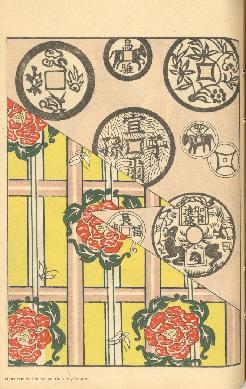
The design is divided diagonally and asymmetrically into two parts; the lower part shows flowers and butterflies on a grid of reeds and a yellow background, while the upper part shows a series of eight different amulets. The two amulets in the upper corners are anepigraphic; the one on the left shows schematic representations of the four elements, (from top to bottom, clockwise: air, fire, earth and water) while the one on the right is decorated with stylized vegetal motifs. Between them we see a small amulet with the figure of a horse and, from top to bottom, the ideograms ma zhui (or wu zhui, in Chinese; uma sui in Japanese), dark horse. \A little further down there is another amulet with an ox, and another one, decorated with a simple rhombus (which could perhaps be the reverse of the previous one). On the ox of this amulet we can read the ideogram wang, king. To the left of the ox is one of the two main pieces of the composition, a large epigraphic amulet with a wave background. The inscription reads yi'er zisun in Chinese and yoore shison in Japanese, [it is] right for you [to have many] descendants. Just below this is a smaller amulet, also epigraphic, but with a plain background. Although the irregular design of the plate does not allow us to see the lower ideogram, we can deduce that it is the phrase changming fugui in Chinese, chomei fuki in Japanese: long life, riches and honors. Finally, at the bottom right is the most colorful and complex amulet, with the inscription jiaguan jinlu (kakan shiroku in Japanese) or, in other words, promotion in an official position and salary increase. In addition to ideograms, the amulet features a deer, a monkey, and other symbols, all alluding to happiness, wealth, and prosperity in the workplace. \The red flowers of the peony, which became so popular in Spain through Manila shawls, came to the Japanese imagination from China long before, in the eighth century. Symbol of good luck and prosperity, they soon became a favorite flower of painters and textile artisans. Like the ancient Greeks and after them the Romans, the Japanese made butterflies symbols of the soul, but Japanese butterflies, instead of undergoing harsh trials before being reunited with Eros, bring happiness and long life on their wings. \All the amulets that appear in the plate are monetiform, that is to say, they have the same round shape with central hole of the oriental coins, although they do not present the same inscriptions as the coins, but a series of images and brief texts of good omen. These are not the inventions of the Japanese designer of the book, but are, as far as we know, actual amulets, Chinese pieces made in the Song Dynasty (960-1279). \Books of this type were known in Japan as hinagata-bon (literally, books of beautiful forms), and began to be printed as early as the late 16th century so that customers could choose designs for their clothes. They usually showed an entire kimono per page, and their features remained unchanged with little change until the early 19th century. By the Meiji period (1868-1912), to which our books belong, the hinagata-bon had become more formally daring, often showing designs asymmetrically and partially. These compendiums of textile motifs were changed every spring and autumn, and copies of the previous collection were resold on the second-hand market. Some came to the attention of Westerners, and thus a number of hinagata-bon have ended up in European and American collections, including that of the Costume Museum Library. \This wonderful five-volume series of designs entitled Nihon or Nippon, i.e. Japan, is curiously anonymous; there is no record of place of publication, date or publisher. However, its characteristics suggest that it was printed in Kyoto in the early years of the 20th century.
Title: Foil
Description:
The design is divided diagonally and asymmetrically into two parts; the lower part shows flowers and butterflies on a grid of reeds and a yellow background, while the upper part shows a series of eight different amulets.
The two amulets in the upper corners are anepigraphic; the one on the left shows schematic representations of the four elements, (from top to bottom, clockwise: air, fire, earth and water) while the one on the right is decorated with stylized vegetal motifs.
Between them we see a small amulet with the figure of a horse and, from top to bottom, the ideograms ma zhui (or wu zhui, in Chinese; uma sui in Japanese), dark horse.
\A little further down there is another amulet with an ox, and another one, decorated with a simple rhombus (which could perhaps be the reverse of the previous one).
On the ox of this amulet we can read the ideogram wang, king.
To the left of the ox is one of the two main pieces of the composition, a large epigraphic amulet with a wave background.
The inscription reads yi'er zisun in Chinese and yoore shison in Japanese, [it is] right for you [to have many] descendants.
Just below this is a smaller amulet, also epigraphic, but with a plain background.
Although the irregular design of the plate does not allow us to see the lower ideogram, we can deduce that it is the phrase changming fugui in Chinese, chomei fuki in Japanese: long life, riches and honors.
Finally, at the bottom right is the most colorful and complex amulet, with the inscription jiaguan jinlu (kakan shiroku in Japanese) or, in other words, promotion in an official position and salary increase.
In addition to ideograms, the amulet features a deer, a monkey, and other symbols, all alluding to happiness, wealth, and prosperity in the workplace.
\The red flowers of the peony, which became so popular in Spain through Manila shawls, came to the Japanese imagination from China long before, in the eighth century.
Symbol of good luck and prosperity, they soon became a favorite flower of painters and textile artisans.
Like the ancient Greeks and after them the Romans, the Japanese made butterflies symbols of the soul, but Japanese butterflies, instead of undergoing harsh trials before being reunited with Eros, bring happiness and long life on their wings.
\All the amulets that appear in the plate are monetiform, that is to say, they have the same round shape with central hole of the oriental coins, although they do not present the same inscriptions as the coins, but a series of images and brief texts of good omen.
These are not the inventions of the Japanese designer of the book, but are, as far as we know, actual amulets, Chinese pieces made in the Song Dynasty (960-1279).
\Books of this type were known in Japan as hinagata-bon (literally, books of beautiful forms), and began to be printed as early as the late 16th century so that customers could choose designs for their clothes.
They usually showed an entire kimono per page, and their features remained unchanged with little change until the early 19th century.
By the Meiji period (1868-1912), to which our books belong, the hinagata-bon had become more formally daring, often showing designs asymmetrically and partially.
These compendiums of textile motifs were changed every spring and autumn, and copies of the previous collection were resold on the second-hand market.
Some came to the attention of Westerners, and thus a number of hinagata-bon have ended up in European and American collections, including that of the Costume Museum Library.
\This wonderful five-volume series of designs entitled Nihon or Nippon, i.
e.
Japan, is curiously anonymous; there is no record of place of publication, date or publisher.
However, its characteristics suggest that it was printed in Kyoto in the early years of the 20th century.
Related Results
Evening dress, knitted foil tape, designed by Craig Lawrence, London, 2011. Evening dress, knitted with gold and silver metallic tape. Full length and with plated straps. The structure is an internal knitted tube with long loose ends projecting from the e
Evening dress, knitted foil tape, designed by Craig Lawrence, London, 2011. Evening dress, knitted with gold and silver metallic tape. Full length and with plated straps. The structure is an internal knitted tube with long loose ends projecting from the e
Evening dress, knitted foil tape, designed by Craig Lawrence, London, 2011. Evening dress, knitted with gold and silver metallic tape. Full length and with plated straps. The struc...
Huang Chih-Cheng 黃至正, Dance (2024)
Huang Chih-Cheng 黃至正, Dance (2024)
Embroidery, ink, pigment ink and watercolor on gold foil, copper foil, silver foil, aluminum foil, mulberry paper and jangji paper., 78 × 53 cm...
Pendant, 'The Love Cup', enamel with foil on copper, set in gold, with an enamel tear drop, Edinburgh, 1902. Enamel with foil on copper, set in gold, with an enamel tear drop.
Pendant, 'The Love Cup', enamel with foil on copper, set in gold, with an enamel tear drop, Edinburgh, 1902. Enamel with foil on copper, set in gold, with an enamel tear drop.
Pendant, 'The Love Cup', enamel with foil on copper, set in gold, with an enamel tear drop, Edinburgh, 1902. Enamel with foil on copper, set in gold, with an enamel tear drop....
Huang Chih-Cheng 黃至正, FengMei (2024)
Huang Chih-Cheng 黃至正, FengMei (2024)
Embroidery, ink, pigment ink and watercolor on gold foil, copper foil, silver foil, sulphide silver leaves and jangji paper., 82 × 58 cm...
Huang Chih-Cheng 黃至正, Conciliation (2024)
Huang Chih-Cheng 黃至正, Conciliation (2024)
Embroidery, ink, pigment ink and watercolor on copper foil, silver foil, aluminum foil, sulphide silver leaves, mulberry paper and jangji paper ., 107 × 79 cm...
Sunil Das, Acrylic Foil Burn, Metal Screens, Acrylic Paint, Metal Wire on Board, Red, Black (each artwork) (Set of 2 works) by Master Indian Artist "In Stock" (1994)
Sunil Das, Acrylic Foil Burn, Metal Screens, Acrylic Paint, Metal Wire on Board, Red, Black (each artwork) (Set of 2 works) by Master Indian Artist "In Stock" (1994)
Acrylic Foil Burn, Metal Screens, Acrylic Paint, Metal Wire on Board, 6 × 6 in...
Pilgrim's Banner
Pilgrim's Banner
This object is derived from the Ottoman shield-shaped banners known as "sanjak." The decorative program consists of Arabic inscriptions enhanced with talismanic emblems and floral ...