
Search engine for discovering works of Art, research articles, and books related to Art and Culture



Javascript must be enabled to continue!
Foil
View through Europeana Collections
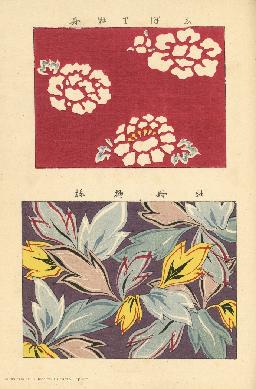
Two designs arranged horizontally, in the upper one, on the intense red three flowers of peonies in white; in the lower one, on a purple background, leaves in cold colours and yellow. On both designs inscriptions. \The red flowers of the peony, which became so popular in Spain through the Manila shawls, came to the Japanese imagination from China long before, in the eighth century. Symbol of good luck and prosperity, they soon became a favourite flower of painters and textile craftsmen. \Books of this type were known in Japan as hinagata-bon (literally, books of beautiful forms), and began to be printed as early as the late 16th century so that customers could choose designs for their clothes. They usually showed an entire kimono per page, and their features remained unchanged with little change until the early 19th century. By the Meiji period (1868-1912), to which our books belong, the hinagata-bon had become more formally daring, and often showed designs asymmetrically and partially. These compendiums of textile motifs were changed every spring and autumn, and copies of the previous collection were resold on the second-hand market. Some came to the attention of Westerners, and thus a number of hinagata-bon have ended up in European and American collections, including that of the Costume Museum Library. \nHasegawa became famous for his floral designs, especially of chrysanthemums, the flowers associated with the Japanese imperial household. In honor of his fame, in our book Keika Zuan, Designs of Kyoto, the author, instead of using the usual name of the city, uses the formula Keika, the capital of flowers. The first ideogram remains the same, but it is read differently, and instead of the usual to, capital, we find ka, flower. This gives rise to a play on words, since this appellation of Kyoto is read the same as the author's own first name, although the first ideogram is different.
Title: Foil
Description:
Two designs arranged horizontally, in the upper one, on the intense red three flowers of peonies in white; in the lower one, on a purple background, leaves in cold colours and yellow.
On both designs inscriptions.
\The red flowers of the peony, which became so popular in Spain through the Manila shawls, came to the Japanese imagination from China long before, in the eighth century.
Symbol of good luck and prosperity, they soon became a favourite flower of painters and textile craftsmen.
\Books of this type were known in Japan as hinagata-bon (literally, books of beautiful forms), and began to be printed as early as the late 16th century so that customers could choose designs for their clothes.
They usually showed an entire kimono per page, and their features remained unchanged with little change until the early 19th century.
By the Meiji period (1868-1912), to which our books belong, the hinagata-bon had become more formally daring, and often showed designs asymmetrically and partially.
These compendiums of textile motifs were changed every spring and autumn, and copies of the previous collection were resold on the second-hand market.
Some came to the attention of Westerners, and thus a number of hinagata-bon have ended up in European and American collections, including that of the Costume Museum Library.
\nHasegawa became famous for his floral designs, especially of chrysanthemums, the flowers associated with the Japanese imperial household.
In honor of his fame, in our book Keika Zuan, Designs of Kyoto, the author, instead of using the usual name of the city, uses the formula Keika, the capital of flowers.
The first ideogram remains the same, but it is read differently, and instead of the usual to, capital, we find ka, flower.
This gives rise to a play on words, since this appellation of Kyoto is read the same as the author's own first name, although the first ideogram is different.
Related Results
Evening dress, knitted foil tape, designed by Craig Lawrence, London, 2011. Evening dress, knitted with gold and silver metallic tape. Full length and with plated straps. The structure is an internal knitted tube with long loose ends projecting from the e
Evening dress, knitted foil tape, designed by Craig Lawrence, London, 2011. Evening dress, knitted with gold and silver metallic tape. Full length and with plated straps. The structure is an internal knitted tube with long loose ends projecting from the e
Evening dress, knitted foil tape, designed by Craig Lawrence, London, 2011. Evening dress, knitted with gold and silver metallic tape. Full length and with plated straps. The struc...
Huang Chih-Cheng 黃至正, Dance (2024)
Huang Chih-Cheng 黃至正, Dance (2024)
Embroidery, ink, pigment ink and watercolor on gold foil, copper foil, silver foil, aluminum foil, mulberry paper and jangji paper., 78 × 53 cm...
Pendant, 'The Love Cup', enamel with foil on copper, set in gold, with an enamel tear drop, Edinburgh, 1902. Enamel with foil on copper, set in gold, with an enamel tear drop.
Pendant, 'The Love Cup', enamel with foil on copper, set in gold, with an enamel tear drop, Edinburgh, 1902. Enamel with foil on copper, set in gold, with an enamel tear drop.
Pendant, 'The Love Cup', enamel with foil on copper, set in gold, with an enamel tear drop, Edinburgh, 1902. Enamel with foil on copper, set in gold, with an enamel tear drop....
Huang Chih-Cheng 黃至正, FengMei (2024)
Huang Chih-Cheng 黃至正, FengMei (2024)
Embroidery, ink, pigment ink and watercolor on gold foil, copper foil, silver foil, sulphide silver leaves and jangji paper., 82 × 58 cm...
Huang Chih-Cheng 黃至正, Conciliation (2024)
Huang Chih-Cheng 黃至正, Conciliation (2024)
Embroidery, ink, pigment ink and watercolor on copper foil, silver foil, aluminum foil, sulphide silver leaves, mulberry paper and jangji paper ., 107 × 79 cm...
Sunil Das, Acrylic Foil Burn, Metal Screens, Acrylic Paint, Metal Wire on Board, Red, Black (each artwork) (Set of 2 works) by Master Indian Artist "In Stock" (1994)
Sunil Das, Acrylic Foil Burn, Metal Screens, Acrylic Paint, Metal Wire on Board, Red, Black (each artwork) (Set of 2 works) by Master Indian Artist "In Stock" (1994)
Acrylic Foil Burn, Metal Screens, Acrylic Paint, Metal Wire on Board, 6 × 6 in...
Pilgrim's Banner
Pilgrim's Banner
This object is derived from the Ottoman shield-shaped banners known as "sanjak." The decorative program consists of Arabic inscriptions enhanced with talismanic emblems and floral ...