
Search engine for discovering works of Art, research articles, and books related to Art and Culture


Javascript must be enabled to continue!
Urban Memories and Countryside Mirrors: A History of Romani Performing Arts by Miguel Angel Vargas
View through Europeana Collections
Abstract:
Raising the question of when can we start talking about Romani Performing Arts beyond Romani performers and Romani characters, help us build an international reading of the crucial variety of national examples of Romani performers from Turkey to USA, in a crossed chronology. Connecting influences of the different contexts we learn about the capacity of Romani artistic agency to break genre limits and adapt the public discourses of alterity. A real trip from the dawn of modernity to the challenges of XXI Century, with examples including the Romani Turkish Puppet tradition, the Spanish Golden Age Theater and the XIX Century Teatro Gitanesco, the Royal masquerades in France, the Roma Slave Jesters in Walachia and Moldavia, the work with animals in Roma circuses and bullfighting, fairs and carnivals, the theatricality of different Roma religious traditions, the experiences of XIX and XX century international exhibitions and the relation between institutionalised and independent theatre companies. Though the remains of texts and the imagery created for and associated with Roma performing arts artists, we reflect on the space that theatrical fiction and representation might have in the questioning of XXI Century Romani identities.
Bavarlipe Roma Online University is an online educational platform where Roma and non-Roma can access knowledge about the Roma identity(ies), history(ies) and culture(s) thorough a collection of high-quality lectures delivered by leading Roma scholars on topics ranging from the Roma Holocaust to Roma cultural productions. In partnership with Central European University (CEU), this project is part of ERIAC’s Roma Cultural History Initiative financed by the German Federal Foreign Office (FFO).
European Roma Institute for Arts and Culture
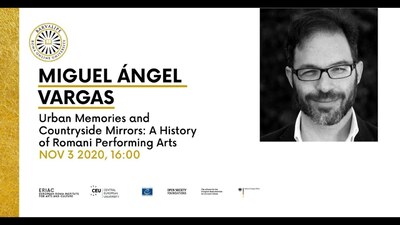
Title: Urban Memories and Countryside Mirrors: A History of Romani Performing Arts by Miguel Angel Vargas
Description:
Abstract:
Raising the question of when can we start talking about Romani Performing Arts beyond Romani performers and Romani characters, help us build an international reading of the crucial variety of national examples of Romani performers from Turkey to USA, in a crossed chronology.
Connecting influences of the different contexts we learn about the capacity of Romani artistic agency to break genre limits and adapt the public discourses of alterity.
A real trip from the dawn of modernity to the challenges of XXI Century, with examples including the Romani Turkish Puppet tradition, the Spanish Golden Age Theater and the XIX Century Teatro Gitanesco, the Royal masquerades in France, the Roma Slave Jesters in Walachia and Moldavia, the work with animals in Roma circuses and bullfighting, fairs and carnivals, the theatricality of different Roma religious traditions, the experiences of XIX and XX century international exhibitions and the relation between institutionalised and independent theatre companies.
Though the remains of texts and the imagery created for and associated with Roma performing arts artists, we reflect on the space that theatrical fiction and representation might have in the questioning of XXI Century Romani identities.
Bavarlipe Roma Online University is an online educational platform where Roma and non-Roma can access knowledge about the Roma identity(ies), history(ies) and culture(s) thorough a collection of high-quality lectures delivered by leading Roma scholars on topics ranging from the Roma Holocaust to Roma cultural productions.
In partnership with Central European University (CEU), this project is part of ERIAC’s Roma Cultural History Initiative financed by the German Federal Foreign Office (FFO).
Related Results
Small Circular Mirror with Loop Handle and Geometric Decor in Relief
Small Circular Mirror with Loop Handle and Geometric Decor in Relief
This small circular bronze mirror is slightly irregular in shape and decorated very simply, with radiating lines raised in relief around the central loop handle. Although now cover...
The Meeting of Tamar and Judah
The Meeting of Tamar and Judah
To judge from their similar style and dimensions, these two canvases should be considered a pair, both depicting Old Testament scenes. They were formerly in the Watney collection i...
The Annunciation to Manoah's Wife
The Annunciation to Manoah's Wife
To judge from their similar style and dimensions, these two canvases should be considered a pair, both depicting Old Testament scenes. They were formerly in the Watney collection i...
Exhibition | Romani Language #2
Exhibition | Romani Language #2
Speech by Mihaela Zatreanu, Romani language expert, during the opening of the exhibition "Romani Čhib" (November 2021 - March 2022)...
Section of the Emissarium at Lake Albano with inset views, tab. 30 from "Della Magnificenza e d'Architettura de'Romani" (On the Grandeur and the Architecture of the Romans by Gio. Battista Piranesi, Fellow of the Royal Society of Antiquaries of London)
Section of the Emissarium at Lake Albano with inset views, tab. 30 from "Della Magnificenza e d'Architettura de'Romani" (On the Grandeur and the Architecture of the Romans by Gio. Battista Piranesi, Fellow of the Royal Society of Antiquaries of London)
Etching, Della Magnificenza e d'Architettura de'Romani...
Della Magnificenza e d'Architettura de' Romani (On the Grandeur and the Architecture of the Romans by Gio. Battista Piranesi, Fellow of the Royal Society of Antiquaries of London)
Della Magnificenza e d'Architettura de' Romani (On the Grandeur and the Architecture of the Romans by Gio. Battista Piranesi, Fellow of the Royal Society of Antiquaries of London)
Etchings and engravings, Della Magnificenza e d'Architettura de'Romani...
Plate 17: The Arch of Rimini built by Augustus (Arco di Rimino fabbricato da Augusto), from "Alcune Vedute di Archi Trionfali ed altri monumenti inalzati da Romani parte di quali se veggono in Roma e parte per l'Italia"
Plate 17: The Arch of Rimini built by Augustus (Arco di Rimino fabbricato da Augusto), from "Alcune Vedute di Archi Trionfali ed altri monumenti inalzati da Romani parte di quali se veggono in Roma e parte per l'Italia"
Etching, Alcune Vedute di Archi Trionfali ed altri monumenti inalzati da Romani parte di quali se veggono in Roma e parte per l'Italia (Some Views of Triumphal Arches and other mon...
Plate 18: The Tomb of the Scipios (Sepolcro della famiglia de' Scipioni), from "Alcune Vedute di Archi Trionfali ed altri monumenti inalzati da Romani parte di quali se veggono in Roma e parte per l'Italia"
Plate 18: The Tomb of the Scipios (Sepolcro della famiglia de' Scipioni), from "Alcune Vedute di Archi Trionfali ed altri monumenti inalzati da Romani parte di quali se veggono in Roma e parte per l'Italia"
Etching, Alcune Vedute di Archi Trionfali ed altri monumenti inalzati da Romani parte di quali se veggono in Roma e parte per l'Italia (Some Views of Triumphal Arches and other mon...