
Search engine for discovering works of Art, research articles, and books related to Art and Culture


Javascript must be enabled to continue!
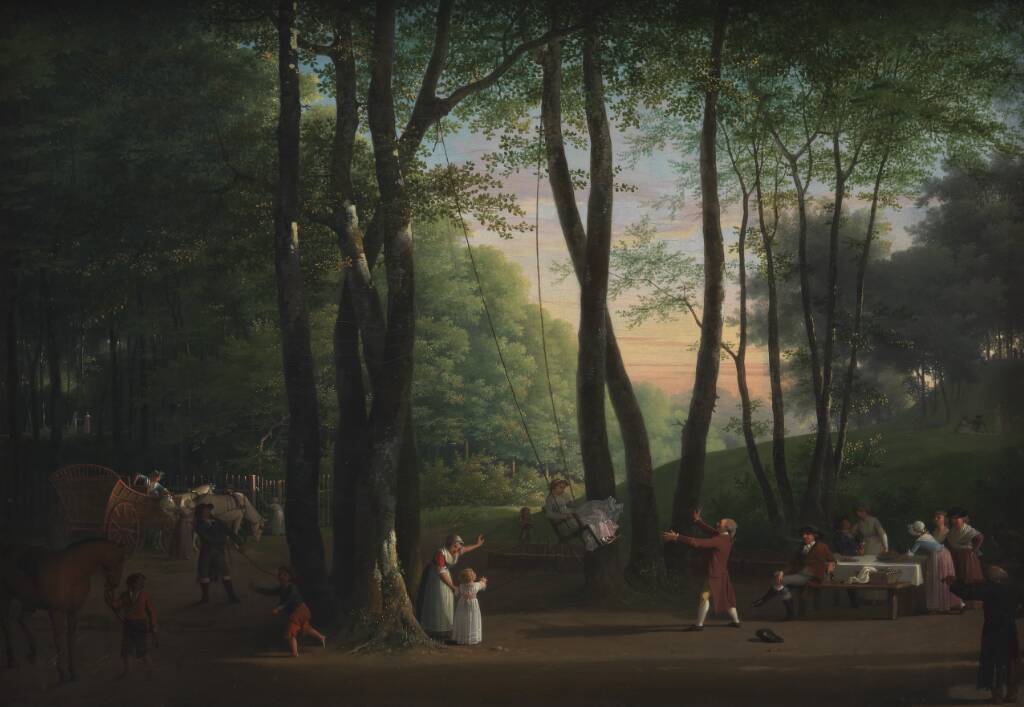
The Dancing Glade at Sorgenfri, North of Copenhagen
View through National Gallery of Denmark
At the end of the 18th century a new pastime became popular among the citizens of Copenhagen: outings to the Dancing Glade at Sorgenfri Palace north of Copenhagen. Here, the crowds would picnic, relax, and while away time playing games. Juel captures one of these carefree events.
The central motif: The woman in the swing
To the left a party is climbing out of their carriage while several other celebrants have already made themselves comfortable at one of the tables or in a clearing between the trees. The central motif is the woman in the swing, who introduces movement to the picture and brings the composition together. During the period immediately preceding this time, the Rococo, women in swings appeared in a great many paintings, always with a hint of eroticism as the skirts fluttered around their legs. Juel’s painting has no such erotic undertones.
A middle-class idyll
The scene is a middle-class idyll where city dwellers take a rest from the frantic pace of their everyday lives. In this respect the painting points towards the next major period in Danish painting, the so-called Golden Age, where life was very much seen through the eyes of the industrious middle classes. As in several others of Juel’s pictures from around 1800, the landscape itself occupies a prominent position here.
Title: The Dancing Glade at Sorgenfri, North of Copenhagen
Description:
At the end of the 18th century a new pastime became popular among the citizens of Copenhagen: outings to the Dancing Glade at Sorgenfri Palace north of Copenhagen.
Here, the crowds would picnic, relax, and while away time playing games.
Juel captures one of these carefree events.
The central motif: The woman in the swing
To the left a party is climbing out of their carriage while several other celebrants have already made themselves comfortable at one of the tables or in a clearing between the trees.
The central motif is the woman in the swing, who introduces movement to the picture and brings the composition together.
During the period immediately preceding this time, the Rococo, women in swings appeared in a great many paintings, always with a hint of eroticism as the skirts fluttered around their legs.
Juel’s painting has no such erotic undertones.
A middle-class idyll
The scene is a middle-class idyll where city dwellers take a rest from the frantic pace of their everyday lives.
In this respect the painting points towards the next major period in Danish painting, the so-called Golden Age, where life was very much seen through the eyes of the industrious middle classes.
As in several others of Juel’s pictures from around 1800, the landscape itself occupies a prominent position here.
Related Results
Self-Portrait. The Cottage Spurveskjul at Sorgenfri, North of Copenhagen
Self-Portrait. The Cottage Spurveskjul at Sorgenfri, North of Copenhagen
We see Hammershøi holding a brush, engaged in the act of painting - presumably he is painting this picture of himself. We see a convincing image of a person in a room. But we see s...
Dancing Fairies
Dancing Fairies
The moon illuminates a still landscape through which a river flows sedately. Trees appear as dark silhouettes against the sky. Hand-in-hand, the elves sweep like a wispy mist throu...
Frederik VI av Danmark (1768–1839)
Frederik VI av Danmark (1768–1839)
New acquisitions, November 2016 Five paintings by Christoffer Wilhelm Eckersberg Nationalmuseum has added no fewer than five works by Christoffer Wilhelm Eckersberg to its Danish a...
Karen Margrethe Borch
Karen Margrethe Borch
New acquisitions, November 2016 Five paintings by Christoffer Wilhelm Eckersberg Nationalmuseum has added no fewer than five works by Christoffer Wilhelm Eckersberg to its Danish a...
En ubesmykket Landsknægt-vise om digteren Sorgenfri's hele kompagni (i anledning af 70 års dagen)
En ubesmykket Landsknægt-vise om digteren Sorgenfri's hele kompagni (i anledning af 70 års dagen)
His seventy-year Highness Hans Hartvig celebrated his round day at a royal party, where the well-known spirit and swing chief, the conservative social democrat and literature presa...
Two men and a woman playing cards at a table, one man pressing his nose toward the woman's forehead, from a series of ten scenes of musicians and couples dancing, drinking, playing music, and playing cards
Two men and a woman playing cards at a table, one man pressing his nose toward the woman's forehead, from a series of ten scenes of musicians and couples dancing, drinking, playing music, and playing cards
Engraving, Ten scenes of musicians and couples dancing drinking playing music and playing cards...