
Search engine for discovering works of Art, research articles, and books related to Art and Culture


Javascript must be enabled to continue!
Roy Lichtenstein: Expressionist Woodcuts
View through Artsy
Composed of energetic lines and bright colors, [Roy Lichtenstein](/artist/roy-lichtenstein)’s “Expressionist Heads” (1980) was a breakthrough print series for the Pop artist. The portfolio includes Lichtenstein’s first depictions of nude women and his first use of the woodcut printmaking technique—both of which would feature prominently in his later works. Lichtenstein’s inspiration for “Expressionist Heads” began when he met Robert Rifkind, an avid collector of German Expressionist woodcuts, at a dinner party in Los Angeles in 1978. Rifkind invited Lichtenstein to visit his collection in person, and the artist spent hours studying the jagged, expressive lines of [Ernst Ludwig Kirchner](/artist/ernst-ludwig-kirchner), [Max Pechstein](/artist/max-pechstein), and [Erich Heckel](/artist/erich-heckel) up close. While working on the “Expressionist Heads” woodcuts, Lichtenstein invited Rifkind into the printmaking studio at Gemini G.E.L., allowing the collector a preview of the works that their friendship inspired. Throughout the 1980s, Lichtenstein continued to draw from his research on German Expressionism, incorporating motifs from the movement into a variety of sculptures, prints, and paintings.
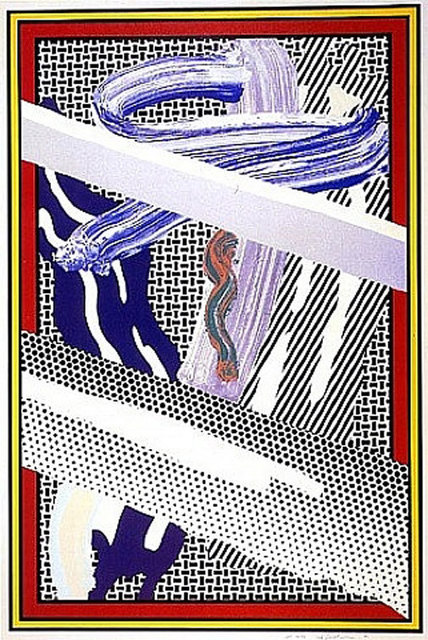
Title: Roy Lichtenstein: Expressionist Woodcuts
Description:
Composed of energetic lines and bright colors, [Roy Lichtenstein](/artist/roy-lichtenstein)’s “Expressionist Heads” (1980) was a breakthrough print series for the Pop artist.
The portfolio includes Lichtenstein’s first depictions of nude women and his first use of the woodcut printmaking technique—both of which would feature prominently in his later works.
Lichtenstein’s inspiration for “Expressionist Heads” began when he met Robert Rifkind, an avid collector of German Expressionist woodcuts, at a dinner party in Los Angeles in 1978.
Rifkind invited Lichtenstein to visit his collection in person, and the artist spent hours studying the jagged, expressive lines of [Ernst Ludwig Kirchner](/artist/ernst-ludwig-kirchner), [Max Pechstein](/artist/max-pechstein), and [Erich Heckel](/artist/erich-heckel) up close.
While working on the “Expressionist Heads” woodcuts, Lichtenstein invited Rifkind into the printmaking studio at Gemini G.
E.
L.
, allowing the collector a preview of the works that their friendship inspired.
Throughout the 1980s, Lichtenstein continued to draw from his research on German Expressionism, incorporating motifs from the movement into a variety of sculptures, prints, and paintings.
Related Results
Roy Lichtenstein: The Surrealist Series
Roy Lichtenstein: The Surrealist Series
In 1977, [Roy Lichtenstein](/artist/roy-lichtenstein) entered his brief but impactful Surrealist period, finding inspiration in the absurdist works of [Salvador Dalí](/artist/salva...
Roy Lichtenstein, Roy Lichtenstein Mirrors 1971 (Roy Lichtenstein Castelli gallery announcement) (1971)
Roy Lichtenstein, Roy Lichtenstein Mirrors 1971 (Roy Lichtenstein Castelli gallery announcement) (1971)
Folding announcement card on smooth wove paper; offset printed., 8 × 10 in...
Red Apple from the Seven Apple Woodcuts Series
Red Apple from the Seven Apple Woodcuts Series
Woodcut printed in five colors, Seven Apple Woodcuts...
Essential Roy Lichtenstein
Essential Roy Lichtenstein
A legendary figure in the Pop art movement, Roy Lichtenstein is best known for transforming the visual language of cartoons into fine art. Whether depicting Mickey Mouse or musical...
Roy Lichtenstein, Nude in the Woods, from Expressionist Woodcuts (G. 882, C. 174) (1980)
Roy Lichtenstein, Nude in the Woods, from Expressionist Woodcuts (G. 882, C. 174) (1980)
Woodcut in colors with embossing, on Arches paper, with full margins., 101.6 × 90.2 cm...
Roy Lichtenstein, Nude in the Woods, from Expressionist Woodcuts (G. 882, C. 174) (1980)
Roy Lichtenstein, Nude in the Woods, from Expressionist Woodcuts (G. 882, C. 174) (1980)
Woodcut in colors with embossing, on Arches Cover paper, with full margins., 39 63/100 × 35 1/2 in...