
Search engine for discovering works of Art, research articles, and books related to Art and Culture


Javascript must be enabled to continue!
skulptur, figur, sculpture
View through Europeana Collections
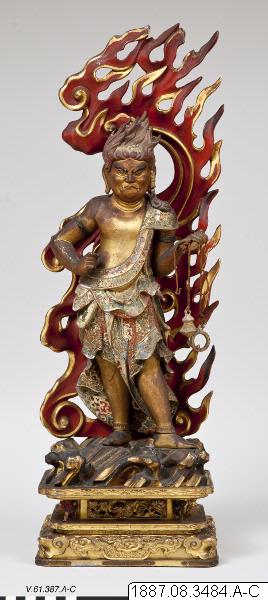
“Fudo-mio-o of wood, richly painted and gilded. In the left hand a snare; the sword of the higher hand is missing. Shear a red firebox.” (The catalogue of the general). Standing Fudo-myo-o with red fireflies behind and standing on cliff, very rich (dragon) patterned costume. His veiled facial expressions show an open and a half-closed eye and his teeth protrude over his lips.
The Fudo figure is the Japanese form of Acala or Arya achalanatha (Sanskrit). Acala means the unruly and Fudo is one of the five light kings in the Shingon sect. He often holds snares in his hands apart from his twisted sword (which is missing here) and these serve to capture those who need his help and in the state after death to be sentenced for his life and to capture Mara, the tempter. He is a legal coffee advocate, a sort of death defense lawyer. White.Schumann, H W. 1986, p 206. According to Edmunds 1934 p 243, he is identifiable with Shiva and he resembles a Dharmapala form of Varjapani, while some identify him with Dai Ichi Nyorai (Vairocana), writes Edmunds. He is the special god of the waterfall. (Edmunds 1934, p 244). His veiled view shows his attitude towards madness, which he is trying to expel. The sword cuts through the evil of the illusory worlds to bring out the real world. The rope can be used to bind the illusory enemy of the Enlightenment. He is also a guardian god for samurai. White.: Smith, L, Harris, C, Clark, T. 1990, p 33. Fudo is one of the five myo-o and his sword can also symbolize wisdom and compassion and with it he can fight the three folly (anger, madness and greed). The rope can also be used to tie those who oppose the Buddha. The Fudo cult became especially popular from the 16th century. His two associates often appearing in the same constellation are Seitaka and Kongara. White.Asiatic Mythology.1932. London, p 425-26. (PH)
Title: skulptur, figur, sculpture
Description:
“Fudo-mio-o of wood, richly painted and gilded.
In the left hand a snare; the sword of the higher hand is missing.
Shear a red firebox.
” (The catalogue of the general).
Standing Fudo-myo-o with red fireflies behind and standing on cliff, very rich (dragon) patterned costume.
His veiled facial expressions show an open and a half-closed eye and his teeth protrude over his lips.
The Fudo figure is the Japanese form of Acala or Arya achalanatha (Sanskrit).
Acala means the unruly and Fudo is one of the five light kings in the Shingon sect.
He often holds snares in his hands apart from his twisted sword (which is missing here) and these serve to capture those who need his help and in the state after death to be sentenced for his life and to capture Mara, the tempter.
He is a legal coffee advocate, a sort of death defense lawyer.
White.
Schumann, H W.
1986, p 206.
According to Edmunds 1934 p 243, he is identifiable with Shiva and he resembles a Dharmapala form of Varjapani, while some identify him with Dai Ichi Nyorai (Vairocana), writes Edmunds.
He is the special god of the waterfall.
(Edmunds 1934, p 244).
His veiled view shows his attitude towards madness, which he is trying to expel.
The sword cuts through the evil of the illusory worlds to bring out the real world.
The rope can be used to bind the illusory enemy of the Enlightenment.
He is also a guardian god for samurai.
White.
: Smith, L, Harris, C, Clark, T.
1990, p 33.
Fudo is one of the five myo-o and his sword can also symbolize wisdom and compassion and with it he can fight the three folly (anger, madness and greed).
The rope can also be used to tie those who oppose the Buddha.
The Fudo cult became especially popular from the 16th century.
His two associates often appearing in the same constellation are Seitaka and Kongara.
White.
Asiatic Mythology.
1932.
London, p 425-26.
(PH).
Related Results
Standing Buddha Shakyamuni in Varada-mudra
Standing Buddha Shakyamuni in Varada-mudra
This sculpture depicts a Buddha gracefully standing on a shallow lotus pedestal, the Buddha likely the Buddha Sakyamuni (the Historical Buddha) though possibly the Buddha Dipankara...
figur, skulptur, snidad figur, sculpture, statue, figure, goam
figur, skulptur, snidad figur, sculpture, statue, figure, goam
The sculpture shows a male figure sitting with his legs pulled under him. He wears a tall, cylindrical headdress that narrows upwards. A snake winds on the front of the sculpture a...
Head of Buddha, probably the Buddha Sakyamuni
Head of Buddha, probably the Buddha Sakyamuni
Carved in gray limestone in Thailand in the seventh or early eighth century, this stone sculpture depicts the head of a Buddha, probably the Buddha Sakyamuni, the Historical Buddha...
regelmäßige Figur (A), unregelmäßige Figur (B), gleichförmige Figuren (EE), gleichgroße Figuren (FF), gleichwinklige Figur (C), gleichseitige Figur (C, D)
regelmäßige Figur (A), unregelmäßige Figur (B), gleichförmige Figuren (EE), gleichgroße Figuren (FF), gleichwinklige Figur (C), gleichseitige Figur (C, D)
DFG technology history (digitalization)...
skulptur, figur, sculpture
skulptur, figur, sculpture
Procession figure (wahana) of cut and painted wood. The sculpture depicts a mythological animal; a clothed snake, naga, with wings. The sculpture is painted red with details in bla...
figur, skulptur, sculpture
figur, skulptur, sculpture
God image. Temple figure of cut and painted wood. The sculpture depicts the dreaded, bare-looking witch Rangda with a bare torso, demon head, long hair and extended tongue.
Accord...
skulptur, figur, sculpture
skulptur, figur, sculpture
God image. Temple figure (arca lingga or pratima) of the shade and painted jati wood (teak, tectonia grandis). According to the catalogue general, the sculpture shows Pandji, a fig...