
Search engine for discovering works of Art, research articles, and books related to Art and Culture


Javascript must be enabled to continue!
figur, skulptur, sculpture
View through Europeana Collections
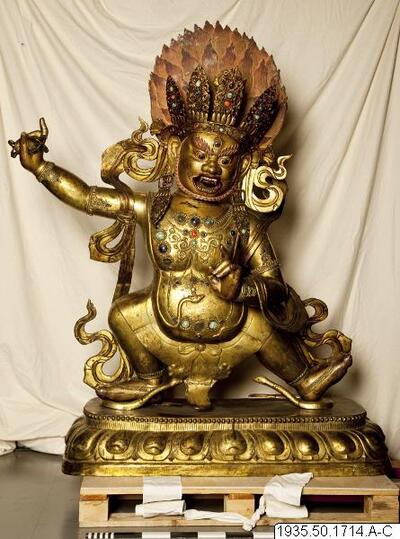
Function: Statue of Vajrapani, a major Mahayana Bodhisattva, to be placed in a temple hall, preferably at its entrance since he is variously fierce and compassionate. He appears as a defender of the Buddhist doctrine and is also associated with the removal of obstacles. In the triad where Avalokiteshvara stands for compassion and Manjushri for wisdom, he symbolizes power. The statue represents what could be called Sino-Tibetan or Sino-Mongolian religious art. It illustrates the rich iconography and complicated symbolism generally found in Tibetan art. Vajrapani holds a vajra in his right hand and tramples live snakes under his feet. He is dressed in a tiger-skin loincloth and flames stand out from his eyebrows and hair – all symbolically expressing his fearful character. The rich jewels and the crown, on the other hand, communicate his benign nature.
Acquisition The total set of six statues, including the Vajrapani, was acquired by the Swedish explorer and geographer Sven Hedin on February 13, 1930 from the Mongolian owners of the deserted temple Efi Khalkha, then situated in Chahar, Inner Mongolia. Hedin had encountered the temple a year earlier on a journey to the area, and found it abandoned by its owners, who had been overrun by Chinese settlers. Everything had been taken away or been destroyed apart from the big statues, and the temple itself was probably to be dismantled by a Chinese entrepreneur. Hedin got in touch with the Mongolian owners and a year later he was able to conclude a deal and acquired the statues. They were cleared by the Chinese authorities before being exported.
Why this is a masterpiece
The set including the Vajrapani, is unique in Western collections, since such large scale statues are rarely seen there. They display craftsmanship of the highest order, and stylistically they are related to the school developed in Mongolia by the famous sculptor and abbot, Zanabazar, known for its relative simplicity and beauty.
History of the Object
The statue had been a part of the religious paraphernalia that had turned the Efi Khalka temple into a place of worship. Its history before then is not known. Together with the other statues it could have been commissioned for that temple. It was acquired by Sven Hedin for the so-called Hedin-Bendix collections, which in turn was associated with the project of bringing a temple to Chicago and one to Stockholm for the display of Tibetan Buddhist objects. (The result was Hedin’s commissioning of a full scale, exact copy of the so called “Golden Temple” in Chengde/Jehol.) (Virtual Collection of Masterpieces, http://masterpieces.asemus.museum/Default.aspx)
Title: figur, skulptur, sculpture
Description:
Function: Statue of Vajrapani, a major Mahayana Bodhisattva, to be placed in a temple hall, preferably at its entrance since he is variously fierce and compassionate.
He appears as a defender of the Buddhist doctrine and is also associated with the removal of obstacles.
In the triad where Avalokiteshvara stands for compassion and Manjushri for wisdom, he symbolizes power.
The statue represents what could be called Sino-Tibetan or Sino-Mongolian religious art.
It illustrates the rich iconography and complicated symbolism generally found in Tibetan art.
Vajrapani holds a vajra in his right hand and tramples live snakes under his feet.
He is dressed in a tiger-skin loincloth and flames stand out from his eyebrows and hair – all symbolically expressing his fearful character.
The rich jewels and the crown, on the other hand, communicate his benign nature.
Acquisition The total set of six statues, including the Vajrapani, was acquired by the Swedish explorer and geographer Sven Hedin on February 13, 1930 from the Mongolian owners of the deserted temple Efi Khalkha, then situated in Chahar, Inner Mongolia.
Hedin had encountered the temple a year earlier on a journey to the area, and found it abandoned by its owners, who had been overrun by Chinese settlers.
Everything had been taken away or been destroyed apart from the big statues, and the temple itself was probably to be dismantled by a Chinese entrepreneur.
Hedin got in touch with the Mongolian owners and a year later he was able to conclude a deal and acquired the statues.
They were cleared by the Chinese authorities before being exported.
Why this is a masterpiece
The set including the Vajrapani, is unique in Western collections, since such large scale statues are rarely seen there.
They display craftsmanship of the highest order, and stylistically they are related to the school developed in Mongolia by the famous sculptor and abbot, Zanabazar, known for its relative simplicity and beauty.
History of the Object
The statue had been a part of the religious paraphernalia that had turned the Efi Khalka temple into a place of worship.
Its history before then is not known.
Together with the other statues it could have been commissioned for that temple.
It was acquired by Sven Hedin for the so-called Hedin-Bendix collections, which in turn was associated with the project of bringing a temple to Chicago and one to Stockholm for the display of Tibetan Buddhist objects.
(The result was Hedin’s commissioning of a full scale, exact copy of the so called “Golden Temple” in Chengde/Jehol.
) (Virtual Collection of Masterpieces, http://masterpieces.
asemus.
museum/Default.
aspx).
Related Results
Standing Buddha Shakyamuni in Varada-mudra
Standing Buddha Shakyamuni in Varada-mudra
This sculpture depicts a Buddha gracefully standing on a shallow lotus pedestal, the Buddha likely the Buddha Sakyamuni (the Historical Buddha) though possibly the Buddha Dipankara...
figur, skulptur, snidad figur, sculpture, statue, figure, goam
figur, skulptur, snidad figur, sculpture, statue, figure, goam
The sculpture shows a male figure sitting with his legs pulled under him. He wears a tall, cylindrical headdress that narrows upwards. A snake winds on the front of the sculpture a...
skulptur, figur, sculpture
skulptur, figur, sculpture
Procession figure (wahana) of cut and painted wood. The sculpture depicts a mythological animal; a clothed snake, naga, with wings. The sculpture is painted red with details in bla...
Head of Buddha, probably the Buddha Sakyamuni
Head of Buddha, probably the Buddha Sakyamuni
Carved in gray limestone in Thailand in the seventh or early eighth century, this stone sculpture depicts the head of a Buddha, probably the Buddha Sakyamuni, the Historical Buddha...
figur, skulptur, sculpture
figur, skulptur, sculpture
God image. Temple figure of cut and painted wood. The sculpture depicts the dreaded, bare-looking witch Rangda with a bare torso, demon head, long hair and extended tongue.
Accord...
figur, skulptur, sculpture
figur, skulptur, sculpture
God image. Temple figure (arca lingga or pratima) of cut wood.
The sculpture, according to the catalogue general, depicts a Prabu from gambuh. The sculpture comes, according to th...