
Search engine for discovering works of Art, research articles, and books related to Art and Culture


Javascript must be enabled to continue!
ROMAN MOSAIC
View through Europeana Collections
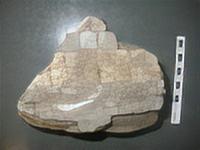
Segment of mosaic. This object is essentially a lump of concrete, upon which is set small tile pieces or tesserae, approximately 18mm by 18mm and approximately 7mm thick. The concrete has red tile fragments mixed within, typical of Roman methods. The tile pieces are dark grey and creamy white and set so that a straight white line is banded either side by the black. The mosaic fragment is presumed to be Roman, though there are no records of any villas or substantial houses in the area that it was found. It is impossible to say whether these represent remains from the locale, or whether they have been collected from elsewhere and merely ‘dumped’ at this location. Because of the uncertainty of the provenance and lack of contextual evidence, a more precise date cannot be given. The fragment is sub triangular in plan and approximately 150mm long, 110mm wide, 85mm high and weighs in excess of half a kilo.
The Portable Antiquities Scheme
Title: ROMAN MOSAIC
Description:
Segment of mosaic.
This object is essentially a lump of concrete, upon which is set small tile pieces or tesserae, approximately 18mm by 18mm and approximately 7mm thick.
The concrete has red tile fragments mixed within, typical of Roman methods.
The tile pieces are dark grey and creamy white and set so that a straight white line is banded either side by the black.
The mosaic fragment is presumed to be Roman, though there are no records of any villas or substantial houses in the area that it was found.
It is impossible to say whether these represent remains from the locale, or whether they have been collected from elsewhere and merely ‘dumped’ at this location.
Because of the uncertainty of the provenance and lack of contextual evidence, a more precise date cannot be given.
The fragment is sub triangular in plan and approximately 150mm long, 110mm wide, 85mm high and weighs in excess of half a kilo.
Related Results
Mosaic of Los Amores of Cástulo (Linares, Spain)
Mosaic of Los Amores of Cástulo (Linares, Spain)
The excavations carried out in Cástulo in 2011 discovered, in area 2 of the archeological site, a large building of approximately 33x12 m (Building D) dated to the end of the first...
The judgement of Paris. Mosaic of los Amores, Castulo (Linares, Spain)
The judgement of Paris. Mosaic of los Amores, Castulo (Linares, Spain)
Judgment of Paris scene present in the Mosaic of the Amores. It is made with stone tiles (black, red, pink, white, gray, yellow) and vitreous paste (black, green, blue, yellow, ora...
Selene and Endymion Mosaic of Los Amores, Cástulo (Linares, Spain)
Selene and Endymion Mosaic of Los Amores, Cástulo (Linares, Spain)
Myth of Selene and Endimión del Mosaico de los Amores. It is one of the main scenes placed next to the scene of the Judgment of Paris. The mosaic is made with stone tiles (black, r...
Artist Choose with assistance with the mosaic artwork above the west portal above the main entrance to the Cathedral. Mosaic composition by artist Bengt Olof Kälde The center of Mosaic is Christ, the ruler of heaven and earth, courted by six sacred figure
Artist Choose with assistance with the mosaic artwork above the west portal above the main entrance to the Cathedral. Mosaic composition by artist Bengt Olof Kälde The center of Mosaic is Christ, the ruler of heaven and earth, courted by six sacred figure
Artist Choose with assistance with the mosaic artwork above the west portal above the main entrance to the Cathedral. Mosaic composition by artist Bengt Olof Kälde The center of Mo...
Artist Choose with assistance with the mosaic artwork above the west portal above the main entrance to the Cathedral. Mosaic composition by artist Bengt Olof Kälde The center of Mosaic is Christ, the ruler of heaven and earth, courted by six sacred figure
Artist Choose with assistance with the mosaic artwork above the west portal above the main entrance to the Cathedral. Mosaic composition by artist Bengt Olof Kälde The center of Mosaic is Christ, the ruler of heaven and earth, courted by six sacred figure
Artist Choose with assistance with the mosaic artwork above the west portal above the main entrance to the Cathedral. Mosaic composition by artist Bengt Olof Kälde The center of Mo...
Einar Jagerwall’s second book, p. 35: Bengt Olof Kälde checks the progress of the mosaic plan. The west portal above the main entrance to the Cathedral has been adorned with a colorful mosaic composition by the artist Bengt Olof Kälde. The center of Mosai
Einar Jagerwall’s second book, p. 35: Bengt Olof Kälde checks the progress of the mosaic plan. The west portal above the main entrance to the Cathedral has been adorned with a colorful mosaic composition by the artist Bengt Olof Kälde. The center of Mosai
Einar Jagerwall’s second book, p. 35: Bengt Olof Kälde checks the progress of the mosaic plan. The west portal above the main entrance to the Cathedral has been adorned with a colo...
Lamp: human figure crouching over phallus
Lamp: human figure crouching over phallus
Mold made lamp. Material is soft, well-levigated light-gray clay with micaceous impurities. Has a reddish brown glaze. Nozzle is coated with carbon. Designed for suspension with tw...
Lamp: Black African crouching over phallus
Lamp: Black African crouching over phallus
Mold made lamp. Material is soft, well-levigated light-gray clay with micaceous impurities. Has a reddish brown glaze. Nozzle is coated with carbon. Designed for suspension with tw...