
Search engine for discovering works of Art, research articles, and books related to Art and Culture


Javascript must be enabled to continue!
The Tribute Money. Peter Finding the Silver Coin in the Mouth of the Fish. Also called "The Ferry Boat to Antwerp"
View through National Gallery of Denmark
The title refers to the Gospel according to St.Matthew (17:24-27) and points to the figure composition on the landing stage to the right.
Jesus has sent the apostle Peter to the lake at Capernaum where he miraculously finds a coin in the mouth of the first fish to bite. The coin allows Jesus and his disciples to pay compulsory tribute money to the temple in Jerusalem.
Flemish 17th century everyday life
The ferryboat, which has far more to do with Flemish 17th century everyday life than with biblical history, takes up the greater part of the canvas. The gunwale is only just clear of the water, meaning that the boat is heavily loaded with animals and passengers of all ages and nationalities.
Jordaens' artistic development
Throughout his long life Jacob Jordaens underwent a process of artistic growth and development that took him from the high level of detail appearing in Tribute Money to a native version of the Baroque devoid of the classical ideals of beauty that permeated the works of his fellow artist Peter Paul Rubens (1577-1640).
Not until after Rubens died in 1640 did Jordaens get a share of the royal commissions; up until that times he found his clients almost exclusively among the wealthy middle classes.
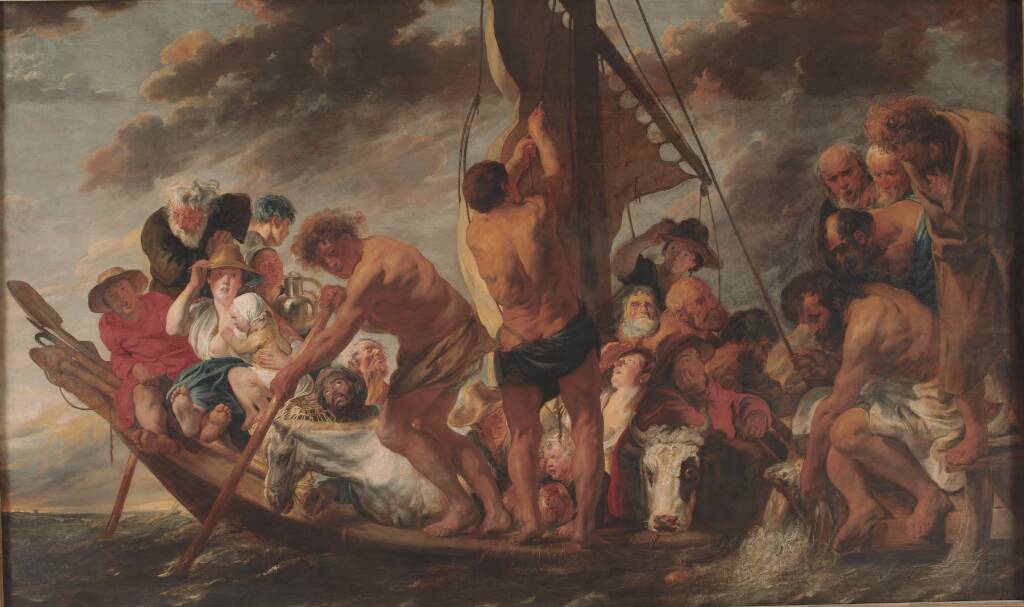
Title: The Tribute Money. Peter Finding the Silver Coin in the Mouth of the Fish. Also called "The Ferry Boat to Antwerp"
Description:
The title refers to the Gospel according to St.
Matthew (17:24-27) and points to the figure composition on the landing stage to the right.
Jesus has sent the apostle Peter to the lake at Capernaum where he miraculously finds a coin in the mouth of the first fish to bite.
The coin allows Jesus and his disciples to pay compulsory tribute money to the temple in Jerusalem.
Flemish 17th century everyday life
The ferryboat, which has far more to do with Flemish 17th century everyday life than with biblical history, takes up the greater part of the canvas.
The gunwale is only just clear of the water, meaning that the boat is heavily loaded with animals and passengers of all ages and nationalities.
Jordaens' artistic development
Throughout his long life Jacob Jordaens underwent a process of artistic growth and development that took him from the high level of detail appearing in Tribute Money to a native version of the Baroque devoid of the classical ideals of beauty that permeated the works of his fellow artist Peter Paul Rubens (1577-1640).
Not until after Rubens died in 1640 did Jordaens get a share of the royal commissions; up until that times he found his clients almost exclusively among the wealthy middle classes.
Related Results
“Putka”, folio from the album Fishes of India
“Putka”, folio from the album Fishes of India
Two small puffer fish are facing each other halfway down the page, just right of the center. The fish on the left is shown in profile, with a green body that is darker at the top a...
Pair of leather gloves with embroidered satin with silver and silver-gilt threads, silk and lace, England, 1600-1625. Pair of leather and satin gloves embroidered with motifs of roses, birds and wheat sheaves in silks. With large gauntlets, each having si
Pair of leather gloves with embroidered satin with silver and silver-gilt threads, silk and lace, England, 1600-1625. Pair of leather and satin gloves embroidered with motifs of roses, birds and wheat sheaves in silks. With large gauntlets, each having si
Pair of leather gloves with embroidered satin with silver and silver-gilt threads, silk and lace, England, 1600-1625. Pair of leather and satin gloves embroidered with motifs of ro...
Necklace with coins and beads
Necklace with coins and beads
The combination of different types of silver beads suggests that this necklace is composed of beads of different origins that have been strung together again. This is also indicate...
“Manua”, folio from the album Fishes of India
“Manua”, folio from the album Fishes of India
The fish is painted in the center of the page in profile. It features a blunt, curved head with large eyes and a downward, curving, agape mouth. Its body tapers to a narrow tail. I...
South Italian Red-figure Fish Plate
South Italian Red-figure Fish Plate
Campanian red-figured fish plate with low stem and broad, molded foot. Broad, shallow bowl with a central depression. Thick, curved rim, downturned beyond vertical.
Pale orangis...
The Old Fish Market on the Dam, Amsterdam
The Old Fish Market on the Dam, Amsterdam
According to Houbraken, Emmanuel de Witte first trained with the Delft still life painter Evert van Aelst. He is documented in the painters’ guild in that city in 1636. He is later...