
Search engine for discovering works of Art, research articles, and books related to Art and Culture


Javascript must be enabled to continue!
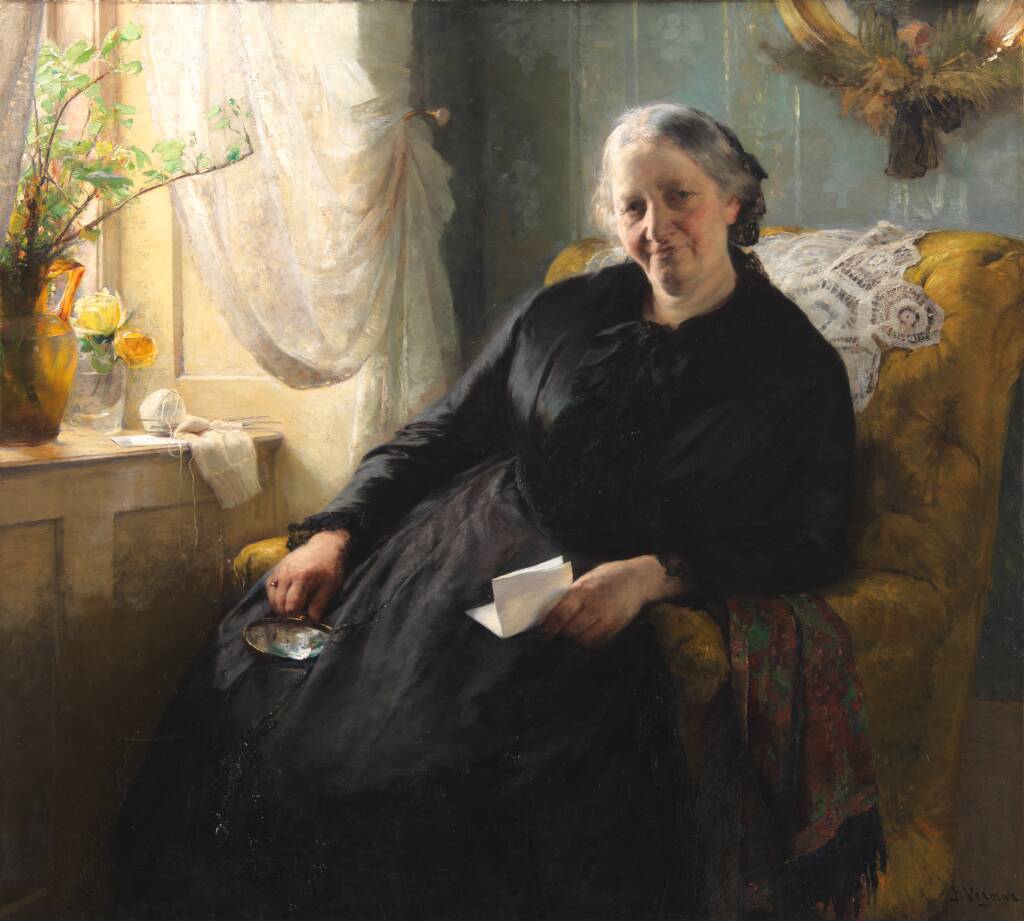
Portrait of Cecilie Trier, née Melchior
View through National Gallery of Denmark
ENGELSK
Bertha Wegmann: Portrait of Cecilie Trier, née Melchior, 1885, oil on canvas, 125.9 x 140.2 cm, SMK – Statens Museum for Kunst, KMS8643
Thanks to new research and an increased awareness of the many overlooked, talented female artists active in the decades around 1900, Bertha Wegmann has been reinstated as one of the important artists of Danish art. With a large production that won her international acclaim, she covered many genres including portraits, pure landscapes, landscapes with figures, interiors, flower paintings, and still lives. However, it was the portraits – such as that of Cecilie Trier – that were exhibited at the great international exhibitions and resulted in medals and honourable mentions. As a case in point, the portrait of Trier was on display both at the World’s Fairs in Paris 1889 and Chicago 1893.
This critical acclaim was due to the fact that Wegmann was an eminently skilled portrait painter who mastered the artistic effects of the genre. She was capable of delivering paintings that complied with the age’s demand for ’ambience portraits’: informal depictions of situations combining the profound character sketch with the naturalistic quality of the fleeting moment.
Cecilie Trier, whose birth name was Melchior, belonged to the Jewish bourgeoisie in Copenhagen, and the family remained an important patron for Bertha Wegmann through the years. They ordered several portraits from her, and in her younger years they supported her financially so that she could pursue an artistic career by going abroad to study in Munich.
Værkdatering: (1885)
Dateringen af en studie til maleriet (se Andre værker) til 1885 sandsynlig gør en datering til dette år
Title: Portrait of Cecilie Trier, née Melchior
Description:
ENGELSK
Bertha Wegmann: Portrait of Cecilie Trier, née Melchior, 1885, oil on canvas, 125.
9 x 140.
2 cm, SMK – Statens Museum for Kunst, KMS8643
Thanks to new research and an increased awareness of the many overlooked, talented female artists active in the decades around 1900, Bertha Wegmann has been reinstated as one of the important artists of Danish art.
With a large production that won her international acclaim, she covered many genres including portraits, pure landscapes, landscapes with figures, interiors, flower paintings, and still lives.
However, it was the portraits – such as that of Cecilie Trier – that were exhibited at the great international exhibitions and resulted in medals and honourable mentions.
As a case in point, the portrait of Trier was on display both at the World’s Fairs in Paris 1889 and Chicago 1893.
This critical acclaim was due to the fact that Wegmann was an eminently skilled portrait painter who mastered the artistic effects of the genre.
She was capable of delivering paintings that complied with the age’s demand for ’ambience portraits’: informal depictions of situations combining the profound character sketch with the naturalistic quality of the fleeting moment.
Cecilie Trier, whose birth name was Melchior, belonged to the Jewish bourgeoisie in Copenhagen, and the family remained an important patron for Bertha Wegmann through the years.
They ordered several portraits from her, and in her younger years they supported her financially so that she could pursue an artistic career by going abroad to study in Munich.
Related Results
Sketchbook
Sketchbook
Sketchbook with blue- and black-fabric-covered cardboard covers. Sewn page block; pages of off-white wove paper, each 27.6 x 21.6 cm. Each sheet numbered on verso at l.l. Drawin...
The Artist and his Wife Marie Suzanne Giroust painting the Portrait of Henrik Wilhelm Peill
The Artist and his Wife Marie Suzanne Giroust painting the Portrait of Henrik Wilhelm Peill
Roslin was active in Paris and came to hold a unique position on the international art scene of the 18th century. It was in the French capital that he met his future wife, the port...
Ten Thousand Years, Ten Thousand Years of Sleep, One Hundred Million Scattered Pieces
Ten Thousand Years, Ten Thousand Years of Sleep, One Hundred Million Scattered Pieces
This triptych comprises a set of three hanging scrolls, each painted in ink on paper. The central scroll is a formal portrait of Mao Zedong (1893–1976); the flanking scrolls repres...