
Search engine for discovering works of Art, research articles, and books related to Art and Culture


Javascript must be enabled to continue!
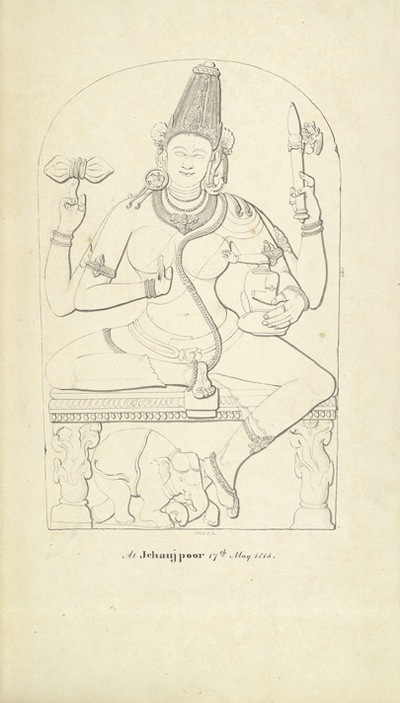
Sculpture of Indrani at Jajpur, Orissa f.12
View through Europeana Collections
Pen and ink drawing of a sculpture of Indrani
from Jajpur in Orissa, by an anonymous artist, taken from an album
of 37 drawings (43 folios) of sculpture at Jajpur, Puri, Bezwada
and Sitanagar made during a journey from Bengal through Orissa to
the Coromandel Coast, part of the MacKenzie Collection, dated 1815.
Colin MacKenzie (1754-1821) joined the East India Company as an
engineer at the age of 28 and spent the majority of his career in
India. He used the salary he earned from his military career as a
Captain, Major and finally a Colonel to finance his research into
the history and religion of Indian and Javan culture, collecting
many sketches and drawings along the way. Jajpur is a sacred
pilgrimage site in Orissa that is situated on the Vaitarani River.
There are numerous temples at the site, the most important being
the shrine of the mother Goddess Viraja (Durga), and the shrine to
Varaha, the incarnation of Lord Vishnu as a boar. The sculpture of
Indrani is depicted in this drawing and was described by M.H.H.
Kuraishi in the "List of ancient monuments...in the Province of
Bihar and Orissa" of 1931: "This four-armed statue...represents
Indrani, the wife of Indra, as one of the Seven Mothers of Hindu
mythology. She is seated on a raised throne in an easy posture
(lilasana) and is readily identifiable through her Vahana, the
elephant...The goddess wears a high conical headdress, elaborate
ornaments, and a sari...On her left thigh she originally held a
child...The image is made of chlorite and carved in full
relief."
Title: Sculpture of Indrani at Jajpur, Orissa f.12
Description:
Pen and ink drawing of a sculpture of Indrani
from Jajpur in Orissa, by an anonymous artist, taken from an album
of 37 drawings (43 folios) of sculpture at Jajpur, Puri, Bezwada
and Sitanagar made during a journey from Bengal through Orissa to
the Coromandel Coast, part of the MacKenzie Collection, dated 1815.
Colin MacKenzie (1754-1821) joined the East India Company as an
engineer at the age of 28 and spent the majority of his career in
India.
He used the salary he earned from his military career as a
Captain, Major and finally a Colonel to finance his research into
the history and religion of Indian and Javan culture, collecting
many sketches and drawings along the way.
Jajpur is a sacred
pilgrimage site in Orissa that is situated on the Vaitarani River.
There are numerous temples at the site, the most important being
the shrine of the mother Goddess Viraja (Durga), and the shrine to
Varaha, the incarnation of Lord Vishnu as a boar.
The sculpture of
Indrani is depicted in this drawing and was described by M.
H.
H.
Kuraishi in the "List of ancient monuments.
in the Province of
Bihar and Orissa" of 1931: "This four-armed statue.
represents
Indrani, the wife of Indra, as one of the Seven Mothers of Hindu
mythology.
She is seated on a raised throne in an easy posture
(lilasana) and is readily identifiable through her Vahana, the
elephant.
The goddess wears a high conical headdress, elaborate
ornaments, and a sari.
On her left thigh she originally held a
child.
The image is made of chlorite and carved in full
relief.
".
Related Results
Standing Buddha Shakyamuni in Varada-mudra
Standing Buddha Shakyamuni in Varada-mudra
This sculpture depicts a Buddha gracefully standing on a shallow lotus pedestal, the Buddha likely the Buddha Sakyamuni (the Historical Buddha) though possibly the Buddha Dipankara...
Konorak, Orissa, Indien
Konorak, Orissa, Indien
Woman writing love letters. Sculpture from the Sun Temple in
Konorak, Orissa, India. The 1000s. (See Postryttaren 1964).
Reproduction Photo 1940s after an illustration....
Loving Couple (Mithuna)
Loving Couple (Mithuna)
Ferruginous stone, Eastern Ganga dynasty, India (Orissa)...
Foliated Scrolls Inhabited by Birds and Monkeys
Foliated Scrolls Inhabited by Birds and Monkeys
Ivory, India (Orissa)...
Head of Buddha, probably the Buddha Sakyamuni
Head of Buddha, probably the Buddha Sakyamuni
Carved in gray limestone in Thailand in the seventh or early eighth century, this stone sculpture depicts the head of a Buddha, probably the Buddha Sakyamuni, the Historical Buddha...