
Search engine for discovering works of Art, research articles, and books related to Art and Culture


Javascript must be enabled to continue!
After the Storm
View through National Gallery of Denmark
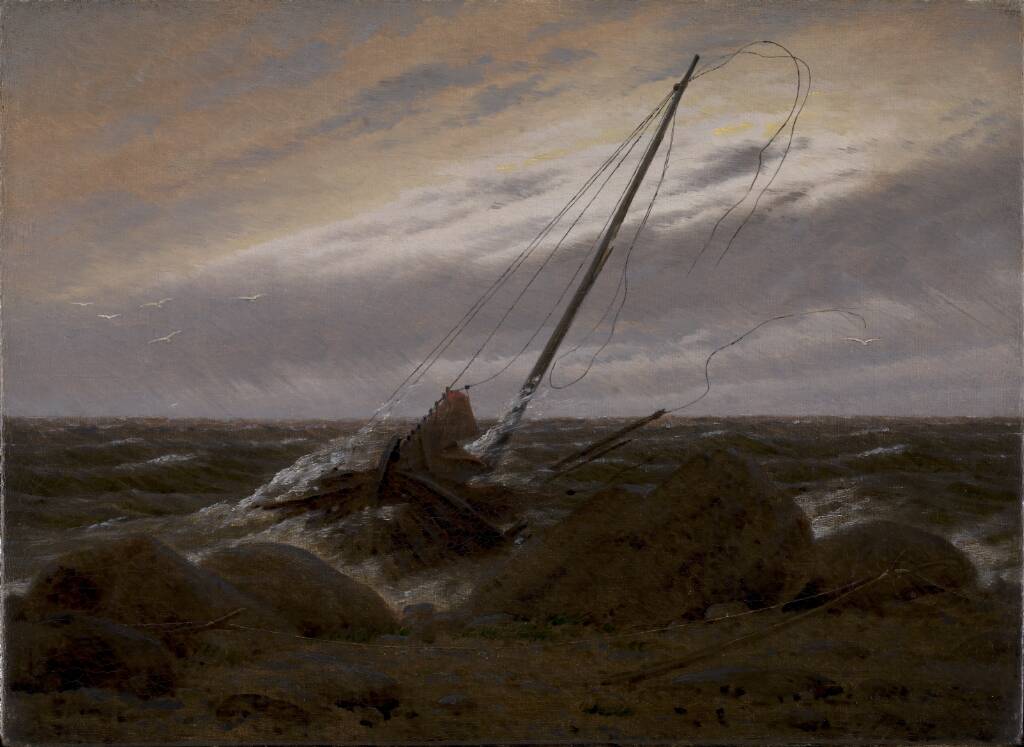
A violent storm has brought a ship off course, smashing it onto the rocks. But perhaps the rocks are also its salvation, embedding it on firm ground. Friedrich grew up in Greifswald near the Baltic Sea, and he visited the nearby island of Rügen all his life. Here he observed the sky and sea in all weathers, and ships at sea was a recurring theme in his art, often symbolising the journey of life. Perhaps this scene shows the firm bedrock of faith saving the ship. The dramatic, finely nuanced depiction of the stormy sky testifies to how Friedrich, like many other European painters, was keenly interested in exploring cloud formations in various weather and lighting conditions. He has very carefully portrayed the sunlight piercing the clouds and details such as the gulls, the partially broken mast, the fluttering ropes and the rain falling out at sea.
Værkdatering: 1817
Den angivne datering forekommer overbevisende (første gang påpeget af Karl W. Jähnig i håndskrevet notat bag på gammelt foto, dateret 1. februar 1959). Werner Sumowski har godtaget denne datering (1970).
Title: After the Storm
Description:
A violent storm has brought a ship off course, smashing it onto the rocks.
But perhaps the rocks are also its salvation, embedding it on firm ground.
Friedrich grew up in Greifswald near the Baltic Sea, and he visited the nearby island of Rügen all his life.
Here he observed the sky and sea in all weathers, and ships at sea was a recurring theme in his art, often symbolising the journey of life.
Perhaps this scene shows the firm bedrock of faith saving the ship.
The dramatic, finely nuanced depiction of the stormy sky testifies to how Friedrich, like many other European painters, was keenly interested in exploring cloud formations in various weather and lighting conditions.
He has very carefully portrayed the sunlight piercing the clouds and details such as the gulls, the partially broken mast, the fluttering ropes and the rain falling out at sea.
Related Results
Landscape with a Storm
Landscape with a Storm
Marco Ricci was the nephew of the painter Sebastiano Ricci, with whom he collaborated and who may have been his first teacher, although it has also been suggested that he studied w...
X-radiograph(s) of "Coming Storm"
X-radiograph(s) of "Coming Storm"
X-Radiograph Description: X-Radiograph
X-Radiograph Settings: 21 and 30 kv, 5 ma, 24 and 6 sec.
Burroughs Number: 3466
X-Radiograph(s) of:
Artist: Inness, George, Americ...
Krishna and Radha Embrace during a Storm (recto); Priests Worship Shrinathji (verso); folio from a royal Kota-Jaipur album
Krishna and Radha Embrace during a Storm (recto); Priests Worship Shrinathji (verso); folio from a royal Kota-Jaipur album
Seated under an awning outside of a sumptuous bedchamber, the blue-skinned Krishna and his consort, Radha, hold one another close. The lightning that snakes across the dark sky abo...
Christ in the Storm on the Sea of Galilee
Christ in the Storm on the Sea of Galilee
Jan Brueghel belonged to a dynasty of painters whose first outstanding member was Pieter Bruegel, Jan’s father, who died when he was a child. According to Karel van Mander, Jan tra...
Stage design, 1st act, 4th scene “The Volsker knocking off the storm” to B. Brecht “Coriolan” at the Berlin ensemble with stage music by Paul Dessau (premiere 23 September 1964). Karl von Appen, 1964. Colours; 45.4 x 63.3 cm. Dresden: Copper stick cabinet
Stage design, 1st act, 4th scene “The Volsker knocking off the storm” to B. Brecht “Coriolan” at the Berlin ensemble with stage music by Paul Dessau (premiere 23 September 1964). Karl von Appen, 1964. Colours; 45.4 x 63.3 cm. Dresden: Copper stick cabinet
Stage design, 1st act, 4th scene “The Volsker knocking off the storm” to B. Brecht “Coriolan” at the Berlin ensemble with stage music by Paul Dessau (premiere 23 September 1964). K...