
Search engine for discovering works of Art, research articles, and books related to Art and Culture


Javascript must be enabled to continue!
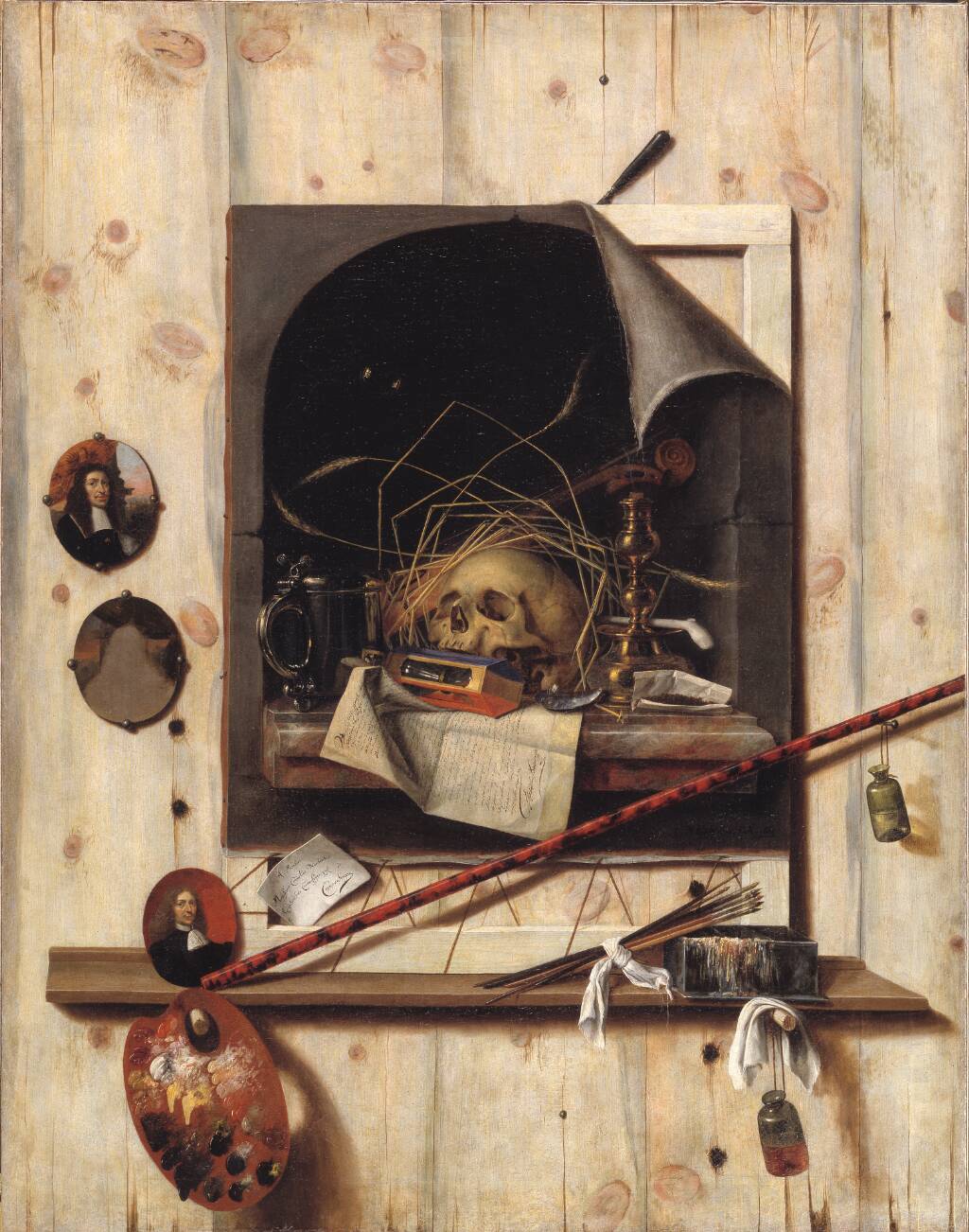
Trompe l'oeil with Studio Wall and Vanitas Still Life
View through National Gallery of Denmark
A depiction of a painting within an artist’s studio. A still life
is positioned on a shelf, referencing objects of transience
(a skull, an hourglass, and a candle, etc.). The completed
artwork is still mounted on a provisional stretcher. The upper
right-hand corner of the canvas has become detached,
thereby exposing the woven ground of the canvas.
A collection of brushes, a paint box and a maulstick (a tool
used to stabilise the hand while painting) are positioned
below the painting. From a palette, paint is running down and
dripping. It looks as if the painter has just left his studio.
By featuring his own working tools in such a prominent
manner, Cornelius Gijsbrechts places considerable emphasis
on the production and creative process inherent to the essence
of painting depicted here. Furthermore, he asserts his role
in the production of these works by not only signing the still
life, but also immortalising himself by prominently placing his
name on the note attached to the stretcher frame (50 Favorites in the SMK Collection).
Title: Trompe l'oeil with Studio Wall and Vanitas Still Life
Description:
A depiction of a painting within an artist’s studio.
A still life
is positioned on a shelf, referencing objects of transience
(a skull, an hourglass, and a candle, etc.
).
The completed
artwork is still mounted on a provisional stretcher.
The upper
right-hand corner of the canvas has become detached,
thereby exposing the woven ground of the canvas.
A collection of brushes, a paint box and a maulstick (a tool
used to stabilise the hand while painting) are positioned
below the painting.
From a palette, paint is running down and
dripping.
It looks as if the painter has just left his studio.
By featuring his own working tools in such a prominent
manner, Cornelius Gijsbrechts places considerable emphasis
on the production and creative process inherent to the essence
of painting depicted here.
Furthermore, he asserts his role
in the production of these works by not only signing the still
life, but also immortalising himself by prominently placing his
name on the note attached to the stretcher frame (50 Favorites in the SMK Collection).
Related Results
A Roberta di Camerino printed jersey 'trompe d'oeil', 'Guanahato', dress, late 1960s. This jersey printed day dress with trompe d'oeil garments details and bold colour combinations is representative of Roberta di Camerino designs of the early 1970s. Rober
A Roberta di Camerino printed jersey 'trompe d'oeil', 'Guanahato', dress, late 1960s. This jersey printed day dress with trompe d'oeil garments details and bold colour combinations is representative of Roberta di Camerino designs of the early 1970s. Rober
A Roberta di Camerino printed jersey 'trompe d'oeil', 'Guanahato', dress, late 1960s. This jersey printed day dress with trompe d'oeil garments details and bold colour combinations...
Materials for a Leisure Hour
Materials for a Leisure Hour
Shortly before painting Materials for a Leisure Hour, William Harnett had learnt to master the complex, painstaking trompe l’oeil technique, which he would regularly use thereafter...
Trompe l'oeil. The Reverse of a Framed Painting
Trompe l'oeil. The Reverse of a Framed Painting
With the absence of the frame that traditionally serves as the architectural transition between the spectator’s reality and the picture’s painted universe, this work by the Flemish...
Trompe-l'Oeil Exercise: Prints on a Table Top
Trompe-l'Oeil Exercise: Prints on a Table Top
Pen and brown ink brush and brown wash over traces of graphite...
Trompe l'Oeil. A Cabinet of Curiosities with an Ivory Tankard
Trompe l'Oeil. A Cabinet of Curiosities with an Ivory Tankard
This artwork is a cabinet door that can actually be opened. It was probably made to fit into a panel or wall of the Green Cabinet at Rosenborg Castle. The Green Cabinet contained F...
Trompe l'oeil of a Letter Rack with Proclamation by Frederik III
Trompe l'oeil of a Letter Rack with Proclamation by Frederik III
Envelopes were not used in the seventeenth century; in-stead, letters were folded up and sealed with red wax and a signet. This letter rack holds many letters, opened and un-opened...