
Search engine for discovering works of Art, research articles, and books related to Art and Culture


Javascript must be enabled to continue!
Polarized Landscape
View through National Gallery of Denmark
Gunnar Aagaard Andersen began experimenting with light in the early 1950s. These experiments later crystallised, giving rise to large light sculptures and light installations. Here, he worked with splitting daylight and electric light, taking it from its monochrome to its polarised form. To Aagaard Andersen, light was ”a figurative language of tone and colour.” A light installation Polarized Landscape from 1969 is a light installation consisting of a number of carefully arranged objects with transparent and electrically lit elements. The mirrors in the installation reflect the electric light, and prisms split it into colours, thereby imbuing the individual elements of the construction with life. The spectator’s perception of the work changes according to his or her position in relation to the work. Change your position, and you change the way you see the colours. Light and the natural laws According to Aagaard Andersen, the order associated with the laws of physics could be transferred to the arts. The artist had carefully studied light and the natural laws applying to it and was interested in manipulating light to create a new world. He did not wish to copy nature, but defined his works of art as parallel phenomena. Aagaard Andersen saw himself as a hybrid artist who sought to form a synthesis of the arts. He greatly influenced artists such as Viera Collaro (1946-) and Niels Nedergaard (1944-1987).
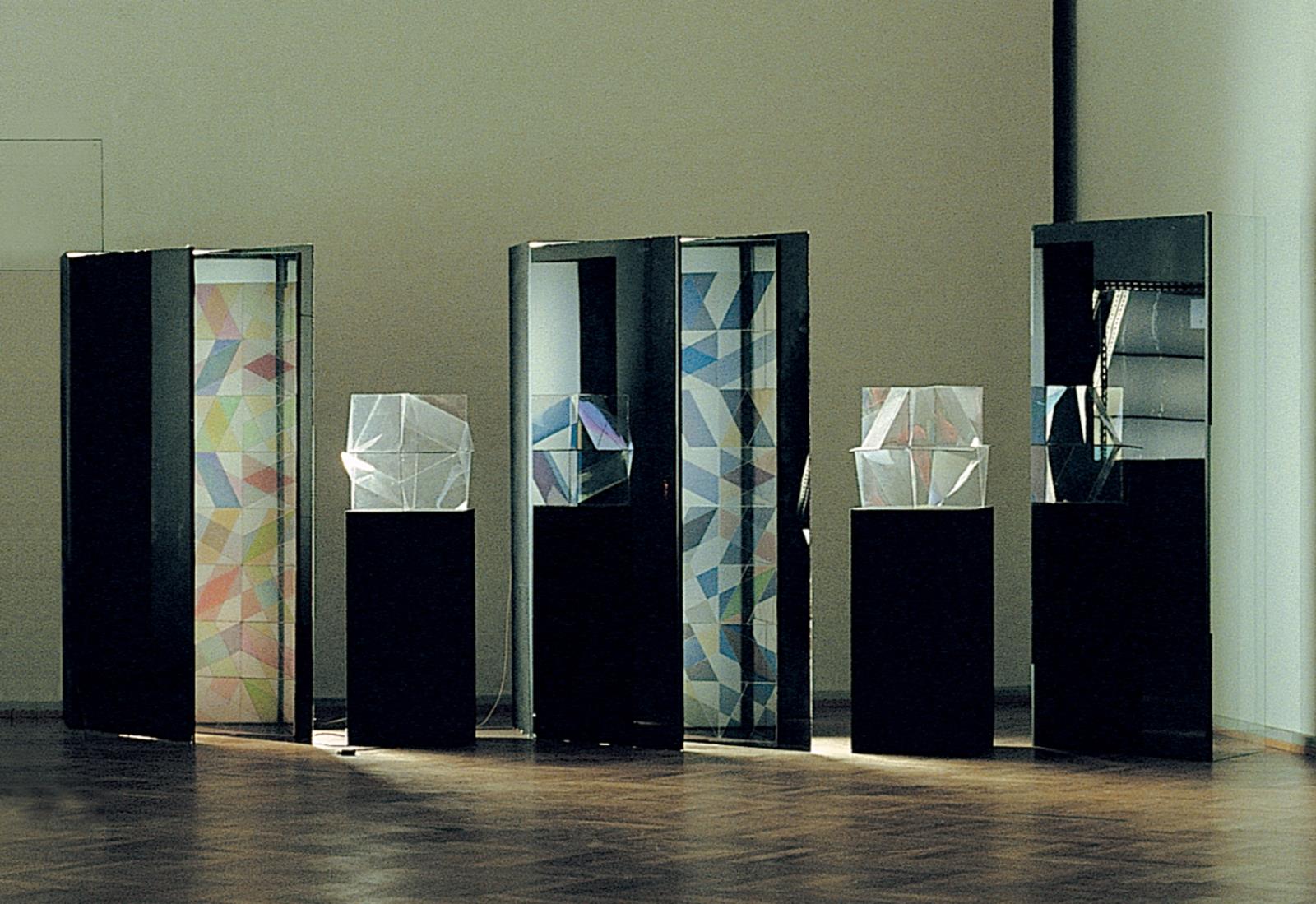
Title: Polarized Landscape
Description:
Gunnar Aagaard Andersen began experimenting with light in the early 1950s.
These experiments later crystallised, giving rise to large light sculptures and light installations.
Here, he worked with splitting daylight and electric light, taking it from its monochrome to its polarised form.
To Aagaard Andersen, light was ”a figurative language of tone and colour.
” A light installation Polarized Landscape from 1969 is a light installation consisting of a number of carefully arranged objects with transparent and electrically lit elements.
The mirrors in the installation reflect the electric light, and prisms split it into colours, thereby imbuing the individual elements of the construction with life.
The spectator’s perception of the work changes according to his or her position in relation to the work.
Change your position, and you change the way you see the colours.
Light and the natural laws According to Aagaard Andersen, the order associated with the laws of physics could be transferred to the arts.
The artist had carefully studied light and the natural laws applying to it and was interested in manipulating light to create a new world.
He did not wish to copy nature, but defined his works of art as parallel phenomena.
Aagaard Andersen saw himself as a hybrid artist who sought to form a synthesis of the arts.
He greatly influenced artists such as Viera Collaro (1946-) and Niels Nedergaard (1944-1987).
Related Results
Wooded Mountain Landscape with Waterfall and Travellers
Wooded Mountain Landscape with Waterfall and Travellers
Wooded Mountain Landscape with Waterfall and Travellers is a magnificent fantasy landscape in the Flemish tradition, painted in the first half of the 17th century by the Antwerp pa...
Panoramic Landscape with a City in the Background
Panoramic Landscape with a City in the Background
Landscape was a leading genre in 17th-century Dutch painting. During that century Dutch artists succeeded in formulating a type of representation that allowed them to depict the wo...
Ten Thousand Years, Ten Thousand Years of Sleep, One Hundred Million Scattered Pieces
Ten Thousand Years, Ten Thousand Years of Sleep, One Hundred Million Scattered Pieces
This triptych comprises a set of three hanging scrolls, each painted in ink on paper. The central scroll is a formal portrait of Mao Zedong (1893–1976); the flanking scrolls repres...
Ten Thousand Years, Ten Thousand Years of Sleep, One Hundred Million Scattered Pieces
Ten Thousand Years, Ten Thousand Years of Sleep, One Hundred Million Scattered Pieces
This triptych comprises a set of three hanging scrolls, each painted in ink on paper. The central scroll is a formal portrait of Mao Zedong (1893–1976); the flanking scrolls repres...
A Creek in the Woods
A Creek in the Woods
“Have just returned from a tour in search of the picturesque, ” wrote Thomas Cole in his diary on 8 July 1837, “[...] To Mr Durand the scenery was entirely new and I am happy in ha...
Pastoral Landscape with the Flight into Egypt
Pastoral Landscape with the Flight into Egypt
Claude Lorraine, whose artistic inspiration derived from the Roman Campagna, can be considered one of the great figures of 17th-century classical landscape painting. He arrived in ...
Expulsion. Moon and Firelight
Expulsion. Moon and Firelight
“The whole landscape, which, seen by a favourable light, and in a genial temperature, had been found so lovely, appeared now like some pictured allegory of life, in which objects w...