
Search engine for discovering works of Art, research articles, and books related to Art and Culture


Javascript must be enabled to continue!
The Fat Kitchen. An Allegory
View through National Gallery of Denmark
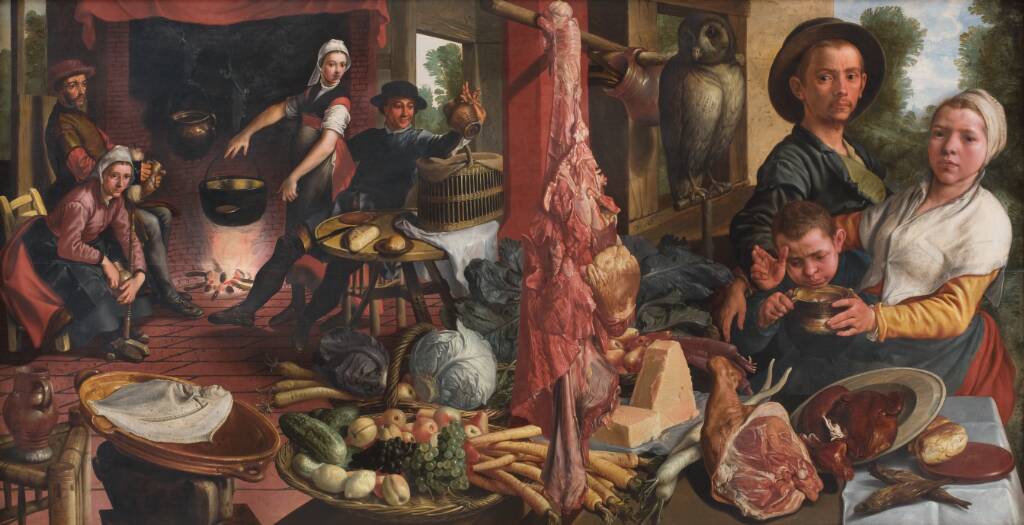
The table is groaning under its load of meat, fish, bread, and fresh vegetables. To the right, behind the table, a peasant stands by his family, regarding us with an eloquent look. He pointedly turns his back to what goes on in the left half of the picture where we get a glimpse of a room with two couples, one young and the other old, gathered around the fireplace.
The young man is in high spirits, raising his jug of ale as he puts his arm around the girl. The old couple stare into space with a melancholy air, making them the key to understanding the picture: it is a warning against "voluptas carnis", i.e. a life in the throes of the senses, leading to gluttony, drunkenness, and moral looseness.
The still life genre
The still life genre was created by Pieter Aertsen in an Antwerp that was the leading commercial centre in Europe at the time. To Aertsen, the arrangements of food - the symbolism of which was explained in the figure scenes in the background - were a necessary alternative to religious painting. During the early years of his career he created a number of altarpieces that he, to his great wrath and sorrow, saw destroyed during the iconoclastic riots of the Reformation.
Værkdatering: 1565-1575
Billedet er fra kunstnerens seneste år.
Title: The Fat Kitchen. An Allegory
Description:
The table is groaning under its load of meat, fish, bread, and fresh vegetables.
To the right, behind the table, a peasant stands by his family, regarding us with an eloquent look.
He pointedly turns his back to what goes on in the left half of the picture where we get a glimpse of a room with two couples, one young and the other old, gathered around the fireplace.
The young man is in high spirits, raising his jug of ale as he puts his arm around the girl.
The old couple stare into space with a melancholy air, making them the key to understanding the picture: it is a warning against "voluptas carnis", i.
e.
a life in the throes of the senses, leading to gluttony, drunkenness, and moral looseness.
The still life genre
The still life genre was created by Pieter Aertsen in an Antwerp that was the leading commercial centre in Europe at the time.
To Aertsen, the arrangements of food - the symbolism of which was explained in the figure scenes in the background - were a necessary alternative to religious painting.
During the early years of his career he created a number of altarpieces that he, to his great wrath and sorrow, saw destroyed during the iconoclastic riots of the Reformation.
Related Results
[Croquis of the ground floor of the Alcázar of Seville] [Material graphic]
[Croquis of the ground floor of the Alcázar of Seville] [Material graphic]
Handwritten annotation with pen and brown ink on the upper left side: "Explanation/1 Gate of the monteria p.a enter the Palace/2 Employee rooms/3 Cocheras/4 Material storage/5 Step...
The Kitchen Maid
The Kitchen Maid
“The Kitchen Maid” is considered by many to be one of Rembrandt’s most representative works. The warm shades of red, brown and yellow, and the vivid depiction of the girl, make thi...