
Search engine for discovering works of Art, research articles, and books related to Art and Culture


Javascript must be enabled to continue!
Hans Christian Andersen Robot
View through National Gallery of Denmark
The four robot sculptures were created by Nam June Paik for the SMK in 1996. They depict four major figures from Danish history: Physicist Niels Bohr, philosopher Søren Kierkegaard, film director Carl. Th. Dreyer and writer Hans Christian Andersen. The robots combine technology, in the form of television cabinets and screens, with everyday objects such as toys, books and an umbrella. The videos screened and the objects themselves are linked to the lives and works of the persons portrayed. Paik was greatly interested in the evolution of new mass media and information technologies. He was a pioneering figure within video art, and began incorporating TV objects in interactive installations back in the early 1960s. To Paik, new technology held social as well as aesthetic potential, and his experiments have helped push media art in new directions. Despite the humorous undercurrents often seen in Paik’s work, the main objective was not to create “scientific toys”, but rather to “humanise technology”. The four friendly robot portraits reflect this position. They also point to how science, literature and philosophy can enter into and be presented in new settings, carried aloft by technology and entertainment.
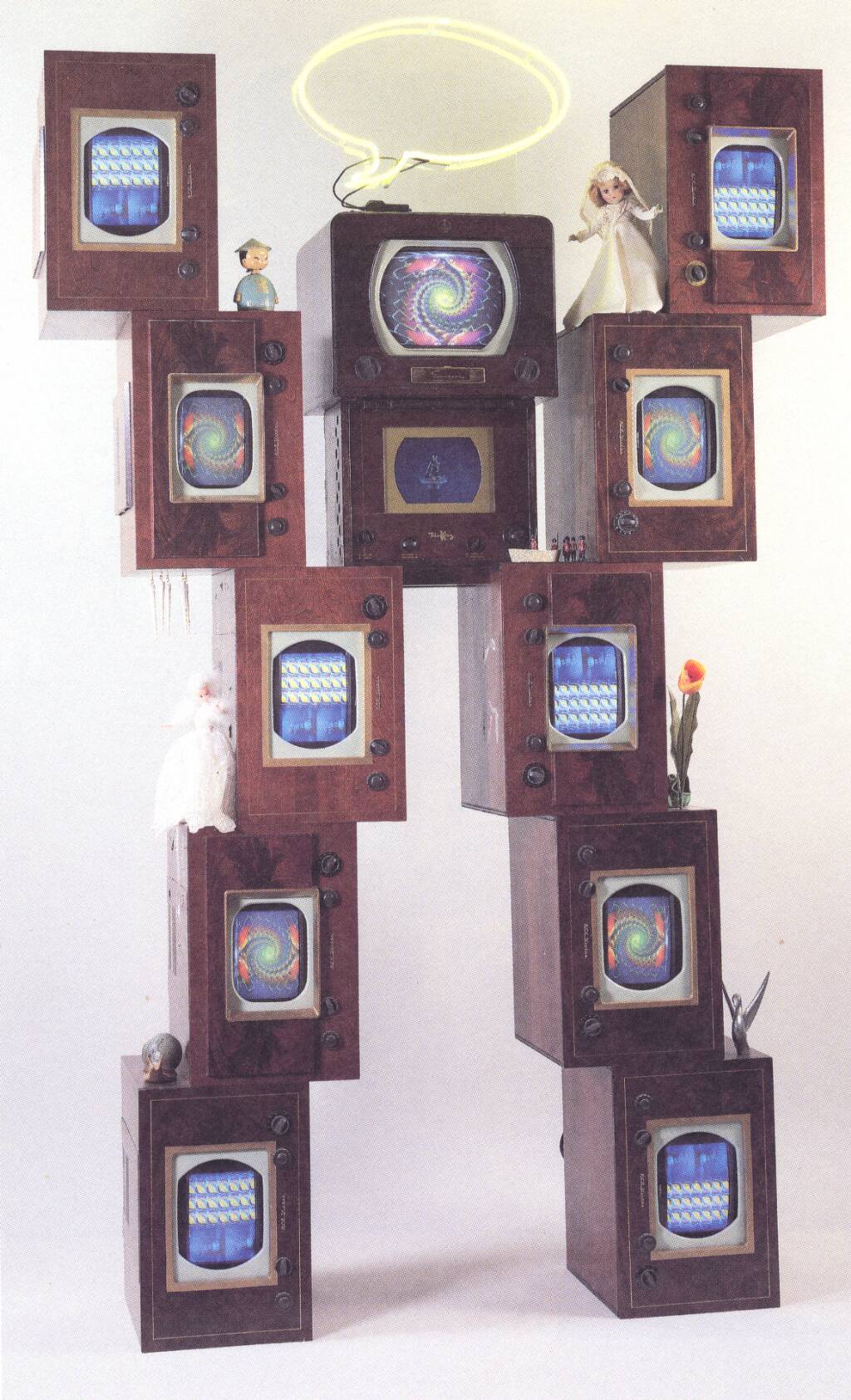
Title: Hans Christian Andersen Robot
Description:
The four robot sculptures were created by Nam June Paik for the SMK in 1996.
They depict four major figures from Danish history: Physicist Niels Bohr, philosopher Søren Kierkegaard, film director Carl.
Th.
Dreyer and writer Hans Christian Andersen.
The robots combine technology, in the form of television cabinets and screens, with everyday objects such as toys, books and an umbrella.
The videos screened and the objects themselves are linked to the lives and works of the persons portrayed.
Paik was greatly interested in the evolution of new mass media and information technologies.
He was a pioneering figure within video art, and began incorporating TV objects in interactive installations back in the early 1960s.
To Paik, new technology held social as well as aesthetic potential, and his experiments have helped push media art in new directions.
Despite the humorous undercurrents often seen in Paik’s work, the main objective was not to create “scientific toys”, but rather to “humanise technology”.
The four friendly robot portraits reflect this position.
They also point to how science, literature and philosophy can enter into and be presented in new settings, carried aloft by technology and entertainment.
Related Results
Drawing, Portrait of M. Andersen, A. Kerckhoff
Drawing, Portrait of M. Andersen, A. Kerckhoff
Kerckhoffs, Alphonse (née 1887), Dutch/Danish
“Portrait of Marie Andersen, Author.” 1923.
Portrait head of children’s book author Marie Andersen, profile to the left.
Marie Ander...
The Fairy Tales of Hans Christian Andersen
The Fairy Tales of Hans Christian Andersen
Illustrations: wood engraving...
Motif from The Story of a Mother by Hans Christian Andersen
Motif from The Story of a Mother by Hans Christian Andersen
In a dynamic pose, Death strides over the mother crouching on the ground. Her dead child is half hidden by the fluttering cloak.
Hans Christian Andersen’s (1805-1875) tale The S...
The fifth Invention: Equestrian procession with Duke Friedrich von Sachsen-Altenburg as leader of the supremely Saxon Truchsesse Hans von Schönberg, Hans von Taube, Hans Albrecht von Bernstein and Hartwig Christoph Kürkölßky. Illustration from the elevato
The fifth Invention: Equestrian procession with Duke Friedrich von Sachsen-Altenburg as leader of the supremely Saxon Truchsesse Hans von Schönberg, Hans von Taube, Hans Albrecht von Bernstein and Hartwig Christoph Kürkölßky. Illustration from the elevato
The fifth Invention: Equestrian procession with Duke Friedrich von Sachsen-Altenburg as leader of the supremely Saxon Truchsesse Hans von Schönberg, Hans von Taube, Hans Albrecht v...
Hunter elevator. Hunters with buffaloes, leopard and predatory cat in cage, drawn by horses, Duke Johann Georg zu Saxony, Joachim von Schulenburg, Caspar von Schwolentzki, Tobias von Thür (Dier?), Heinrich von Gunteradt (Günderrode), Hans Georg von Osterh
Hunter elevator. Hunters with buffaloes, leopard and predatory cat in cage, drawn by horses, Duke Johann Georg zu Saxony, Joachim von Schulenburg, Caspar von Schwolentzki, Tobias von Thür (Dier?), Heinrich von Gunteradt (Günderrode), Hans Georg von Osterh
Hunter elevator. Hunters with buffaloes, leopard and predatory cat in cage, drawn by horses, Duke Johann Georg zu Saxony, Joachim von Schulenburg, Caspar von Schwolentzki, Tobias v...
Venstrevikingerne
Venstrevikingerne
Nyboe Andersen with a coffin full of padlocks and keys Kofoed and Nyboe Andersen stand on board the ship. Andersen opens the coffin full of padlocks and keys for people’s freezers....
Andersen Brothers
Andersen Brothers
Bugtaler with H. C. Andersen doll The Foreign Minister’s campaign is that he entertains as a panther with an H. C. Andersen doll....