
Search engine for discovering works of Art, research articles, and books related to Art and Culture


Javascript must be enabled to continue!
Giotto, Frescoes on north wall of Scrovegni (Arena) Chapel (1305-1306)
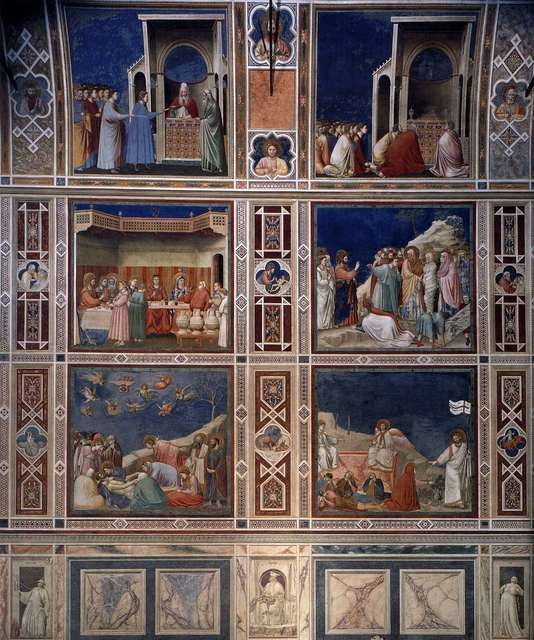
Title: Giotto, Frescoes on north wall of Scrovegni (Arena) Chapel (1305-1306)
Description:
Fresco.
Related Results
Mural paintings at the Chapel of Saint Casimir of Vilnius Cathedral
Mural paintings at the Chapel of Saint Casimir of Vilnius Cathedral
The Royal Chapel of St Casimir in Vilnius Cathedral is the masterpiece of Lithuanian Baroque. Beside expressive paintings there are two huge frescoes decorating its eastern and wes...
Giotto and the Scrovegni chapel.
Giotto and the Scrovegni chapel.
34 - framing of the entrance wall where the universal judgment is painted...
Inscription. Church. Lopera castle (Jaén, Spain)
Inscription. Church. Lopera castle (Jaén, Spain)
The castle of Lopera (Jaén) underwent countless transformations throughout its history. In the 16th century, the old fortified church was reduced to its minimum expression, becomin...
Detail of The Ascension of Saint John the Evangelist, after Giotto (recto and verso)
Detail of The Ascension of Saint John the Evangelist, after Giotto (recto and verso)
This drawing is based on the Giotto mural at the Peruzzi Chapel, Santa Croce, Florence....
Wendtholt’s chapel
Wendtholt’s chapel
“Harmony” cast! The Wendtholt chapel existed until about 1950/52. Affixed on the central cover of a waltz by Clemens Dunker, see Inv. No. 0000.64913. The Wendholt’s chapel was ...
München Maximilianische Residenz 1600 - 1608
München Maximilianische Residenz 1600 - 1608
Under Duke Maximilian I (r. 1597-1651) the Maximilian Residence, named after him, was built on the west side of the Antiquarium from 1599/1600 until around 1608.
After Maximilian h...
Plan of Arena Chapel, Padua, after Giotto; verso: Copies after Giotto
Plan of Arena Chapel, Padua, after Giotto; verso: Copies after Giotto
image continues on page 28 recto...
Orbignano: The frescoes attributed to Giotto and his school were discovered by the parish priest don Massimo Bartignani
Orbignano: The frescoes attributed to Giotto and his school were discovered by the parish priest don Massimo Bartignani
2 - workers leave the church carrying wheelbarrows full of rubble...