
Search engine for discovering works of Art, research articles, and books related to Art and Culture


Javascript must be enabled to continue!
mask
View through Europeana Collections
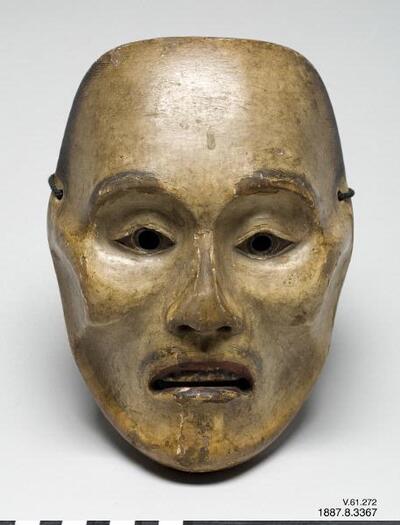
Function: Forty-five theatre masks form a part of the Vanadis Collection, most of them are meant for the no-theatre. The no-theatre is counted as one of the oldest now living theatre traditions in the world. It got its present form during the first part of the fifteenth century, but has an even older ancestry. The no-theatre is usually called the theatre of the aristocracy, as opposed to the kabuki-theatre, whose audience used to come from the middle class. In both theatre-forms, the characters are all played with male actors. The usual term for a mask in Japanese is, kamen, which means “temporary face”. The words nohmen, with the meanings “face” and “surface”, and omote, which means “outside” are used to talk about no-masks. The no-masks are tools for change – of the face to specific characters and of the state on the stage. They symbolize the heart and soul of the character. The verb, which is used to describe that a no-mask is put on, means that you “attach” a face, a surface or an outside to the real outside, the face of the actor. The mask becomes a part of the actor’s body and acts together with the scene-costume to create the character. By not reproducing a particular feeling or a particular expression the mask can communicate a multiplicity of emotions and states. The actor can, through small movements of the face, make the mask shift its expression in a way that is remarkable.
Acquisition Acquired in Kyoto by Hjalmar Stolpe (1841-1905) during a six weeks’ halt in Japan during the circumnavigation with the Vanadis 1883-1885. Hjalmar Stolpe was the archaeologist and ethnographer who managed to establish the Museum of Ethnography as a separate museum splitting the collections from those of the Museum of Natural History.
Why this is a masterpiece
No-masks are among the most sought after and treasured objects from Japan, exemplifying the long and unbroken tradition of Japanese crafts with its emphasis on maintaining minute high standards in every respect of making and using the objects. This mask is just one example from the collection. In accordance with the ethics adhered to in the Museum of Ethnography, they have generally not been repaired, only well taken care of, and remain as they were acquired in Kyoto. They are unusually early acquisitions of no-masks in Japan, just a decade after Japan opened up to foreign contacts.
History of the Object
The collection of no-masks to which this particular item belongs originally formed a part of the so-called “Vanadis” collection that Hjalmar Stolpe amassed when he took part in the circumnavigation of 1883-1885 with the Swedish naval ship Vega. It belong s to a sub-collection brought together in Kyoto totalling more than 500 items. The Vanadis collection was added to the museum collections in 1887.
(Virtual Collection of Masterpieces, http://masterpieces.asemus.museum/Default.aspx)
Title: mask
Description:
Function: Forty-five theatre masks form a part of the Vanadis Collection, most of them are meant for the no-theatre.
The no-theatre is counted as one of the oldest now living theatre traditions in the world.
It got its present form during the first part of the fifteenth century, but has an even older ancestry.
The no-theatre is usually called the theatre of the aristocracy, as opposed to the kabuki-theatre, whose audience used to come from the middle class.
In both theatre-forms, the characters are all played with male actors.
The usual term for a mask in Japanese is, kamen, which means “temporary face”.
The words nohmen, with the meanings “face” and “surface”, and omote, which means “outside” are used to talk about no-masks.
The no-masks are tools for change – of the face to specific characters and of the state on the stage.
They symbolize the heart and soul of the character.
The verb, which is used to describe that a no-mask is put on, means that you “attach” a face, a surface or an outside to the real outside, the face of the actor.
The mask becomes a part of the actor’s body and acts together with the scene-costume to create the character.
By not reproducing a particular feeling or a particular expression the mask can communicate a multiplicity of emotions and states.
The actor can, through small movements of the face, make the mask shift its expression in a way that is remarkable.
Acquisition Acquired in Kyoto by Hjalmar Stolpe (1841-1905) during a six weeks’ halt in Japan during the circumnavigation with the Vanadis 1883-1885.
Hjalmar Stolpe was the archaeologist and ethnographer who managed to establish the Museum of Ethnography as a separate museum splitting the collections from those of the Museum of Natural History.
Why this is a masterpiece
No-masks are among the most sought after and treasured objects from Japan, exemplifying the long and unbroken tradition of Japanese crafts with its emphasis on maintaining minute high standards in every respect of making and using the objects.
This mask is just one example from the collection.
In accordance with the ethics adhered to in the Museum of Ethnography, they have generally not been repaired, only well taken care of, and remain as they were acquired in Kyoto.
They are unusually early acquisitions of no-masks in Japan, just a decade after Japan opened up to foreign contacts.
History of the Object
The collection of no-masks to which this particular item belongs originally formed a part of the so-called “Vanadis” collection that Hjalmar Stolpe amassed when he took part in the circumnavigation of 1883-1885 with the Swedish naval ship Vega.
It belong s to a sub-collection brought together in Kyoto totalling more than 500 items.
The Vanadis collection was added to the museum collections in 1887.
(Virtual Collection of Masterpieces, http://masterpieces.
asemus.
museum/Default.
aspx).
Related Results
Ivory pendant in the shape of a miniature mask
Ivory pendant in the shape of a miniature mask
There are various interpretations of its function in the literature. One emphasizes the protective and healing influence of the pendant on the wearer. The other states that the pen...
mask, kiwoyo
mask, kiwoyo
The Georg von Békesy Collection, page 182-183.
Wooden dance mask
The Eastern Bapende live in a large L-shaped area on the Loange and Kasai rivers, in the middle of wich lies the ...
ansiktsmask, mask, topeng
ansiktsmask, mask, topeng
Mask of painted wood, yellow with long pointed nose.
The mask is a dance mask that is part of the prop of a trancedans- set called kuda kepang (Indonesian, kuda: horse, kepang: b...