
Search engine for discovering works of Art, research articles, and books related to Art and Culture


Javascript must be enabled to continue!
Intimacy
View through National Gallery of Denmark
Degas’ figures are usually characterised by a distancing realism, by a vein of observation whose cool intensity seems less fascinated by the body’s erotic aura than by its simple, concrete existence as an object. This gaze appears to be a negative one; a gaze whose lack of mercy corroborates claims of Degas’ misogyny.
Socio-cultural interpretations of women
Degas’ women are worn-out prostitutes, tired washerwomen, or unsightly dancers also bearing the marks of their profession. Degas’ choice of types and the manner of his presentation opens up his renditions of women to socio-cultural interpretations. They become images of social constructs, the constraints of which defines them and marks them through the lives they lead.
A socio-cultural coercion
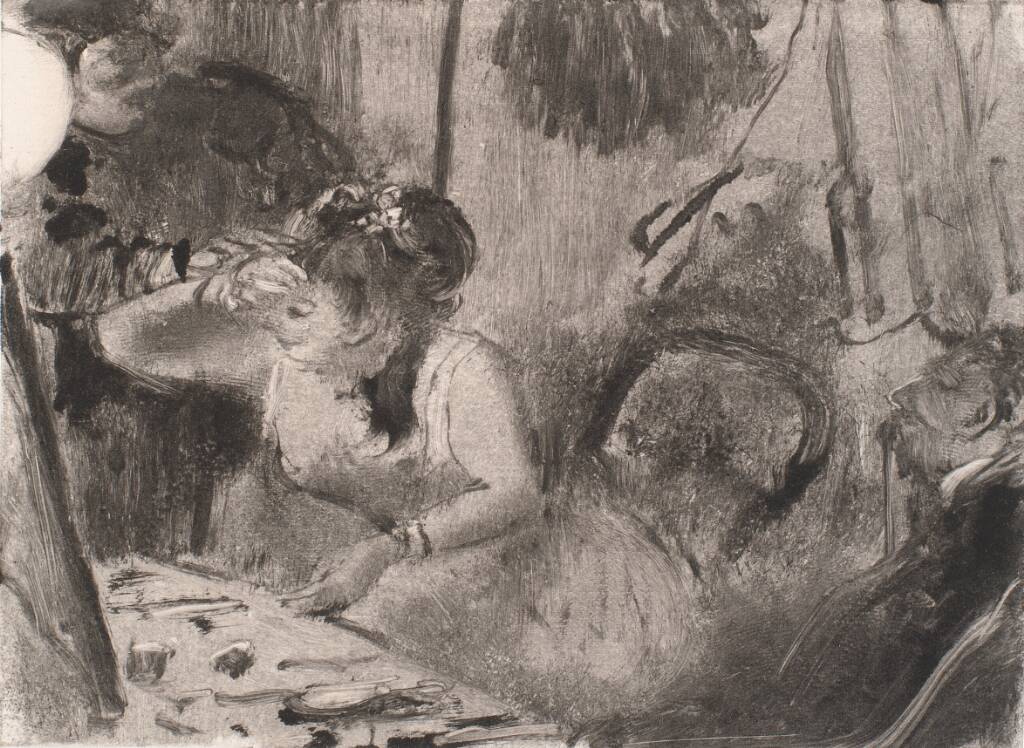
In this monotype, however, the female figure clearly and irresistibly radiates an erotic voluptuousness that Degas’ art can also include. The picture’s masquerade-like feel, its similarity to a stage wardrobe, defines the woman in relation to the waiting man, his gaze fixing her above the subtle sign of his cane. The space itself becomes an image of anticipated union, enfolding this relationship that has been brought about by socio-cultural coercion.
Title: Intimacy
Description:
Degas’ figures are usually characterised by a distancing realism, by a vein of observation whose cool intensity seems less fascinated by the body’s erotic aura than by its simple, concrete existence as an object.
This gaze appears to be a negative one; a gaze whose lack of mercy corroborates claims of Degas’ misogyny.
Socio-cultural interpretations of women
Degas’ women are worn-out prostitutes, tired washerwomen, or unsightly dancers also bearing the marks of their profession.
Degas’ choice of types and the manner of his presentation opens up his renditions of women to socio-cultural interpretations.
They become images of social constructs, the constraints of which defines them and marks them through the lives they lead.
A socio-cultural coercion
In this monotype, however, the female figure clearly and irresistibly radiates an erotic voluptuousness that Degas’ art can also include.
The picture’s masquerade-like feel, its similarity to a stage wardrobe, defines the woman in relation to the waiting man, his gaze fixing her above the subtle sign of his cane.
The space itself becomes an image of anticipated union, enfolding this relationship that has been brought about by socio-cultural coercion.
Related Results
Emily Simmons, "Quiet Intimacy", Figurative, Contemporary Art, Animal, Cat, Intimacy, Soft Light, Impressionism, Emotional, Domestic, Painting (2024)
Emily Simmons, "Quiet Intimacy", Figurative, Contemporary Art, Animal, Cat, Intimacy, Soft Light, Impressionism, Emotional, Domestic, Painting (2024)
Mixed Media, oil on canvas, 70 × 50 × 2 cm...
Boys Boys Boys
Boys Boys Boys
In this exhibition, we focus on Boys Boys Boys and their emotional expressions. Artists challenge traditional aesthetics, exploring vulnerability, desire, and intimacy. Through int...
Rubiks and Crystals
Rubiks and Crystals
Made of painted steel, this new series of sculptures by Hong Kong-Australian artist Anton Poon consist of interconnected and geometrical patterns with complex relationships of form...
Judith with the Head of Holofernes
Judith with the Head of Holofernes
Judith was a young Hebrew widow who, through divine intervention, was able to liberate the besieged town of Bethulia and save her people by seducing, and courageously beheading, th...
Paul Richards: A Day at the Zoo
Paul Richards: A Day at the Zoo
Paul Richards is the first major British portraitist to build an emotive profile of ZSL London Zoo. Over a three year period he spent time getting to know its creatures, allowing h...