
Search engine for discovering works of Art, research articles, and books related to Art and Culture


Javascript must be enabled to continue!
Ten Women from Stralsund
View through National Gallery of Denmark
Ten Women of Stralsund belongs to a group of drawings that were presumably done as studies for woodcuts for a projected book about the history of clothes.
Ten women are lined up, showing attire from the 1600th century. The women’s poses allow Melchior Lorck to display their garb from all angles while also creating excellent rhythm within the composition.
The history of the drawing
The drawing is executed with precision in pen and brown ink. It was exhibited at the Department of Prints and Drawings in 1962 and subsequently bought from the English Evelyn Collection.
The artist Lorck
Lorck is the first artist of Danish origin whose artistic production is extensively documented. His connections with King Christian 3. (1503-1559) and the emperor Ferdinand 1. (1503-1564) took him far and wide in the world. Lorck recorded his impressions on paper. His circle of motifs was wide-ranging, spanning urban scenes, architecture, scenes of everyday life, and studies of clothes, weapons, tools, and portraits.
Inspired by Cranahc and Dürer
The drawings would later be translated into woodcuts and copperplates and published in books. Surviving drawings, woodcuts, and copperplates from his youth and study tours show how he was inspired by Lucas Cranach (1472-1553) and Albrecht Dürer (1471-1528).
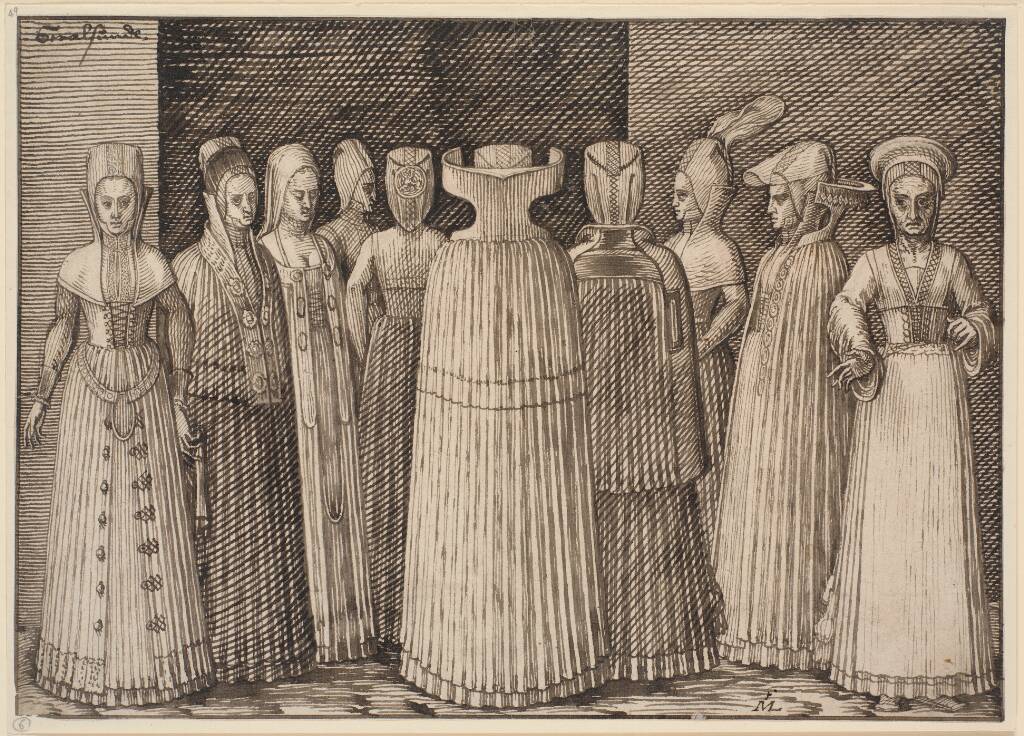
Title: Ten Women from Stralsund
Description:
Ten Women of Stralsund belongs to a group of drawings that were presumably done as studies for woodcuts for a projected book about the history of clothes.
Ten women are lined up, showing attire from the 1600th century.
The women’s poses allow Melchior Lorck to display their garb from all angles while also creating excellent rhythm within the composition.
The history of the drawing
The drawing is executed with precision in pen and brown ink.
It was exhibited at the Department of Prints and Drawings in 1962 and subsequently bought from the English Evelyn Collection.
The artist Lorck
Lorck is the first artist of Danish origin whose artistic production is extensively documented.
His connections with King Christian 3.
(1503-1559) and the emperor Ferdinand 1.
(1503-1564) took him far and wide in the world.
Lorck recorded his impressions on paper.
His circle of motifs was wide-ranging, spanning urban scenes, architecture, scenes of everyday life, and studies of clothes, weapons, tools, and portraits.
Inspired by Cranahc and Dürer
The drawings would later be translated into woodcuts and copperplates and published in books.
Surviving drawings, woodcuts, and copperplates from his youth and study tours show how he was inspired by Lucas Cranach (1472-1553) and Albrecht Dürer (1471-1528).
Related Results
Booties for mannequin
Booties for mannequin
"(Western?) Apache moccasins for a doll; buckskin, sinew, glass beads; l. (of sole) 5 cm., h. 9 cm., w. 2.5 cm.; ca. 1880.\These beaded miniature high-top moccasins with toe tabs a...
Women's Layout
Women's Layout
CLOTHING AND ACCESSORIES: production and decoration The wealth of the Plains consisted of the immense bison herds. The bison didn't just provide food. The hide of this animal was u...
Women's Layout
Women's Layout
CLOTHING AND ACCESSORIES: production and decoration The wealth of the Plains consisted of the immense bison herds. The bison didn't just provide food. The hide of this animal was u...
Babymoccasins
Babymoccasins
CLOTHING AND ACCESSORIES: production and decoration The wealth of the Plains consisted of the immense bison herds. The bison didn't just provide food. The hide of this animal was u...